
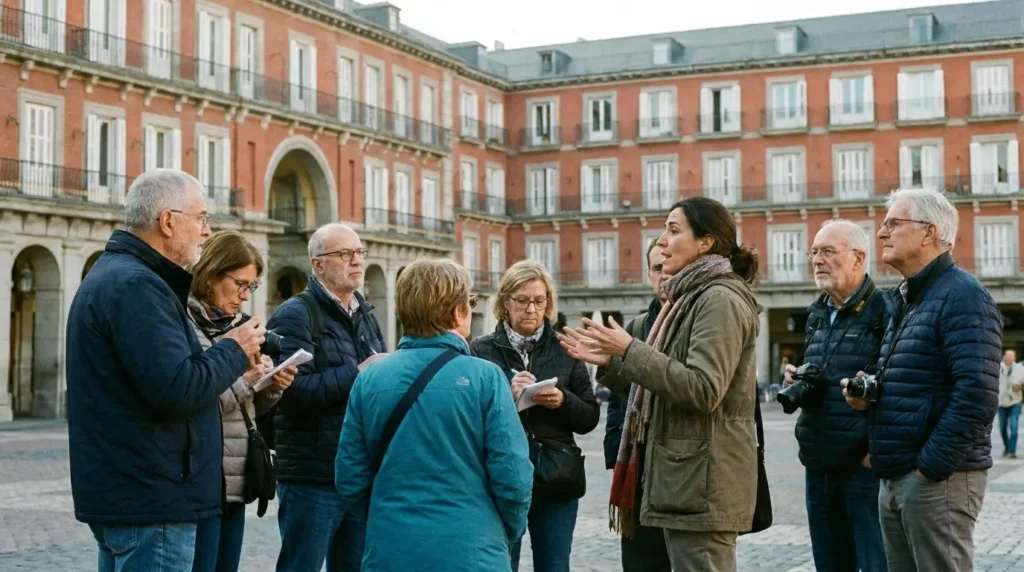
A good guided tour of Madrid should offer more than just a list of dates and monuments. The tour needs a clear structure, understandable explanations, a suitable pace, and time to observe and ask questions. It should also provide information before booking about the duration, group size, meeting point, language, price, and included services.
Madrid can be explored independently. Furthermore, its main squares are well connected, the historic center is relatively walkable, and there is plenty of information available about its monuments.
However, finding a building is not the same as understanding it.
A guided tour adds value when it helps connect places, reconstruct the city's changes, and distinguish historical facts from legends. In fact, the goal shouldn't be for the visitor to finish the tour memorizing a list of dates, but rather to gain a deeper understanding of the Madrid they've just explored.
Furthermore, the city offers a wide range of tours. There are historical, artistic, literary, gastronomic, family-friendly, accessible, shared, and private tours. Madrid City Council It develops programs with essential, original and accessible visits, while the Community of Madrid continues to promote cultural and thematic tours in collaboration with professionals in the sector.
Therefore, before booking, it is important to know what differentiates a well-designed experience from a simple guided walk.
What is a guided tour?
In fact, a guided tour is a tour led by a person who interprets and explains the places included in the itinerary.
It can be done:
- Walking.
- By transport.
- Inside a museum.
- At a monument.
- For a neighborhood.
- Around a historical theme.
- For a shared group.
- Privately.
- With a fixed itinerary.
- Through a custom route.
On the other hand, the guide should not simply repeat information that the visitor could read on a plaque. Their role is to select, organize, contextualize, and communicate the content.
Furthermore, a good visit allows you to answer questions such as:
- Why did Madrid become the capital?
- How did the city change with the arrival of the court?
- Which buildings truly belong to Habsburg Madrid?
- Why does the Plaza Mayor have that shape?
- What was there before the Royal Palace?
- How did the old corrales de comedias (open-air theaters) work?
- What parts of a story are documented?
- Which stories belong to popular tradition?
What should a good guided tour of Madrid include?
1. A clear description before booking
The traveler should know what they are booking before making the payment or confirming their place.
The description should also include:
- Route name.
- Main topic.
- Places included.
- Duration.
- Language.
- Price or contribution system.
- Group type.
- Approximate or maximum number of participants.
- Meeting point.
- End point.
- Distance or difficulty.
- Accessibility.
- Tickets included or not included.
- Cancellation policy.
- Clothing or footwear recommendations.
- Procedure in case of rain.
Furthermore, an overly generic description can lead to incorrect expectations.
In fact, simply advertising "discover the secrets of Madrid" is not enough. Specifically, the user needs to know if the tour will cover Habsburg Madrid, the Literary Quarter, the area around the Royal Palace, or a broader selection of the city center.
2. An easy-to-locate meeting point
Furthermore, the meeting point must be easily identifiable.
Similarly, the confirmation should include:
- Address or square.
- Visual reference.
- Statue, building or nearby establishment.
- Recommended metro station.
- Guide identification.
- Exact time.
- Courtesy time, when available.
- Telephone or contact channel.
Furthermore, in large places like Puerta del Sol or Plaza Mayor, simply stating the name of the square may not be sufficient.
In fact, a good instruction would be:
“We will meet next to the statue of Charles III, in the center of the Puerta del Sol. Furthermore, the guide will be carrying [IDENTIFYING ITEM].”
It should also be clarified if the route ends in a different place.
3. A coherent itinerary
On the other hand, the route must proceed logically.
Likewise, a well-designed itinerary avoids:
- Going back and forth along the same streets without justification.
- Making long journeys between explanations.
- Stopping in places that are too noisy.
- Block passageways.
- Gather the group on narrow sidewalks.
- Accumulating stops with no relation to each other.
The order of the stops should also help in understanding the story.
For example, a route through Habsburg Madrid might start at the Puerta del Sol and continue to the Plaza Mayor, Plaza de la Villa, Almudena Cathedral, and the Royal Palace. This route effectively illustrates the city's evolution from a medieval village to a courtly and monumental metropolis.
On the other hand, simply including well-known places is not enough. There must be a thread that connects them.
4. A recognizable theme
On the other hand, every good visit needs a central idea.
Likewise, some possible approaches are:
- Essential History of Madrid.
- Madrid of the Habsburgs.
- Literary Quarter.
- Medieval Madrid.
- Monarchy and power.
- Women in the history of Madrid.
- Legends and traditions.
- Architecture.
- Art.
- Civil war.
- Commerce and everyday life.
- Madrid for families.
- A tour of a museum.
In addition, a visit can include curiosities and secondary topics, but it should not become a disorganized collection of data.
In fact, the visitor should be able to answer at the end:
“What was this tour really about?”
5. An introduction that situates the visitor
Before starting the walk, the guide should briefly explain:
- Which area will be covered?.
- How long will it last?.
- Where will it end?.
- What theme connects the stops?.
- Yes, there will be breaks.
- What to do if someone separates.
- How to formulate questions.
- What conditions affect the route?.
On the other hand, the introduction doesn't need to be long.
Furthermore, its function is to provide a mental structure so that the visitor understands where they are and what they are going to discover.
6. Understandable explanations
Likewise, a guided tour should not resemble a university lecture given in the middle of the street.
The content must be rigorous, but also:
- Clear.
- Tidy.
- Adapted to the group.
- Easy to follow.
- Related to what is being observed.
- Proportioned to the available time.
An explanation may include names and dates when necessary, but it should show why that data matters.
Rather than simply listing reigns, it is more useful to explain how the decision to establish the court transformed the population, trade, and layout of Madrid.
7. Context, not just data
In addition, a plaque can indicate who built a building and in what year.
In fact, the guide must go further.
For example, in front of the Plaza Mayor, you can explain:
- What existed before.
- Why did it transform?.
- What functions did it perform?.
- How the audience was distributed.
- What fires changed its appearance?.
- What was his relationship with trade?.
- Why does it have uneven surfaces?.
- How its use changed.
On the other hand, context turns isolated information into a comprehensible story.
8. Time to observe
On the other hand, a common mistake is to talk throughout the entire visit without allowing the group to really look at the place.
Likewise, a good explanation should include time for:
- Observe a facade.
- Locate a shield.
- Compare two buildings.
- Look at a perspective.
- To read an inscription.
- Recognize a difference in level.
- Identify a shape.
- Take a photograph without interrupting the tour.
Furthermore, the guide should not compete with the space.
In fact, their job is to direct attention to what deserves it.
9. Space for questions
On the other hand, questions are part of the experience.
The guide should:
- Indicate that they can be performed.
- Answer clearly.
- Recognize when you don't know a fact.
- Avoid inventing.
- To differentiate an opinion from a fact.
- Ensure that a single person does not monopolize the route.
- Picking up where we left off after an intervention.
On the other hand, a visit with participation is usually more memorable than a completely one-sided explanation.
Private tours also offer greater flexibility for asking specific questions. Similarly, shared group tours require a balance to stay on schedule.
10. Historical rigor
Madrid is full of attractive stories, but not all of them have the same level of documentation.
Furthermore, a thorough visit must differentiate between:
- Proven facts.
- Interpretations.
- Hypothesis.
- Traditions.
- Legends.
- Anecdotes of dubious origin.
Useful expressions are:
- “The preserved documentation indicates…”
- “One of the interpretations maintains…”
- “According to tradition…”
- “Legend says…”
- “There is no conclusive proof, but…”
- “This story later became popular…”
Legends can be part of the tour, as long as they are not presented as indisputable facts.
11. A suitable pace
In fact, rhythm does not only refer to walking speed.
It also includes:
- Duration of the explanations.
- Number of stops.
- Distance.
- Changing the subject.
- Pauses.
- Stake.
- Fatigue management.
- Time for photographs.
On the other hand, a two-hour tour shouldn't include thirty stops. Nor is it advisable to spend twenty minutes at each building facade.
Furthermore, alternation improves attention:
1. Main explanation.
2. Short displacement.
3. Curiosity or visual detail.
4. Ask the group.
5. New historic stop.
6. Observation time.
12. A duration proportional to the content
Likewise, the appropriate duration depends on the type of visit.
As a guide:
- 60–90 minutes: brief introduction, families with children or specific space.
- Two hours: general route through an area.
- Two and a half or three hours: in-depth tour or with more stops.
- Half-day: combination of several zones or entrance to monuments.
- Full day: comprehensive itinerary, excursion or customized program.
Furthermore, a longer visit is not necessarily better.
In fact, the content should be adjusted to the time a person can walk, listen, and stand while maintaining attention.
13. A manageable group size
On the other hand, the size of the group directly influences the quality of the experience.
On the other hand, in large groups it can be more difficult:
- Hear.
- See what is explained.
- Crossing streets.
- Meet after each trip.
- Formulate questions.
- Maintain a steady pace.
- Avoid blocking public space.
Audio systems may also be required.
Likewise, the appropriate number will depend on:
- Type of route.
- Street width.
- Interior spaces.
- Use of headphones.
- Guide experience.
- Age of participants.
- Mobility needs.
In addition, some cultural spaces in Madrid establish specific capacity limits, time slots, and reservations for groups accompanied by their own guide, which demonstrates the importance of checking the conditions of each interior beforehand.
14. Adaptation to the profile of the participants
In fact, the same explanation does not work the same way for all audiences.
The guide should know, where possible:
- Country or place of origin.
- Approximate age.
- First visit or repeat visit.
- Interests.
- Prior knowledge.
- Language.
- Mobility.
- Presence of children.
- Available time.
- Reason for the trip.
This doesn't mean completely changing the course for each participant in a shared group. It means adjusting examples, pace, and level of depth.
On a private tour, the adaptation should be considerably greater.
15. Attention to accessibility
On the other hand, accessibility should not be reduced to simply stating that a route "is easy".
It is important to clarify:
- Distance.
- Uneven terrain.
- Stairs.
- Cobblestone streets.
- Standing time.
- Possibility of sitting down.
- Alternative access routes.
- Bathrooms.
- Use of a wheelchair.
- Need for a companion.
- Hearing support systems, where available.
Madrid has official accessible visit programs, reflecting the need to design routes that take into account different physical, sensory, and cognitive conditions.
When a route is not fully accessible, you should communicate honestly and offer an alternative where possible.
16. Climate Management
Madrid can present very different conditions depending on the time of year.
In summer
Furthermore, the visit should consider:
- Hours of greatest heat.
- Sections without shade.
- Access to water.
- Pauses.
- Distance reduction.
- Interior alternatives.
In winter
In addition, it is important to keep in mind:
- Cold.
- Wind.
- Daylight hours.
- Possible rain.
- Reduced comfort during long stops.
In case of rain
In fact, the company must report:
- If the visit continues.
- If the itinerary is changed.
- An umbrella or raincoat is recommended.
- What happens in extreme conditions.
- What are the cancellation conditions?.
A visit should not improvise these criteria after the client is already at the meeting point.
17. Safety during the journey
On the other hand, security is part of the organization.
The guide must:
- Use pedestrian crossings.
- Avoid explaining in the middle of a route.
- Choose safe zones to stop the group.
- Count the participants after the travel.
- Warn of steps or uneven surfaces.
- Avoid blocking entrances.
- Report on particularly busy areas.
- Provide a contact for incidents.
- Maintain control of the group without treating participants in a childish way.
In the center of Madrid, it is also worth remembering, in a natural way, to keep an eye on bags and personal belongings in very busy areas.
18. Price transparency
The payment method must be clear before starting.
On a fixed-price visit
It must be indicated:
- Total price.
- Whether it's per person or per group.
- Taxes.
- Tickets.
- Headphones.
- Supplements.
- Cancellation policy.
- Method of payment.
On a free-contribution visit
It must be explained:
- It does not have a fixed price beforehand.
- The guide expects a donation at the end.
- That the contribution is part of the model.
- If there is a booking fee.
- What happens with large groups?.
- What is the cancellation policy?.
Furthermore, it should not be presented as a service without value, nor should the word "free" be used in a misleading way.
19. Information about what is not included
Likewise, the description should clearly indicate if the following are excluded:
- Tickets.
- Transport.
- Consumption.
- Headphones.
- Hotel pickup.
- Tips.
- Photographs.
- Personal expenses.
- Extended hours.
- Return to the starting point.
Transparency prevents the low price from later turning into a sum of unexpected extras.
20. A useful closure
The tour should not end abruptly after the final explanation.
Additionally, a good closing can include:
- Summary of the main idea.
- Relationship between the stops.
- Recommendations for continuing.
- Transport directions.
- Restaurants or nearby areas.
- Related museums.
- Places that can be visited independently.
- Answers to the last questions.
It is also important to clearly remember where the visit ended.
What should a good guided tour avoid?
An accumulation of dates
Dates are useful when they organize the narrative, not when they replace explanation.
Stories without sources presented as true
In fact, an engaging anecdote should not distort history.
Memorized explanations without adaptation
The guide should observe whether the group is listening, understanding, or needs to change the pace.
Constant jokes
Humor can help, but it shouldn't turn the tour into a performance devoid of content.
Personal opinions presented as facts
On the other hand, interpretations must be distinguished from verified information.
Exaggerated promises
Expressions like “the best tour of Madrid” or “you will discover secrets that nobody knows” need proof or should be avoided.
Stops that are too long
Standing in the same place for twenty minutes can be uncomfortable.
Commercial pressure
The guide can recommend other tours, but the experience should not turn into a continuous sales pitch.
Lack of time control
Furthermore, the visit must reasonably respect the advertised duration.
Neglect of those who walk more slowly
Likewise, the group must remain united without penalizing those who need a moderate pace.
What is the difference between a tour and a well-designed experience?
A basic route indicates where the places are.
Furthermore, a well-designed experience explains why they matter.
In fact, the difference can be observed in several aspects:
Is a general or themed visit better?
Furthermore, it depends on the time of the trip.
General visit
It is appropriate when:
- It's the first time in Madrid.
- There is little time available.
- The goal is to understand the center.
- There is no specific interest.
- Guidance is sought for the following days.
It may include:
- Puerta del Sol.
- Main Square.
- Madrid of the Habsburgs.
- Royal Palace.
- Plaza de Oriente.
- Gran Vía.
Themed visit
It is most appropriate when:
- The city is already known.
- There is interest for a period.
- Greater depth is sought.
- The aim is to explore a specific neighborhood.
- A museum is visited.
- The trip is for cultural reasons.
Some examples are:
- Literary Quarter.
- Madrid of the Habsburgs.
- Prado Museum.
- Women in Madrid.
- Civil war.
- Architecture.
- Gastronomy.
- Legends.
- Family-friendly Madrid.
Shared visit or private tour?
A shared visit can work when:
- Are you traveling alone or as a couple?.
- You're looking for an introduction.
- You accept a fixed schedule.
- You don't need to change your itinerary.
- You enjoy meeting other travelers.
- You want to reduce the cost.
A private tour can provide more value when:
- You are traveling as a family.
- You are part of a group.
- You have only a few hours.
- You need a different rhythm.
- There are mobility needs.
- You are interested in a specific topic.
- You want to end up at a certain point.
- You prefer to ask a lot of questions.
- You need a specific schedule.
How do you know if a visit is right for you?
Before booking, it's advisable to answer these questions:
1. Is this my first visit to Madrid?
2. Do I want an overview or a specific topic?
3. How long can I walk?
4. Do I prefer a shared or exclusive group?
5. Am I traveling with children?
6. Is there a need for mobility?
7. Do I want to enter monuments?
8. Do I need to finish near another place?
9. In what language do I want to do it?
10. What is my budget?
11. Am I interested in asking a lot of questions?
12. Am I looking for historical content, art, leisure, or gastronomy?
On the other hand, the best visit isn't necessarily the longest, most expensive, or most popular. Rather, it's the one that best meets the specific needs of the trip.
What should a family visit include?
On the other hand, a visit designed for families should adjust:
- Duration.
- Number of stops.
- Language.
- Rhythm.
- Stories.
- Stake.
- Pauses.
- Distances.
- Level of detail.
- Time of day.
It is not enough to allow children to attend.
Likewise, a family experience should be designed taking into account their attention span and their need to participate.
What should a private visit include?
In addition to the basic elements, it should offer some real degree of customization.
For example:
- Exclusive attention.
- Prior consultation.
- Tight rhythm.
- Topic selection.
- Agreed starting point.
- Convenient ending.
- Adaptation for children or the elderly.
- Possibility of going deeper.
- Time for questions.
- Personalized recommendations.
Furthermore, not all aspects need to be modified. Similarly, the company must explain what can be customized and what belongs to a fixed itinerary.
What should a museum visit include?
On the other hand, a guided tour of a museum requires a different organization.
You must indicate:
- Entry included or not.
- Access time.
- Meeting point.
- Duration inside the museum.
- Main works or theme.
- Group size.
- Use of headphones.
- Space rules.
- Possible changes due to room closures.
- Accessibility.
- Continued independently.
Furthermore, the City Council and municipal museums establish reservations, capacity limits and specific time slots for certain groups, so any indoor visit must be prepared in accordance with the current conditions.
How long should a visit to the center of Madrid last?
Likewise, a duration of between two and three hours is usually suitable for a first outdoor route.
Two hours allows you to explore a specific area without overloading the content.
Three hours may be appropriate when:
- There are more stops.
- A pause is added.
- The group walks slowly.
- A topic is explored in depth.
- This is a private visit.
- The route includes several nearby neighborhoods.
In addition, an experience lasting more than three hours should incorporate breaks or be clearly divided into blocks.
What questions should you ask before booking?
1. What is the itinerary?
2. How long does it last?
3. Where does it begin and end?
4. In what language is it done?
5. How many people are participating?
6. Is it shared or private?
7. What is the final price?
8. Are tickets included?
9. Is it accessible?
10. Can it be done with children?
11. What happens if it rains?
12. What is the cancellation policy?
13. Is it necessary to arrive earlier?
14. How is the guide identified?
15. Can the route be adapted?
16. Are headphones used?
17. Will there be time for questions?
18. Do you enter any monuments?
19. What happens if we arrive late?
20. Does the activity end on time?
In fact, a professional company should be able to answer clearly.
How does 4U Madrid plan its visits?
On the other hand, at 4U Madrid we understand a guided tour as a way of relating places to the people, events and decisions that transformed the city.
Furthermore, the goal is not to visit as many monuments as possible, but to help the visitor understand what they are seeing.
Likewise, the experiences can be presented in different formats:
- Shared tours.
- Historical tours.
- Cultural visits.
- Family routes.
- Private tours.
- Personalized experiences.
- Group tours.
In addition, each modality must maintain a clear structure, transparent information, and content adapted to the type of visitor.
Discover Madrid with a visit that makes sense
Madrid can be explored by looking at facades or by connecting each space with its history.
In fact, a good guided tour should help you orient yourself, understand the context, and recognize details that you would probably miss during a self-guided tour.
On the other hand, at 4U Madrid we offer different ways to explore the city, from open tours to private visits and experiences tailored to families or groups.
Frequently asked questions about a guided tour of Madrid
Before booking the guided tour
On the other hand, an exterior visit to the city center typically lasts between two and three hours. Family tours may be shorter, while private experiences, museums, or specialized routes may require more time.
It's recommended. In fact, booking allows you to control the group size and communicate changes to the meeting point or time. For private tours, museums, and peak seasons, booking in advance is especially important.
Furthermore, a guided tour can be shared with other participants and follow a set schedule. On a private tour, the guide caters exclusively to the booking group, and there may be greater flexibility to adapt the pace, content, or itinerary.
During and after the tour
Not necessarily. Also, many routes through the city center are outdoors. When visiting a museum or monument, the description should indicate whether admission is included, must be purchased separately, or requires a reservation for a specific time.
Yes, but it's best to choose a route adapted to their age. A good family visit reduces the length of explanations, incorporates participation, and avoids too many stops.
It also depends on the company's policies. Some tours will proceed even in moderate rain, while others may modify their itinerary or allow for date changes in extreme conditions. Please check the policy before booking.
