
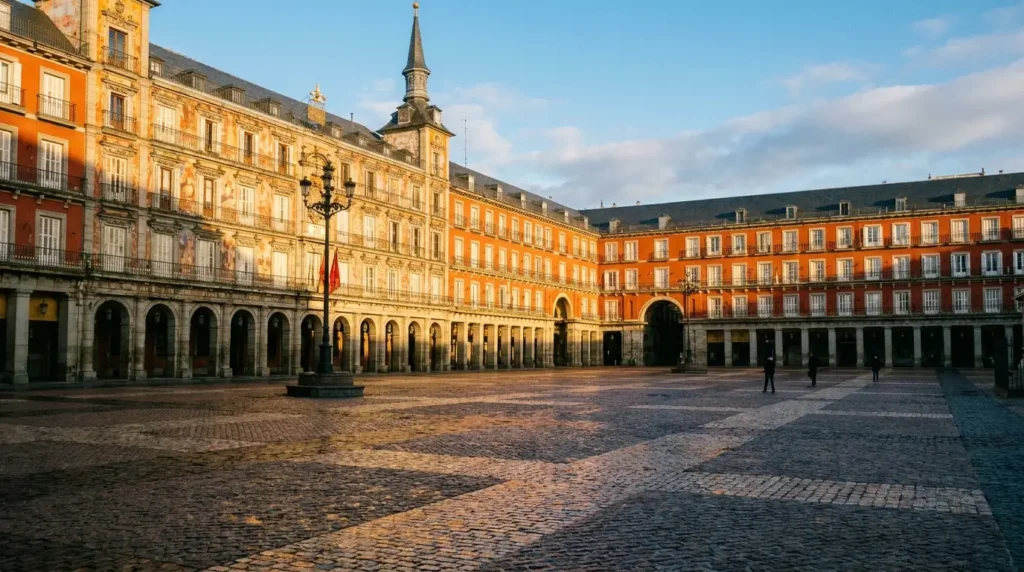
The Habsburg district of Madrid encompasses some of the capital's most important historical sites, such as the Plaza Mayor, the Plaza de la Villa, the Almudena Cathedral, and the area surrounding the Royal Palace. The district can easily be explored on foot in about two or three hours, although it's advisable to allow more time if you plan to visit its monuments.
Walking through this part of Madrid isn't just about linking squares and old buildings. It also allows you to understand how a relatively modest town ended up becoming the capital of a monarchy that extended its power across much of the world.
The route we propose begins at Puerta del Sol and ends at Plaza de Oriente. It is a short, central, and easy-to-follow route that encompasses different stages of Madrid's history: the medieval layout, the transformation initiated by the Habsburgs, and the subsequent monumentalization of the city.
What is Habsburg Madrid?
The name “Madrid de los Austrias” is used to identify the part of the city that retains a particularly close relationship with the reigns of the House of Austria, also known as the Habsburg dynasty.
This dynasty ruled the Hispanic monarchy during the 16th and 17th centuries. It was a defining period for Madrid, especially after Philip II established the court in the city in 1561. From then on, its population, economic activity, and urban needs increased.
It is not a neighborhood with precise administrative boundaries. Rather, it is a historical and tourist designation that encompasses a large part of the old town located around the Plaza Mayor, Calle Mayor, Plaza de la Villa, and the area surrounding the old Alcázar.
The Official website of Madrid Tourism The Plaza Mayor, the Monastery of the Incarnation, and the Plaza de la Villa stand out as some of the main architectural ensembles related to this period.
However, not all the buildings currently included in a route through Habsburg Madrid were built during the reign of this dynasty. The Royal Palace and the Almudena Cathedral, for example, belong to later periods, but are part of the route because they occupy a fundamental space for understanding the historical evolution of the city.
How long does it take to travel it?
A first exterior route through Habsburg Madrid can be done in about two or three hours.
This amount of time allows for leisurely strolls, pausing in the main squares to admire the facades and most noteworthy details. If you wish to visit the Royal Palace, the Almudena Cathedral Museum, or have a longer lunch break, it's advisable to set aside at least half a day.
The duration will also depend on the type of visit:
- Fast outdoor route: between 90 minutes and 2 hours.
- Historical tour with explanations: between 2 and 3 hours.
- Route with entrance to monuments: noon.
- Leisurely visit with food and museums: practically a whole day.
Most of the route follows pedestrianized or traffic-limited streets in the city center. Even so, there are some changes in elevation, especially as you approach the area around Calle de Segovia, the Almudena Cathedral, and the Royal Palace's cornice.
Walking tour of Habsburg Madrid
1. Puerta del Sol: the starting point
Puerta del Sol is a practical place to start because it is well connected and links directly to Calle Mayor, one of the main axes of this route.
Although the current square is the result of numerous transformations after the Habsburg period, its location helps to understand the growth of Madrid. Originally, this spot was near one of the eastern entrances to the city.
Before continuing, it is worth locating some of its best-known elements:
- The Royal Post Office.
- The clock that chimes on New Year's Eve.
- The Kilometer Zero plaque.
- The statue of the bear and the strawberry tree.
- The equestrian statue of Charles III.
From Sol, you can proceed along Calle Mayor or take a short detour along Calle de Postas before entering Plaza Mayor.
2. Plaza Mayor: the grand stage of Habsburg Madrid
The Plaza Mayor is the main stop on the tour.
Its origins lie in the old Arrabal square, located outside the walls of medieval Madrid. Roads and merchants converged there, making it an important market area.
During the reign of Philip III, its transformation was promoted. In 1617, Juan Gómez de Mora was commissioned to standardize the buildings surrounding the square. Since then, the space has hosted markets, public celebrations, bullfights, proclamations, religious ceremonies, and executions.
When exploring it, pay attention to:
- The Bakery House, recognizable by the paintings on its facade.
- The equestrian statue of Philip III, located in the center.
- The Arch of Cutlers, one of its best-known entrances.
- The arcades, which show the commercial function that the square still retains.
- The regularity of the facades, the result of various reconstructions after several fires.
One common mistake is to rush through the Plaza Mayor, take a photo, and move on. It's worth pausing in the center and observing the difference in elevation between the plaza and the streets that slope down towards Cuchilleros. This difference in level helps to understand how the building adapted to the terrain.
3. Arco de Cuchilleros and Cava de San Miguel
From the Plaza Mayor you can exit through the Arco de Cuchilleros, designed to overcome the difference in level between the square and the lower streets.
Its name comes from the old cutlers' guild that supplied the butchers located in this area. The surroundings retain narrow streets, brick facades, and establishments related to traditional Madrid restaurants.
Nearby is the Botín restaurant, known for occupying a historic building on Cuchilleros Street. You don't need to stop for a meal to include this street in your route: the main interest lies in observing how the urban layout changes as soon as you leave the regular geometry of the Plaza Mayor.
4. San Miguel Market
The San Miguel Market is just a few steps away.
The current building does not belong to Habsburg Madrid, as its iron structure was built at the beginning of the 20th century. However, it occupies an area historically linked to commerce and allows us to observe how the center of Madrid has adapted its uses without completely losing its original function.
It's primarily a food venue these days. It can be a convenient stop, although it tends to get very crowded during the middle of the day.
To better appreciate the building, it is advisable to walk around it and observe its exterior structure, rather than simply entering through the entrance closest to the Plaza Mayor.
5. Plaza de la Villa: from medieval Madrid to the city of the Habsburgs
The next stop is Plaza de la Villa, one of the best-preserved historical sites in the city center.
Before Madrid became the capital, this area was already one of the main centers of the medieval town. Streets related to the old layout, such as Calle del Codo, Calle del Cordón, and Calle de Madrid itself, radiate from the square.
It contains three particularly important buildings:
- The Tower and House of the Lujanes, linked to the end of the Middle Ages.
- The House of Cisneros, built in the 16th century.
- The Town Hall, former headquarters of the Madrid City Council.
The Town Hall was inaugurated in the 17th century and served as the seat of the Mayor's Office until 2007.
This square offers a glimpse into several periods of Madrid's architectural history within a very small space. It's also a good place to understand that the so-called Habsburg Madrid didn't spring up on empty land, but rather on top of a medieval city that already had streets, gates, and centers of power.
6. Calle Mayor and the old political center of Madrid
From Plaza de la Villa, the route continues along Calle Mayor towards Almudena.
This thoroughfare connected the commercial area near the Plaza Mayor with the vicinity of the old Alcázar. For centuries it was one of Madrid's most important streets and the setting for celebrations, court visits, and political events.
Along the way you can see different buildings, passageways and small streets that preserve part of the historical structure of the center.
Also located here is the Cathedral of the Armed Forces, known as the Military Cathedral, whose building was originally the Church of the Blessed Sacrament. Its construction dates from after the first Habsburg period, but it forms part of the monumental complex of this area.
Before reaching the end of Calle Mayor, the view opens up towards the Almudena Cathedral and the Royal Palace.
7. Almudena Cathedral
The Cathedral of Santa María la Real de la Almudena is a much more recent construction than the main buildings of Habsburg Madrid.
Its history was long and complex: construction began in the 19th century and the temple was consecrated in 1993. Its presence on this route is explained by its location, next to the site of the former Alcázar of Madrid.
The exterior can be viewed from Bailén Street and Plaza de la Armería. It is also possible to visit the temple itself and, with a separate ticket, access the museum and the dome. Opening hours, prices, and conditions should be checked on the official website before visiting.
An interesting detail is the difference between their facades. The one facing the Royal Palace has a more classic and restrained appearance, designed to maintain a certain harmony with the palace complex.
8. Royal Palace of Madrid
The Royal Palace occupies the site where the Alcázar of Madrid was formerly located, a residence used by the monarchs of the House of Austria.
After the Alcázar burned down in 1734, the current palace was built under the new Bourbon dynasty. Therefore, the building we see today does not belong to the Habsburg period, although its location was the main center of royal power during that era.
The Royal Palace has more than 3,000 rooms and houses collections linked to the Spanish monarchy, with works by artists such as Velázquez, Goya and Caravaggio.
If you wish to visit the interior, it is advisable to book tickets in advance. National Heritage It notes that capacity is limited and that the number of tickets available at the box office may be reduced.
The exterior visit can be completed by observing:
- The Armory Square.
- The main facade.
- The Campo del Moro from nearby viewpoints.
- The Gallery of Royal Collections.
- The panoramic view of the Casa de Campo.
- The Sabatini Gardens.
9. Plaza de Oriente: end of the route
The Plaza de Oriente is a good place to end the tour.
It is located between the Royal Palace and the Royal Theatre and offers a broad view of the monumental complex. Its design dates from the 19th century, so it is not strictly part of the Madrid built by the Habsburgs.
However, it serves as a conclusion because it allows us to observe how the surroundings of the old Alcázar were transformed after the arrival of the Bourbons.
From here you can continue towards:
- The Royal Theatre.
- The Sabatini Gardens.
- Plaza de España.
- The Monastery of the Incarnation.
- The Temple of Debod.
Tips for exploring Habsburg Madrid
- Wear comfortable shoes: the route includes cobblestone streets and some uneven terrain.
- Start in the morning if you want to find fewer people in the Plaza Mayor.
- Avoid trying to visit the interior of all the monuments on a single route.
- Book in advance if you wish to enter the Royal Palace.
- Check the official opening hours of churches, museums and gardens.
- Carry water during the hottest months.
- Look at the side streets: many historical details are not in the main squares.
- Don't confuse "Madrid de los Austrias" with an administrative district with exact boundaries.
- Pay attention to the different eras of the buildings: not everything that is part of the route was built by the Habsburgs.
Is it better to explore it independently or with a guide?
The itinerary can be done independently because the main stops are close together and it is easy to get around on foot.
The difference of doing it with a guide lies not only in finding the buildings, but in understanding the relationship between them: why the Plaza Mayor was built that way, how the arrival of the court influenced it, what remains of medieval Madrid and why the current Royal Palace does not really belong to the Habsburg era.
A guided tour also allows you to distinguish documented facts from legends that have been passed down about some places in the center.
Discover historic Madrid with 4U Madrid
At 4U Madrid, we offer tours to discover the history, people, and curiosities of the city center. You can choose from different tour options and find the experience that best suits your travel time, pace, and interests.
Frequently asked questions about Habsburg Madrid
The route: where it starts and how long it lasts
It doesn't have a precise official boundary. It's generally considered to encompass the area between Puerta del Sol, Plaza Mayor, Plaza de la Villa, and the Royal Palace. Some routes also include nearby streets and monuments in La Latina or Plaza de Oriente.
A tour of the main sights typically takes between two and three hours. To enter the Royal Palace, visit the Almudena Cathedral, or stop for lunch, it's best to set aside half a day.
Yes. It's a central area and the distances between the main stops are short. There are some inclines and cobblestone streets, but the overall route isn't particularly difficult for someone used to walking.
Monuments, cost and best time to visit
The current Royal Palace was not built during the Habsburg era. It was erected in the 18th century, after the old Alcázar burned down. It is included on the route because it occupies the site of the royal residence used during the Habsburg period.
Exploring its streets and squares on your own is free. Some monuments, such as the Royal Palace, the Almudena Cathedral Museum, and the Monastery of the Incarnation, require an entrance fee, and their prices should be checked on their official websites. Our guided tours operate on a pay-what-you-want basis: there is no deposit required to book, and each participant decides how much to contribute at the end of the tour.
The early morning hours usually allow for a more peaceful stroll through the squares. At dusk, the area around the Royal Palace and the Plaza de Oriente offers good views, although it can get more crowded on weekends and during peak tourist seasons.
