
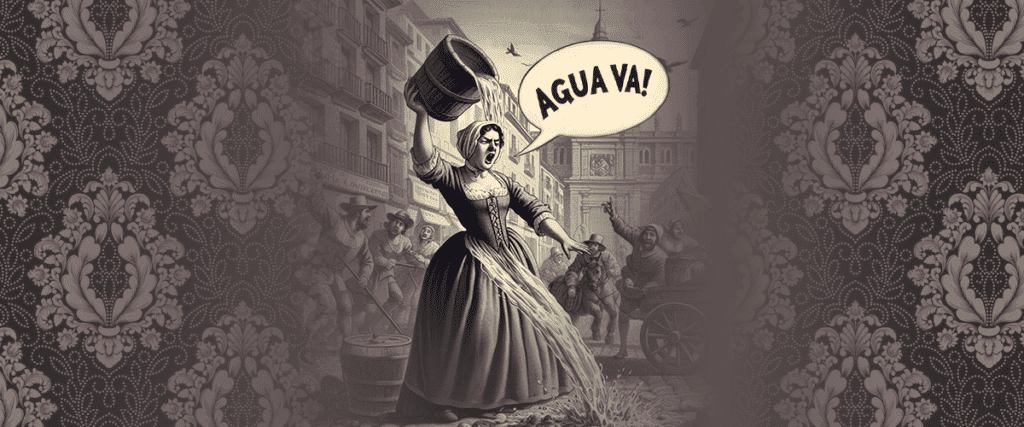
Water's coming! It was the cry heard in the streets of Madrid before someone emptied the contents of a chamber pot out the window. The expression warned the unsuspecting passerby of the fetid rain that was about to fall upon them.
It may sound like a legend, but it was a real and everyday custom for centuries. And it largely explains why Madrid took so long to become a modern capital.
What did "Water's coming!" mean?«
Before the existence of a sewer system, Madrid houses had no drainage. Human waste was collected in a bucket, pail, or tub, and at night it was thrown directly into the street from the window or balcony.
The ordinance required prior warning with the famous cry, precisely so that passersby could move out of the way. In theory, this could only be done after ten or eleven at night, depending on the season. In practice, it was done at any time.
Hence also comes the custom, still in force, of the gentleman walking on the outside of the sidewalk: it was the position least exposed to what might fall from the balconies.
What was Madrid like back then?
- Without sewage systemThe waste ran down the middle of the street into the streams.
- No garbage collectionThe waste accumulated in the corners.
- Without street lightingAt night, anyone who walked did so blindly.
- With loose animals: pigs roamed the streets alongside passersby.
- With a lasting scentForeign travelers described it as unbearable.
The king who came across that
In 1759, Charles III began to reign in Spain. He had previously been King of Naples and Sicily, and had to abdicate in those lands to come and rule the Crown after the death of his brother.
He arrived accompanied by his Italian ministerial team, thinking the change of destination wouldn't make much difference. However, he found an outdated, dirty, and smelly capital.
Tradition tells that the worst came when he heard the first "¡Agua va!" and understood what it meant. From then on, the monarch took a series of measures that would end up transforming the city:
- Health regulations and prohibition of littering.
- Sewerage network and garbage collection system.
- Public lighting on main roads.
- Postal service and creation of the national lottery.
- The Cibeles and Neptune fountains, the Puerta de Alcalá and the building that now houses the Prado Museum.
- Prohibition of pigs roaming freely in the city.
The resistance of the people of Madrid
The results took time to appear. In fact, the people of Madrid resisted the new rules so much that Charles III himself said aloud: "My subjects are like little children, they cry when they are washed.".
The rejection culminated in the Esquilache Riots of 1766. The spark was the prohibition of long capes and wide-brimmed hats, dictated by the Minister of Finance for security reasons, since they allowed the face and weapons to be hidden.
However, behind that seemingly absurd demand there was something more: weariness with so much change imposed from above and the feeling that people's real needs were being neglected.
It is also striking that the king demanded an adaptability from his subjects that he himself did not practice. He was a man of routine and austerity: he always used the same cup for his chocolate, the same tableware, and in thirty years his tailor made him barely ten suits, without varying the size or style.
Ultimately, the story of "¡Agua va!" is a story of resistance to change that remains very familiar to us. Nobody changes just because someone else asks them to; and when they do change by force, it rarely lasts.
Even so, it must be acknowledged: that forced push was the beginning of the modernization of Madrid.
A large part of those ordinances are preserved in the Villa Archive of Madrid City Council, And the Puerta de Alcalá still stands as a reminder of the reform plan. Likewise, the Prado Museum It now occupies the building that Charles III had planned as a science center.
Where to see the traces of that Madrid
- Calle del Codo and Plaza de la Villa, where the medieval layout is preserved almost intact.
- Cava Baja and Cava Alta, former moats of the wall converted into streets.
- Cibeles Fountain and Neptune Fountain, two of the works of that reform plan.
- Alcalá Gate, built in 1778 by order of Charles III himself.
- Plaza Mayor, the setting for much of the public life of the time.
Frequently Asked Questions about Water
If you want to hear this and other stories in the place where they happened, join us on one of our tours of Madrid's historic center.
What was the water going to
It was the mandatory warning given before throwing the contents of chamber pots from windows and balconies into the street. It gave passersby time to move out of the way.
The ordinances permitted it from ten or eleven o'clock at night, depending on the time of year. In practice, however, the rule was frequently broken.
The custom comes precisely from that time: the outside side was the most exposed to what was thrown from the balconies, so the gentleman occupied the risk position.
The reforms and the end of the custom
It gradually disappeared following the reforms of Charles III, who promoted sewage systems and garbage collection from 1761 onwards. Even so, the practice took decades to be completely eradicated.
A popular revolt of 1766 erupted after the prohibition of long cloaks and wide-brimmed hats. Behind it lay a deeper discontent with the imposed reforms and the high cost of food.
Travelers of the time described it this way, although the lack of sanitation was common throughout Europe. What was striking in Madrid was the custom of throwing waste directly out of windows.
