
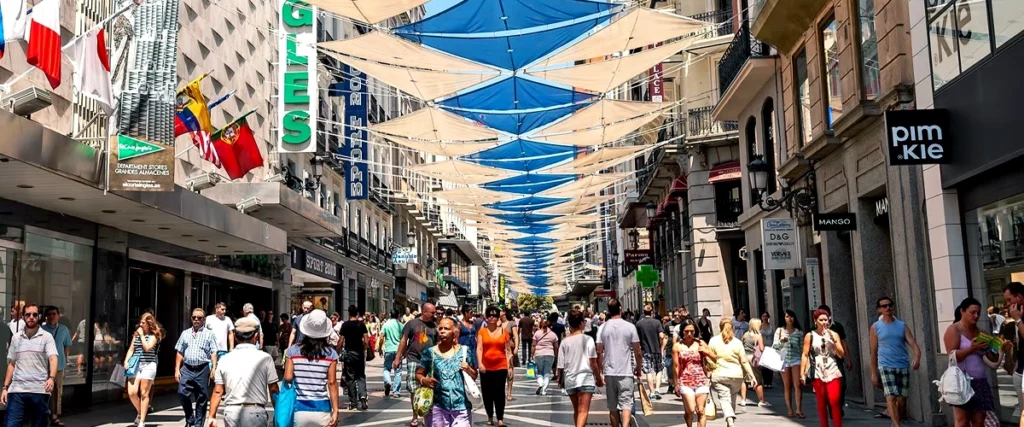
The Preciados Street Today it is one of the busiest commercial arteries in Europe, but its name does not come from commerce: it comes from two brothers who watched to make sure that nobody cheated with weights and measures in 15th century Madrid.
In this article, we review its complete history. It begins in some farmland on the outskirts of the town and ends on the pedestrian street where thousands of people pass by every hour.
This is a summarized chronology of Preciados Street:
- 15th CenturyThe Preciado brothers settle in the area and set up the Peso Real.
- 16th CenturyThe Foundling Home is founded at the entrance of the street.
- 19th Century: the demolitions and urban reforms widen the road and the Puerta del Sol.
- 1943Galerías Preciados opens, one of the first department stores in Madrid.
- 1973The street is pedestrianized along with Carmen Street.
- Today: more than 15,000 people per hour during the Christmas campaign.
The brothers who gave their name to Preciados Street
Preciados Street, located between Puerta del Sol and Plaza de Santo Domingo, owes its name to two brothers with the surname Preciado who lived in the area at the end of the 15th century.
At that time, this area was on the outskirts of the town of Madrid and formed part of the farmland belonging to the Monastery of San Martín. The brothers bought a plot of land from the monks and built their houses there.
Furthermore, they established the Royal Weighing Station, where the weights and measures of traded goods were verified. They acted as almotacones, that is, as official appraisers with the rank of civil servant.
From "Precious" to "Appreciated"«
The brothers' honesty and efficiency earned them the esteem of the entire town. They were known for their meticulous inspection of market and warehouse measurements, a task they carried out on Mondays and Thursdays.
The chronicles of the time recount that they rigorously checked the fanega, the arroba, the quintal, and the celemín. Those caught cheating with the weights were fined up to 12 maravedís. In serious cases, they even applied physical punishments. Salt vendors who manipulated the measures received up to 50 lashes.
Thanks to their work, the mills where flour was refined operated with unprecedented precision. Therefore, their surname became associated with the idea of what is well measured and fair, and the street came to be called "the street of the Preciados.".
In this same area was also located the summer residence of the kings of Castile, which occupied a large part of the land that today corresponds to the street.
Expansions and transformations: from the 16th to the 19th century
As Madrid grew, Preciados Street gained importance.
At the end of the 16th century, the Foundling Home was established at its entrance. It was an orphanage where abandoned babies, usually left at the doors of churches, were cared for. However, the building was demolished in the mid-19th century during the renovations that also enlarged the Puerta del Sol.
At that time, part of the houses and the wall of the orchard belonging to the Descalzas Reales monastery were also expropriated. The aim was to widen a road that was already becoming a major urban thoroughfare.
The commercial boom: 19th and 20th centuries
The street's real take-off occurred throughout the 19th century and, above all, during the 20th.
From the mid-19th century it housed the Centro Numismático Matritense, a well-known exchange house that became a point of reference for collectors and traders.
At the end of that same century, the famous Café Varela opened. Among those who frequented its tables were Miguel de Unamuno, Emilio Carrere, Pío Baroja, Valle-Inclán, and Jacinto Benavente. Consequently, it became a key meeting place for intellectuals and artists.
Galerías Preciados
But the most famous establishment arrived in 1943, when the businessman Pepín Fernández, a pioneer of commerce in Spain, opened one of the first large department stores in Madrid here: Galerías Preciados.
The establishment took its name directly from the street. Furthermore, it quickly became a landmark of Madrid's retail scene and ushered in a new way of shopping in the city.
Pioneer in pedestrianization
Preciados Street stands out not only for its commercial importance, but also for having been one of the first pedestrian streets in Madrid.
In 1973, along with the neighboring Calle del Carmen, it was transformed into a pedestrian street. This was a landmark in the urban planning of the capital. This decision increased pedestrian traffic and established Preciados as one of the busiest streets in Europe. In fact, during shopping seasons like Christmas, the number of people passing through can exceed 15,000 per hour.
Today it remains one of the city's most important commercial thoroughfares. Callao Square divides it into two very distinct halves. The part near Gran Vía is vibrant and modern; the part that connects to Puerta del Sol retains a more traditional feel.
What to see when walking down Preciados Street
- Puerta del Sol, at one end, with kilometer zero and the statue of the Bear and the Strawberry Tree.
- Callao Square, midpoint of the street and one of the most photographed intersections in Madrid.
- Monastery of the Royal Barefoot Nuns, one minute away, with one of the most valuable collections of religious art in Spain.
- Carmen Street, pedestrianized at the same time and with the same commercial atmosphere.
- Gran Vía, at the other end, to continue the walk among theaters and monumental architecture.
- Plaza Mayor, a five-minute walk from Sol.
Frequently asked questions about Preciados Street
Preciados Street is more than just a place to shop: it reflects Madrid's evolution over the centuries. And if you want to discover the stories hidden behind its facades, join us on one of our tours of the historic center.
Sources
- Madrid City Council, data on commerce and pedestrian traffic.
- Archive of the City of Madrid, history of the streets of Madrid.
- National Library of Spain, funds about Galerías Preciados and the history of commerce.
- Institute of Madrid Studies, Preciados Street and the Madrid Numismatic Center.
Origin and history of Preciados Street
The street was named after two brothers named Preciado who lived there at the end of the 15th century. They worked as almotacenes, the officials who verified weights and measures. Their reputation for being rigorous and fair led to the street taking its name.
In the heart of Madrid, between Puerta del Sol and Plaza de Santo Domingo, bisected by Plaza de Callao. The nearest metro stops are Sol (lines 1, 2 and 3) and Callao (lines 3 and 5).
Since 1973, when it was pedestrianized along with Calle del Carmen. It was one of the first projects of its kind in Madrid and served as a model for other areas of the city center.
Visit Preciados Street today
A department store founded in 1943 by Pepín Fernández, which took its name from the street. They were pioneers of modern retail in Spain. For decades they competed with El Corte Inglés, until their closure in 1995.
During campaigns like Christmas, it can exceed 15,000 people per hour, placing it among the busiest shopping streets in Europe.
It takes barely ten minutes from end to end, although you should allow more time if you want to go into the shops or make a detour to the Monastery of the Royal Barefoot Nuns.
