
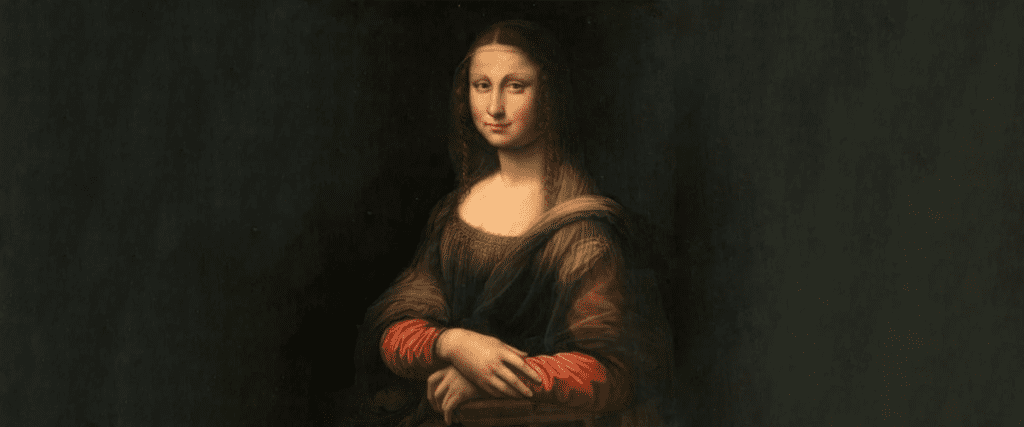
Almost no one knows it. However, in Madrid there is a second Mona Lisa. It is not a late copy or an imitation: it was painted in the same workshop, at the same time and with the same model as the one in the Louvre.
In fact, it hangs in the Prado Museum, It has been listed in their inventory for over 200 years and, unlike its Parisian sister, can be viewed without crowds in front.
The Madrid twin of the Mona Lisa
The Prado Museum's inventory has included for two centuries an anonymous portrait that reproduces Leonardo da Vinci's most famous painting: the portrait of Lisa Gherardini, wife of Francesco del Giocondo, known as *La Gioconda* or *La Mona Lisa*.
Unfortunately, it's not known for certain how the painting arrived in Spain. However, by 1666 it was cataloged within the Royal Collections and located in the South Gallery of the Alcázar of Madrid, described as "Woman by Leonardo Abince." Pronounced quickly, it sounds quite similar to the original.
The discovery of the restoration
For a long time, this Mona Lisa was displayed against a completely black background. Everything changed, however, when the Louvre Museum requested the Madrid piece for an exhibition.
So the Prado decided to restore it before lending it, so that it would travel in the best possible condition. And when they began cleaning the canvas, a surprise came: beneath the blackness emerged a background landscape very similar to that of the original painting.
Furthermore, a subsequent study using infrared reflectography revealed something even more telling. Both paintings had been painted at the same time, in the same place, and with the same model. The corrections to the underdrawing coincide in both panels, which can only be explained if the copyist worked alongside the master.
In short, the experts concluded that a disciple of Da Vinci himself painted it in his workshop and under his supervision. Therefore, it is the oldest and most faithful copy of the work that has been preserved.
Seven differences between the Mona Lisa in the Prado and the one in the Louvre
- The Italian woman's forehead is narrower.
- The Madrid woman preserves eyebrows and eyelashes, lost in Paris.
- The mountain in the background is higher in the painting at the Prado.
- The sleeves of the Prado's Mona Lisa are reds.
- The inner sleeves of the Madrid native are transparent.
- The veil of the woman from Madrid is white; The Parisian one was black.
- It is believed that the landscape in the Prado painting is unfinished.
Furthermore, there is a significant difference in preservation: the Madrid panel lacks the yellowed and oxidized varnish that darkens the one in the Louvre. Consequently, the colors we see in Madrid are much closer to the originals from the early 16th century.
Where to see it at the Prado Museum
- Hall: 056B, on floor 0 of the Villanueva building.
- How to reach: metro Banco de España (line 2) or Atocha (line 1).
- When: early in the morning there are usually very few people in front of the painting.
- Combine itOn the same visit you can see *Las Meninas* and *The Garden of Earthly Delights*. We tell you more in our article about it. history of the Prado Museum.
Furthermore, the work survived the fire at the Alcázar in 1734, which destroyed a large part of the Royal Collections. For that reason alone, it deserves a few minutes of our attention.
Interesting facts about Leonardo and his Mona Lisa
Also, here are some facts that often surprise visitors:
- The work was painted between 1503 and 1519, as well as the original in the Louvre.
- He survived the fire of the Alcázar of 1734, which destroyed a large part of the Royal Collections.
- Was cataloged 200 years ago without its true importance being known.
- The black background that concealed it was a repainting, not a work of the workshop.
- It is the single copy which allows you to see what the original colors of the Mona Lisa were like.
Leonardo da Vinci
Da Vinci was the illegitimate son of Piero Fruosino di Antonio, a nobleman and ambassador of the Republic of Florence, and a young peasant woman named Caterina di Meo Lippi.
So where did the "Da Vinci" come from, the only surname in an era of kilometer-long names? From his birthplace: Vinci, in Tuscany. Translated into colloquial Spanish, it was simply "Leo from Vinci.".
Incidentally, his father married four times and had twelve other children, all of whom he acknowledged. He denied the peasant woman's son his surname, though not his care. He was, in fact, the only one who survived to posterity.
Incidentally, since 2019 the UNESCO celebrates World Art Day Every April 15th. The date is not accidental: it is the day Leonardo was born.
The 4U Madrid team is organizing a private visit to the Prado, just for your group, to discover this and other works up close.
- Private group, 2 to 6 people
- Museum admissions included
- It lasts 2 and a half hours
Frequently asked questions about the Mona Lisa in the Prado
In short, if you visit the Prado, dedicate a few minutes to this Mona Lisa. And if you prefer to hear these stories firsthand, join us on one of our tours of Madrid.
The Mona Lisa of the Prado and its origin
Yes. The Prado Museum houses the oldest known copy of Leonardo's painting, painted in his own workshop at the same time as the original. It is on display in room 056B.
Strictly speaking, it is a workshop copy and not an original work by Leonardo. However, it was made at the same time as the original, in the same space, and with the same model, which makes it an exceptional document.
During the restoration prior to a loan to the Louvre, the removal of the black overpainting from the background revealed a landscape, and analysis with infrared reflectography showed that the corrections in the drawing matched those of the original painting.
Differences and where to watch it
The main features are the visible eyebrows and eyelashes, the white veil, the red sleeves, the higher background mountain, and much more vibrant colors due to the absence of oxidized varnish.
In room 056B, ground floor of the Villanueva building. It is signposted and usually has considerably fewer visitors than the most famous works in the art gallery.
She was a Florentine lady, wife of the silk merchant Francesco del Giocondo. The Italian name of the painting, *La Gioconda*, comes from her married name.
