
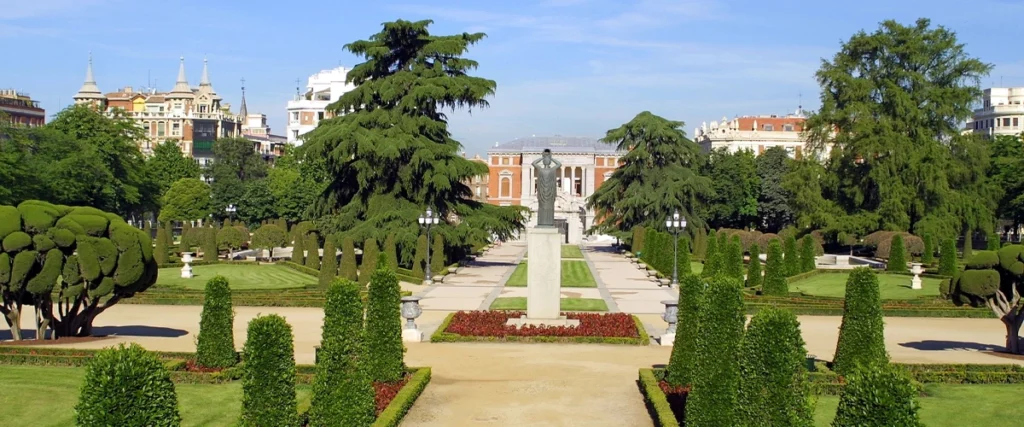
Madrid is a city where history and nature intertwine in surprising ways. One of its best-kept secrets is not a monument or a museum, but a tree: the ahuehuete of the Retiro Park, planted in 1633 and considered the oldest living specimen in the city.
This giant has survived wars, droughts, and nearly four centuries of urban growth. What's more, it's just a few meters from the park's busiest entrance, so seeing it won't require any detour.
What is a Montezuma cypress?
The Montezuma cypress, whose scientific name is *Taxodium mucronatum*, is a conifer native to the humid regions of Mexico and the southern United States. It is not a willow, although it is sometimes mistaken for one: it belongs to the cypress family and loses some of its foliage in winter.
Its name in Nahuatl, *ahuehuetl*, means "old man of the water," referring to its habit of growing near rivers and lakes. In its natural habitat, it can live for more than 2,000 years and reach heights of 40 meters, with trunks that in some cases exceed 14 meters in diameter.
The most famous example of this species is the Tule Tree in Oaxaca, Mexico. It is estimated to be over 1,500 years old, and its trunk is so thick that it takes more than 30 people holding hands to encircle it.
The ahuehuete tree of El Retiro: a guardian of almost four centuries
The ahuehuete tree in El Retiro was planted in 1633 by order of the Count-Duke of Olivares, the influential minister of Philip IV, within the ambitious project of beautifying the gardens of the Buen Retiro Palace.
Those gardens were designed to impress the court and foreign visitors. The tree, brought from Mexico, was one of the many exotic species introduced to the park at that time. However, very few have survived to the present day.
Today, a section of geometrically laid-out garden with clipped hedges still stands in the Parterre area. It is one of the few remaining examples in Spain of the French landscape style that dominated the 17th century.
The tree has withstood the passage of time, the harsh weather, and the damage of the Civil War, when the Retiro Park was the scene of fierce fighting. It lost some of its main branches then, but it still stands.
Data about the ahuehuete tree in Retiro
- Year of planting: 1633, by order of the Count-Duke of Olivares.
- Approximate age: about 400 years.
- Species: *Taxodium mucronatum*, or Montezuma cypress.
- Where is: in the Parterre, next to the entrance of the Gate of Philip IV.
- Protection: It is listed in the catalogue of singular trees of the Community of Madrid.
Other remarkable trees in El Retiro
The Montezuma cypress is not alone. The park preserves several protected specimens that deserve a detour:
- Bald cypress of the pond, a close relative of the ahuehuete and also of American origin.
- Cedars of Lebanon of the Paseo de Coches, planted in the 19th century.
- Sequoias near the Crystal Palace, which is unusual in Madrid's climate.
- Elm of the Parterre, one of the few survivors of Dutch elm disease in the city.
The cultural and botanical importance of the ahuehuete tree
The ahuehuete tree holds deep significance in Mexican culture, where it is associated with longevity, strength, and wisdom. In fact, it is the national tree of Mexico and appears in numerous pre-Hispanic legends.
Legend has it that Moctezuma II rested in the shade of a Montezuma cypress in Chapultepec, in what is now Mexico City. That is why the species is also known as the "Moctezuma cypress.".
From a botanical perspective, it is a remarkable example of resilience. Its deep roots allow it to reach groundwater, crucial for survival in a climate as dry as Madrid's. It also tolerates prolonged droughts and poor soils, reinforcing its symbolism as an emblem of permanence.
El Retiro, a living museum of natural history
The Retiro Park is one of Madrid's most emblematic green spaces and is part of the area declared a World Heritage Site by the UNESCO along with the Paseo del Prado.
Its 118 hectares were originally a royal garden and have been a meeting place for Madrid residents for over three centuries. In addition to the Montezuma cypress, the park is home to other centuries-old trees and a remarkable botanical collection brought from around the world.
El Retiro is also steeped in history. Fairs, concerts, and exhibitions have been held here, shaping the city's cultural life. From the construction of the Estanque Grande (Great Pond) to the assembly of the Palacio de Cristal (Crystal Palace), the park has evolved, though it has always maintained its role as a green lung.
How to visit the ahuehuete tree in El Retiro
- Where is: in the Parterre, very close to the Gate of Philip IV, the entrance located opposite the Prado Museum.
- How to reach: Retiro metro station (line 2) or Banco de España (line 2); also Atocha (line 1) if you enter from the south.
- When to go: early in the morning there are fewer people and better light for photographing it.
- Cost: entry to the park is free and the Parterre is always accessible during opening hours.
- Combine itIt's five minutes from Prado Museum already ten of Literary Quarter.
Frequently asked questions about the ahuehuete tree in El Retiro
Visiting the ahuehuete tree in El Retiro Park is like stepping into a little-known piece of Madrid's natural history. And if you want to discover hidden gems not found in guidebooks, join us on one of our tours of the historic center.
What is the ahuehuete tree and where is it found?
In the Parterre area of the Retiro Park, next to the Felipe IV Gate, the entrance facing the Prado Museum. It is the largest tree in that garden area.
It was planted in 1633, so it's around 400 years old. It's considered the oldest living tree in Madrid.
A conifer of the cypress family, *Taxodium mucronatum*, native to Mexico. It is also known as Montezuma cypress or sabino. Unlike most conifers, it loses some of its foliage in winter.
History and visit
From the Nahuatl word *ahuehuetl*, meaning "old man of the water." The name alludes to its preference for growing near rivers, lakes, and marshy areas.
The tree is protected and fenced off to preserve its roots, so it can only be viewed from the perimeter of the Parterre. Even so, it is perfectly visible and easy to photograph.
Nothing. Entry to Retiro Park is free and the ahuehuete tree is located in a general access area during the park's opening hours.
