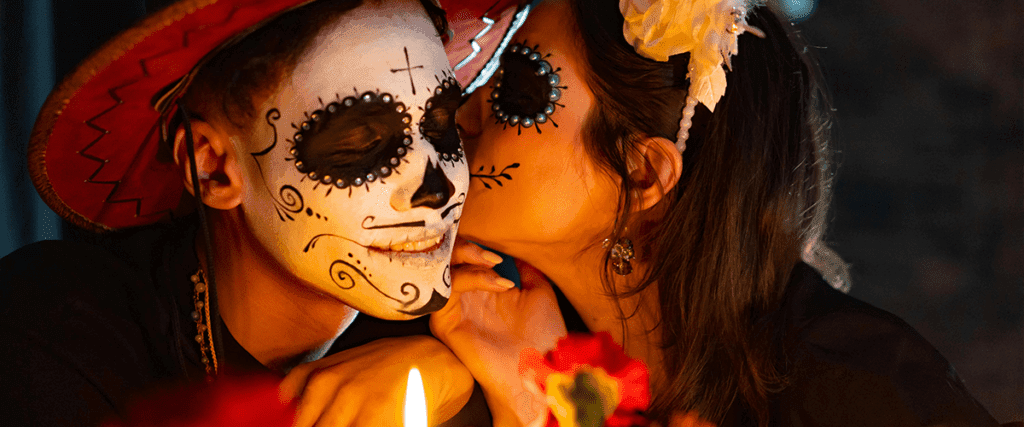
In Spain, the celebration of All Saints Cemeteries are filled with flowers on November 1st. Across the Atlantic, those same dates are observed with altars, papel picado (cut-paper decorations), and mariachis. And in Madrid, thanks to its Latin American community, both ways of remembering coexist.
In this article we review the origin of each tradition, how it is celebrated in the different Spanish regions and what you can do in Madrid during those days.
All Saints' Day, All Souls' Day, and Day of the Dead: what each one is
The Mexican Day of the Dead was registered by the UNESCO on its list of Intangible Cultural Heritage in 2008. However, the three dates overlap and it is important to distinguish them:
- November 1st, All Saints' DayA Catholic holiday dedicated to those who have already attained glory. It is a public holiday throughout Spain.
- November 2nd, All Souls' DayA religious commemoration in which prayers are offered for the souls in Purgatory. It is not a public holiday.
- November 1st and 2nd, Day of the Dead: Mexican celebration of pre-Hispanic origin, declared Intangible Cultural Heritage of Humanity by UNESCO in 2008.
Interestingly, in Spain the main celebration falls on the 1st. That is, it is celebrated with a day off included for those who have already passed the celestial rite.
How is All Saints' Day celebrated in Spain?
However, although the common custom is to bring flowers to the cemetery, each region has its own version of the celebration:
- Gaztañarre Eguna, in the Basque Country.
- Day of the Jacket, in Extremadura.
- The All Saints' Day Festival, in Cadiz.
- The Castanyada, in Catalonia.
- Nochi Los Dijuntos, in Cantabria.
- The Night of the Dead, in the Canary Islands.
- All Saints' Day Fair, in Cocentaina (Alicante).
- Samhain, in Galicia.
- Maroween, in Nerja (Malaga).
On the other hand, the following deserves special mention: Mount of Souls, In Soria, inspired by the legend of Gustavo Adolfo Bécquer. There, the story is read by the warmth of a bonfire, and afterwards the bravest walk barefoot over the embers.
Likewise, as for the table, the dates have their own sweets: panellets, roasted chestnuts, buñuelos de viento, anise doughnuts and huesos de santo.
The Day of the Dead and its presence in Madrid
The Day of the Dead has its headquarters in Mexico. Its pre-Hispanic origins were somewhat more macabre than we imagine today: they included the preservation of skulls as trophies to display in rituals that symbolized death and rebirth.
Later, over time, the celebration transformed into the colorful and endearing festival we know, popularized worldwide by animated films.
In fact, thanks to the large Mexican community living in the capital, Madrid celebrates these festivities every year. The Tabacalera in Lavapiés usually hosts the most ambitious program, with a craft market, food stalls, mariachis, altar-making contests, and Catrina parades. There are also activities at municipal cultural centers and the Mexican Cultural Institute.
It is advisable to check the specific program in mid-October, as the venues and dates change from year to year.
All Saints' Day in 2026: dates and public holiday in Madrid
In 2026, November 1st falls on a Sunday. Therefore, in the Community of Madrid, the All Saints' Day holiday is moved to Monday, November 2nd, which coincides with All Souls' Day. The result is a long weekend, from Saturday, October 31st to Monday, November 2nd, with a lively atmosphere in the city. Before making any plans, check the official work calendar of the Community of Madrid.
If you spend those days in Madrid, our Free tour of Habsburg Madrid It departs from Puerta del Sol and is offered in both Spanish and English. It's a pay-what-you-want tour: you don't pay anything upfront, and at the end, you contribute what you wish.
Days to remember the dead around the world
Furthermore, remembering those who have passed away is not a matter of calendars. Even so, almost every culture has an official date for doing so:
- Ching Ming, April 4th or 5th, in China.
- Gai Jatra, Between August and September, in Nepal, with cloth and bamboo cows paraded through the streets.
- Mahalaya, around September 15, a Hindu ceremony whose date depends on the moon.
- Halloween and Samhain, October 31st, of Celtic origin.
- Fet Gede, November 2nd, Haitian Vodou celebration.
Consequently, traditions become very diverse: from changing the clothes of mummified relatives to hanging willow branches to avoid returning as a yellow dog.
No one is deader than the forgotten.
Let's face it: for most of us, the word "death" is horrifying. And I'm not just referring to its meaning, because even phonetically it sounds unpleasant. However, this perception is strictly linked to the emotional weight we've learned to attach to it: uncertainty, separation, absence, fear, and pain.
Let's think about it this way: imagine for a moment that, as children, we had seen a joyful farewell party for each deceased relative. That movies featuring "Death" weren't categorized as drama or horror, but as comedy. That in books, the end of life was depicted as an anticipated and pleasant journey. That mourning was symbolized with clarity, smiles, and bright colors.
If that were the case, wouldn't we have a different relationship with death?
I am convinced that it is. That if we had learned something else, the term would have the same beauty as the word life.
That's why, as an adult, I opted for expressions like transcendence or change of plane. And more recently I decided that my dead, at least the closest ones, didn't go anywhere: they became invisible and here they are with me, taking their place in the subway car, accompanying and guiding me.
Mourning is an essential process. But, after a reasonable amount of time, we should remember the dead as beings of light who have gone to a better place. Because although melancholy and longing are understandable emotions, they also have the right to be remembered with joy.
Frequently Asked Questions about All Saints
What is celebrated on All Saints' Day?
All Saints' Day, a Catholic holiday dedicated to those who have passed away. It is a national holiday, and the most widespread custom is to visit cemeteries and bring flowers to family graves.
November 1st is dedicated to honoring the saints, that is, the souls who are already in heaven. November 2nd, on the other hand, is dedicated to praying for those in Purgatory. Only November 1st is a public holiday.
It depends on the region. Even so, the most common sweets are huesos de santo (marzipan bones), buñuelos de viento (wind fritters), panellets (small almond cakes), roasted chestnuts, and anise doughnuts.
Traditions and celebrations
Yes. The Mexican community organizes altars, markets, concerts, and Catrina contests every year, usually at La Tabacalera in Lavapiés and at cultural centers throughout the city. The schedule is published during October.
UNESCO inscribed it in 2008 on the list of Intangible Cultural Heritage for its character as a living tradition, its pre-Hispanic origin and its role in the identity of Mexican indigenous communities.
Samaín in Galicia, the Night of the Dead in the Canary Islands, the Castanyada in Catalonia, Tosantos in Cadiz and the Monte de las Ánimas in Soria are some of the local celebrations of this time of year.
