
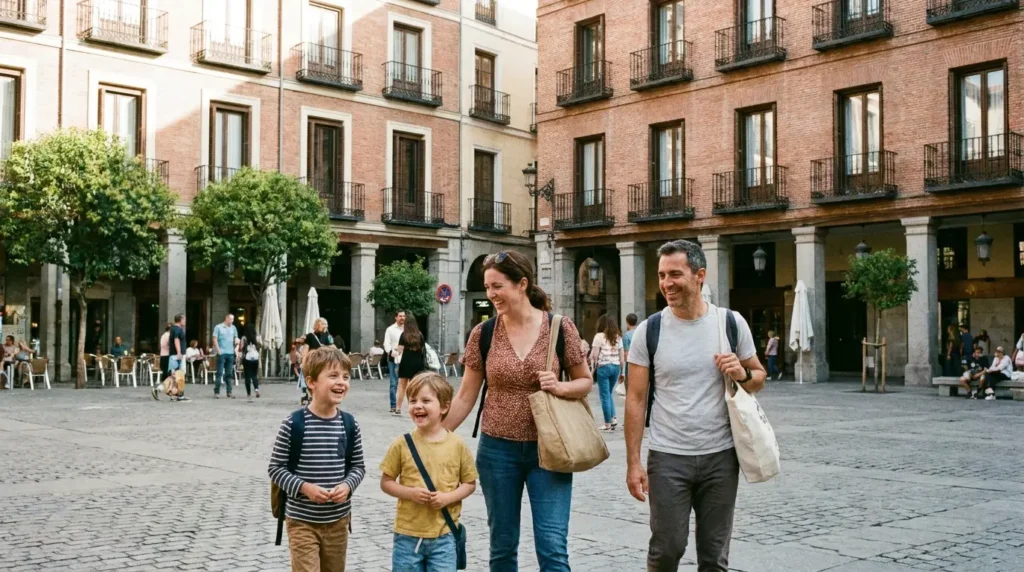
Visiting Madrid with children offers many possibilities, but a good family itinerary shouldn't be organized like an adult tour with children simply added on. It's best to keep distances short, alternate historical sites with moments of relaxation, limit explanations, and choose places that can be observed, explored, and understood without spending the whole day queuing.
The capital boasts pedestrian plazas, parks, museums, shows, and leisure spaces for different ages. Furthermore, the official tourist offerings include family-friendly options, playgrounds, museums, children's theater, and activities specifically designed for children and teenagers.EsMadrid)
However, trying to cram in too many activities is usually the biggest mistake. For children to truly enjoy Madrid, it's best to combine a few well-chosen visits with time to run around, eat, relax, and explore the city on their own.
Is Madrid a good city to visit with children?
Yes. In fact, the city center allows you to connect many places on foot, there is an extensive public transport network, and there are parks and family activities spread throughout different areas.
In addition, some of the main attractions for a visit with children include:
- The Plaza Mayor.
- The Royal Palace and the Plaza de Oriente.
- The Retiro Park.
- Madrid Río.
- The Railway Museum.
- The National Museum of Natural Sciences.
- The Planetarium.
- Children's theaters.
- Theme parks.
- Football stadiums.
- Museums with family activities.
In fact, the official Madrid Tourism website maintains a section dedicated to families and a children's calendar that allows you to consult activities, shows, and temporary offerings. It's advisable to check it before your trip because the program changes throughout the year.EsMadrid)
How many plans should be included in one day?
With children, it usually works better to organize a main activity, a short route, and a rest or play area.
On the other hand, a balanced day could include:
1. In particular, a tour of the historic center.
2. A leisurely meal.
3. An afternoon in the Retiro Park.
4. Moreover, it's an optional indoor activity.
Furthermore, it's not advisable to combine a multi-hour museum visit, a long walk, a late lunch, and another monument with an entrance fee. Although the distances may seem manageable for an adult, the accumulation of waiting and explanations can make the experience exhausting.
As a guide:
- Children under 5 years old: one or two main stops.
- From 6 to 9 years old: 60 to 90 minute route plus one activity.
- From 10 to 13 years old: route of up to two hours with breaks.
- Teenagers: longer itineraries if the content connects with their interests.
In fact, age is just one reference point. Other factors include walking habits, weather, time of day, and each child's individual temperament.
Family route through the center of Madrid
This route connects some of the most well-known places in the city center without making for an excessively long day.
It can be done in about two hours, although it is advisable to extend it with breaks.
1. Puerta del Sol
On the other hand, Puerta del Sol is a practical starting point due to its location and transport connections.
With children, the square can be presented through easily recognizable elements:
- The bear and the strawberry tree.
- The clock that chimes.
- The Kilometer Zero plaque.
- The statue of Charles III.
- The buildings surrounding the square.
Instead of starting with a long historical explanation, you can propose a small observation game: locate the bear, find Kilometer Zero, or discover where the clock that appears every New Year's Eve is.
On the other hand, a fifteen-minute stop is usually sufficient.
2. Post Street and Main Square
Also, from Sol you can continue towards Plaza Mayor via Calle de Postas.
The Plaza Mayor works particularly well on a family route because it is spacious, visually appealing, and allows for explaining different moments in history through specific scenes:
- Markets.
- Celebrations.
- Parades.
- Bullfights.
- Fires.
- Real people.
- Old trades.
The following can also be observed:
- The statue of Philip III.
- The frescoes of the Bakery House.
- The entrance arches.
- The arcades.
- The slope of the Arco de Cuchilleros.
Furthermore, it's not necessary to explain all the historical uses of the square. Two or three short stories are usually more effective than a succession of dates.
3. Cutlers' Arch
In fact, the Cutlers' Arch adds a change of level and perspective that often sparks curiosity.
Similarly, it can be explained that the Plaza Mayor is built on uneven terrain and that this access allows the plaza to be connected to the lower streets.
Alternatively, descending the stairs can be avoided if the group has a stroller or if there are mobility difficulties. In that case, the arch can be viewed from the plaza, and an alternative route can be taken.
4. San Miguel Market
Likewise, the San Miguel Market It can be used as a short stop for drinking water, going to the bathroom, or having a snack.
It's usually very busy, so it's not always the most comfortable place to eat with young children. However, you can still visit the exterior and continue on to a quieter area.
In fact, the stop shouldn't depend on consumption. The building also allows us to talk about the old markets and how the city's supply was organized.
5. Plaza de la Villa
The Plaza de la Villa is smaller and usually less overwhelming than the Plaza Mayor.
On the other hand, here you can see buildings from different eras and narrow streets that help you imagine old Madrid.
To maintain attention, children can be asked to find:
- A shield.
- A tower.
- A balcony.
- An old door.
- The narrowest street leading out of the square.
Furthermore, this type of participation turns the journey into a quest and prevents the child from having to simply listen.
6. Almudena Cathedral and Royal Palace
Likewise, from the Plaza de la Villa, continue along Calle Mayor to the Almudena Cathedral and the Royal Palace.
In addition, the whole is visually appealing and offers space to pause.
In fact, it can be explained to children:
- What is the difference between a cathedral and a palace?.
- Who lived in the old Alcázar?.
- Why the current Royal Palace is not as old as it seems.
- What is it used for today?.
- What function did the ceremonial squares serve?.
Entering the Royal Palace can be worthwhile, but it's best not to combine your visit inside with an overly long outdoor tour. If you book a ticket, your morning should be organized around this monument.
7. Plaza de Oriente
On the other hand, the Plaza de Oriente is a good place to end the route.
It has gardens, benches, and a place to relax. In fact, you can see the Royal Palace and the Royal Theatre.
It also allows you to continue to:
- The Sabatini Gardens.
- Plaza de España.
- Gran Vía.
- The Temple of Debod.
- The Opera metro station.
For a family with young children, ending here might be more sensible than continuing to make stops.
Which places in Madrid are best for children?
Retiro Park
Likewise, El Retiro is one of the best options to balance a day of sightseeing.
Furthermore, it allows you to walk without following a rigid route and to combine different spaces:
- Large Pond.
- Crystal Palace.
- Play areas.
- Grounds.
- Walks.
- Sights.
- Puppet Theatre.
Madrid Tourism includes the Retiro Puppet Theatre among its suggestions for families and recommends checking its performance schedule.EsMadrid)
In fact, it's not necessary to explore the entire park. Especially with children, you can choose a specific area and spend between one and two hours there.
Madrid River
Madrid Río offers green areas, children's play areas and wide paths along the Manzanares River.
It may be especially suitable for families who prefer a less monumental plan and more focused on play and walking.
Furthermore, since it is off the main tourist route, it is advisable to dedicate a specific part of the day to it and not treat it as a quick stop between monuments.
Railway Museum
Likewise, the Railway Museum is often attractive to children interested in trains, machines and transport.
Madrid Tourism includes it among its children's attractions and highlights its collection of locomotives, carriages and railway pieces.EsMadrid)
Before attending, the following should be checked:
- Schedules.
- Rates.
- Available activities.
- Temporary closures.
- Advance sale.
- Family programming.
National Museum of Natural Sciences
It can also work well with children interested in animals, fossils, evolution, and nature.
As with any family museum, it's best to decide beforehand what you want to see. In fact, a shorter, more focused visit is usually more rewarding than trying to see every room.
Madrid Planetarium
The Planetarium can be incorporated as an indoor activity, especially if the children show an interest in space.
The sessions have a schedule and capacity limit, so you should check the times before traveling.
Prado Museum
The Prado can also be visited with children, but it requires a different approach.
On the other hand, it's not advisable to try to see the entire collection. It's preferable to select between five and eight works with visual elements that allow for discussion.
- Animals.
- Characters.
- Objects.
- Mythological scenes.
- Gestures.
- Clothing.
- Stories.
Similarly, a private or family visit can adapt the duration and avoid overly technical explanations.
Royal Palace
In addition, the Royal Palace can impress with its size, halls, and decor.
In fact, for a family visit it is advisable to:
- Buy tickets in advance.
- Explain beforehand what will be shown.
- Avoid a long outdoor route on the same day.
- Do not require children to stop in every room.
- Set aside time to rest afterwards.
How to adapt the route according to age
Madrid with babies and children under 4 years old
On the other hand, logistics should be the priority.
It is advisable to plan ahead:
- Cart suitable for cobblestones.
- Access without stairs.
- Bathrooms.
- Places to eat.
- Shades.
- Pauses.
- Sleep schedules.
- Fewer trips.
The historic center features cobblestones, uneven terrain, and stations with varying accessibility. Before choosing your route, it's advisable to check the available elevators and access points.
On the Madrid Metro, children under four years old can travel without a ticket. Fares and conditions should be checked before traveling, as they may change.Madrid Metro)
Madrid with children aged 5 to 8
They usually work well at these ages:
- Short stories.
- Visual searches.
- Legends presented as legends.
- Questions.
- Challenges.
- Frequent changes in activity.
- Movement stops.
On the other hand, a route of one hour or one and a half hours may be sufficient.
Madrid with children aged 9 to 12
More historical context can be incorporated, as long as it relates to characters, decisions, and consequences.
They also work:
- Maps.
- Scavenger hunts.
- Comparisons between eras.
- Questions about buildings.
- Stories of kings, artists, and writers.
- Explanations about how people lived.
Madrid Tourism offers materials and activities for families, such as games and resources for exploring the city in a more participatory way.EsMadrid)
Madrid with teenagers
Likewise, teenagers do not necessarily need childish content.
Additionally, the route can be linked to:
- Music.
- Soccer.
- Fashion.
- Photograph.
- Political history.
- Legends.
- Social networks.
- TV series and movies.
- Urban art.
- Gastronomy.
The official tourism website also publishes specific plans for teenagers.EsMadrid)
How to get around Madrid as a family
The center can be explored on foot, but it is not necessary to walk for the entire day.
Metro
In fact, the subway is practical for connecting distant areas.
It is also important to keep in mind:
- Not all entrances to the same station have an elevator.
- Rush hour can be inconvenient with strollers.
- It is necessary to validate the corresponding title.
- Children under four years old can travel without a ticket.Madrid Metro)
Furthermore, the Metro's official website and app allow users to check routes, stations, and any disruptions.Madrid Metro)
Bus
Additionally, the bus allows you to observe the city during the journey and can be more comfortable than the subway for short journeys with a stroller, depending on the occupancy.
It also reduces the number of stairs, although traffic may lengthen some routes.
Surroundings
Surroundings It is useful for certain journeys within Madrid and for excursions.
Renfe publishes specific conditions for children, young people, large families, groups, and school groups. Fares should be checked before traveling.Renfe)
Walking
Walking is still the best way to get to know the city center, but a family day out shouldn't be measured solely in kilometers.
It is preferable to take a short route, use transport and save energy for a park or activity rather than forcing children to travel all over the city.
What to do in Madrid with children when it rains
Furthermore, a rainy day doesn't mean you have to cancel all your plans.
The following may be considered:
- Railway Museum.
- Museum of Natural Sciences.
- Planetary.
- Prado Museum with a short route.
- Royal Palace.
- Children's theatre.
- Temporary family activities.
- Cultural centers.
- Indoor leisure spaces.
In fact, the Madrid Tourism children's agenda allows you to consult updated activities, including theatrical proposals and indoor experiences.EsMadrid)
It's best not to rely on just one activity, as tickets may sell out.
How to organize a summer trip to Madrid with children
On the other hand, summers in Madrid can be very hot.
On the other hand, to prevent the route from becoming exhausting:
- Start early.
- Reduce the lengths of time spent in the sun.
- Take the historical route in the morning.
- Reserve the indoors for the middle of the day.
- Bring water.
- Incorporate pauses.
- Avoid unshaded squares during the hottest hours.
- Leave the parks for the end of the afternoon.
- Don't plan overly long journeys.
With high temperatures, the route must be shortened even though it may seem simple on paper.
How to organize Madrid with children in winter
Also, during the winter it is advisable to:
- Wear clothes in layers.
- Alternate exteriors and interiors.
- Avoid excessively long breaks outdoors.
- Check the park closing times.
- Having a covered activity as an alternative.
- Consider that it gets dark earlier.
Madrid can experience cold mornings, although the central hours are more pleasant.
Where is a good place to rest during a tour of the city center
Additionally, some useful areas for introducing pauses are:
- Plaza de Oriente.
- Sabatini Gardens.
- Plaza de España.
- Retiro Park.
- Madrid Río.
- Cafes located away from the busiest squares.
- Pedestrian areas near the Royal Palace.
In fact, it's not necessary to wait until the children are completely tired. Moreover, a preventative break can prevent the rest of the day from becoming complicated.
Common mistakes when visiting Madrid as a family
Organize the same route that the adults would take.
Children need fewer stops, more participation, and frequent breaks.
To over-explain
On the other hand, a family route should not turn into a history lesson.
Don't set aside time to play
Furthermore, the game is not a waste of time within the itinerary. In fact, it's part of the experience.
Choosing restaurants too late
The waits increase when the children are already hungry.
Combining too many interiors
Access controls, queues, and standing time all add up.
Ignoring the weather
In fact, heat or cold can completely change the resistance of the group.
Booking an excessively long tour
More places don't necessarily mean a better experience.
Do not disclose ages when booking a visit
On the other hand, an activity recommended “for families” may not work the same for a four-year-old as it does for a twelve-year-old.
Is it worth booking a private family tour?
It may be especially worthwhile when:
- The children are of very different ages.
- The schedule needs to be adjusted.
- The group has a stroller.
- Older people participate.
- There is little time available.
- The goal is to reduce the distance.
- Children have specific interests.
- It needs to end near another reserve.
- The family prefers to set its own pace.
Furthermore, the value of a private family tour lies not only in the group being alone with the guide. There must be a genuine adaptation of the language, the stories, the pauses, and the duration.
Before booking, please indicate:
- Number of adults.
- Number of children.
- Ages.
- Use of cart.
- Mobility needs.
- Interests.
- Available time.
- Language.
- Desired starting or ending point.
Discover Madrid as a family with 4U Madrid
Exploring Madrid with children doesn't mean missing out on its history. It means choosing what to talk about, how to get around the city, and how much time to spend at each stop.
At 4U Madrid we can adapt a visit to the historic center to the pace, ages and interests of each family, avoiding overly long tours and giving more space for questions, observation and rest.
Frequently asked questions about visiting Madrid with children
Route, duration and breaks
For a first visit, Puerta del Sol, Plaza Mayor, the Royal Palace, Plaza de Oriente, and Retiro Park are all good options. The choice should be tailored to the child's age and combine sightseeing with time for play and relaxation.
Two or three days allow you to explore the city center, visit a museum or monument, and set aside time for a park or children's activity. With more days, you can add leisure activities, excursions, and neighborhoods further from the center.
Yes, but there are cobblestone streets, uneven terrain, and access points with stairs. It's advisable to check the route beforehand, avoid certain sections like the stairs at the Arco de Cuchilleros, and verify the accessibility of the stations.
Food, transportation, and alternative plans
Children under four years old can travel without a ticket. From that age onwards, they must use the corresponding ticket. Conditions and fares should be checked on the official website before traveling.Madrid Metro)
Puerta del Sol, Plaza Mayor, Plaza de Oriente, Madrid Río, and numerous parks can all be visited free of charge. There are also cultural activities and free admission at certain times, the conditions of which should be checked beforehand. Madrid Tourism maintains a selection of affordable family-friendly options.EsMadrid)
A shared tour can work for older children who are used to walking. A private tour offers more flexibility to adapt the duration, language, breaks, and route, especially with young children or mixed-age groups.
