
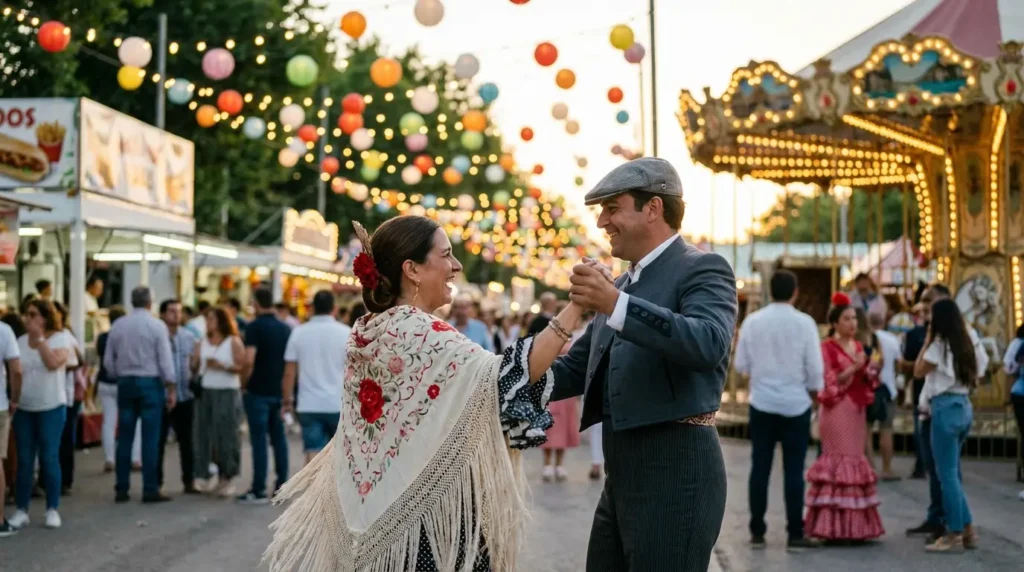
The chotis is one of the great symbols of traditional Madrid, although it wasn't born in the city. Its origins lie in Central Europe, and it arrived in Madrid during the 19th century. Over time, it moved beyond aristocratic salons, adapted to the barrel organ, and eventually became the most recognizable dance of Madrid's street festivals.
Few things seem as quintessentially Madrileño as a couple dressed as chulapa and chulapo dancing to the rhythm of a barrel organ.
He spins almost without moving an inch. She moves around him with short, confident steps. Moreover, everything seems so connected to Madrid that it's easy to imagine the chotis originating in some tenement courtyard in Lavapiés or at a street party in La Latina.
But it wasn't like that.
Likewise, the chotis came from outside and Madrid made it its own.
Furthermore, its history demonstrates that many urban traditions do not arise in isolation. They are formed through influences, adaptations, and customs that eventually become integrated into a city's identity.
What is the Madrid chotis?
The chotis is a partner dance, with a slow rhythm and restrained movement, currently associated with the traditional festivals of Madrid.
In fact, it is usually danced to the sound of a barrel organ and features a very recognizable choreography:
- The man remains almost in the same spot.
- It rotates on its own axis.
- The woman moves around him.
- Both maintain an upright posture.
- The steps are small and rhythmic.
- The turn should be made without taking up too much space.
Hence the well-known idea that the chulapo must be able to dance the chotis on a tile.
He Madrid City Council It precisely describes the dance as a dance in which the woman revolves around the man while he rotates on himself without practically abandoning his position.
Where did the chotis originate?
On the other hand, the chotis was not born in Madrid or in Spain.
Its origins lie in Central Europe, particularly in the historical region of Bohemia. Specifically, its name comes from the German term *Schottisch*, meaning "Scottish." However, this name does not imply that the Madrid dance originated directly in Scotland.
Likewise, the name was used in various European countries to identify a type of partner dance related to polkas and other popular dances of the 19th century.
Therefore, the cultural journey of the chotis is complex:
1. It arises within the environment of Central European dances.
2. In this way, it spreads through different courts and cities.
3. It arrived in Spain during the 19th century.
4. In addition, it is introduced into Madrid's salons.
5. Move to the working-class neighborhoods.
6. It fits the barrel organ.
7. It ends up becoming a quintessential symbol.
When did the chotis arrive in Madrid?
On the other hand, the traditionally accepted date for its first presentation in Madrid is the November 3, 1850.
According to information released by the Community of Madrid and the City Council, it was first danced at a party held in the Royal Palace during the reign of Isabella II. Specifically, at that time it was presented as a “German polka”.
In 2025, Madrid celebrated the 175th anniversary of that introduction with events in the Plaza de Oriente, next to the place where its Madrid history would have begun.
Likewise, the documentary accuracy regarding that first interpretation may depend on the sources consulted, but the date of 1850 is part of the institutional tradition with which Madrid currently explains the arrival of the chotis.
From the halls of the Royal Palace to the local festivals
Furthermore, the chotis began as a dance associated with courtly and aristocratic environments.
However, he soon left the halls.
During the second half of the 19th century it was adopted by the working classes of Madrid and began to be heard in:
- Ballrooms.
- Cafes.
- Theaters.
- Neighborhood parties.
- Festivals.
- Streets.
- Courtyards and corrals.
By the end of the 19th century, it was fully integrated into Madrid's popular culture. In particular, the City Council notes that during this period it began to be heard on barrel organs and in neighborhood spaces, eventually becoming one of the main features of the San Isidro festivals.
On the other hand, the process is significant: a dance imported by the court ended up being appropriated and transformed by the popular neighborhoods.
Why did the chotis become a symbol of Madrid?
Furthermore, the chotis had several characteristics that favored its integration into Madrid life.
It was easy to adapt to small spaces
Also, he didn't need a large living room.
It could be danced in:
- Courtyards.
- Streets.
- Places.
- Taverns.
- Corrals.
- Festivals.
Furthermore, the contained movement of the man and the circular movement of the woman facilitated its practice in small urban spaces.
It was adapted to the barrel organ
In fact, the barrel organ made it possible to bring music to the streets without the need for a full orchestra.
On the other hand, the Italian musician Antonio Apruzzese is related to the adaptation of the chotis rhythms to the barrel organ, contributing to the sound form with which the dance ended up becoming popular in Madrid.
It fit in with the culture of the local festivals
During the 19th and 20th centuries, Madrid developed an intense popular festive culture.
The festivals offered:
- Music.
- Dance.
- Food stalls.
- Attractions.
- Neighborhood meetings.
- Folk costumes.
- Religious and civil celebrations.
On the other hand, the chotis found its natural space there.
He associated with recognizable personalities
The chulapa, the chulapo, the wafer seller and the organ grinder contributed to building an easily identifiable popular image.
Over time, that representation was reinforced by:
- Zarzuelas.
- Songs.
- Theater.
- Cinema.
- Posters.
- Advertising.
- Official holidays.
- Traditional associations.
Madrid Tourism He currently considers the chotis and the organillo two of the fundamental signs of traditional Madrid.
How do you dance the chotis?
The basic choreography is easy to understand, although dancing with elegance requires practice.
Starting position
Likewise, the couple stands facing each other.
The man usually maintains a straight and restrained posture, while the woman has a little more space to move around him.
Man's movement
The man:
- Keep your feet close together.
- It rotates on its own axis.
- Shift your weight from one foot to the other.
- It's making very little progress.
- Try to stay within a small space.
Hence the expression that he can dance on a tile.
Furthermore, it doesn't mean remaining completely still. Make small changes in weight distribution and controlled turns.
Women's Movement
The woman:
- She revolves around her partner.
- Take short steps.
- He keeps up the pace.
- Change direction when appropriate.
- He directs part of the movement.
In a traditional interpretation, the chulapa can adopt a confident and expressive attitude, while the chulapo maintains a more restrained position.
The couple
In fact, dancing requires coordination.
Although from the outside it may seem that the man barely moves, both must control:
- The distance.
- The rhythm.
- Changes of direction.
- The turns.
- The posture.
- The available space.
On the other hand, it's not just about walking around another person. In fact, the appeal of the chotis lies in the precision and the attitude with which it is performed.
Is it true that a man must dance on a tile?
It is one of the most repeated images of the Madrid chotis.
Likewise, the expression encapsulates the idea that the chulapo should spin practically without moving. Similarly, it should not necessarily be interpreted as a precisely measured historical rule.
In fact, in many exhibitions a tile, a small surface or a mark on the floor is used to demonstrate the dancer's control.
Therefore, it can be understood as:
- A popular rule.
- A test of skill.
- A visual way to explain the choreography.
- An element of the traditional Spanish imagery.
On the other hand, the City Council uses the phrase "how to dance on a tile" to describe this characteristic of the chotis.
The barrel organ: the soundtrack of the chotis
On the other hand, the barrel organ is a portable or transportable mechanical instrument that reproduces music through a system of cylinders, pins and internal mechanisms.
Likewise, the organ grinder operates a crank that puts the instrument into operation.
Furthermore, during the 19th and 20th centuries it was common to find organ grinders in:
- Festivals.
- Places.
- Streets.
- Courtyards.
- The Trail.
- Popular festivals.
In fact, the instrument made it possible to bring dance music to spaces where there was no orchestra.
The barrel organ ended up being associated not only with the chotis, but also with:
- Pasodobles.
- Mazurkas.
- Waltzes.
- Couplets.
- Popular songs.
Madrid Tourism continues to present the organ grinder as one of the representative figures of the most traditional Madrid.
Were the chotis and the organillo born together?
No.
The chotis already existed as a dance before it became associated with the Madrid barrel organ.
The relationship was consolidated when his music began to be adapted to the cylinders of these instruments and was regularly performed in neighborhoods and at local festivals.
On the other hand, the barrel organ helped to turn a ballroom dance into a street expression.
How the chulapos and chulapas dress
On the other hand, the current traditional costume is the result of a popular image built and consolidated during the 19th and 20th centuries.
Likewise, not all historical residents of Madrid dressed the same way, nor was there a single, unchangeable uniform.
However, several characteristic elements are recognized today.
chulapo suit
In addition, men's attire typically includes:
- Checkered cap or hat.
- Fitted vest.
- Light shirt.
- White scarf around the neck.
- Dark trousers.
- Boots.
- Carnation on the lapel.
In fact, the parpusa is one of the most recognizable elements. Madrid Tourism defines it as the traditional cap associated with the Madrid dandy.
chulapa outfit
On the other hand, women's attire usually incorporates:
- Fitted dress.
- Long skirt or ankle-length skirt.
- Moles.
- Headscarf.
- One or more carnations.
- Manila shawl.
- Suitable footwear for dancing.
The Manila shawl, despite its Asian origin and its arrival in Spain through the Philippines, ended up becoming one of the garments most associated with the chulapas of Madrid.
Do you have to dress up as a chulapo to dance?
No.
On the other hand, the chotis can be danced in any comfortable clothing.
Traditional dress is used especially in:
- Exhibitions.
- Festivals.
- San Isidro festivities.
- Cultural events.
- Competitions.
- Photographs.
- Folk groups.
In addition, the City Council has promoted initiatives in recent years so that residents and visitors can make or reinterpret chulapa and chulapo costumes, reinforcing their role within Madrid's cultural heritage.
What is the relationship between the chotis and the chulapos?
Furthermore, the term chulapo is related to one of the popular figures of traditional Madrid.
Currently it is used to designate the man dressed in the traditional Madrid costume, while chulapa refers to the woman.
However, Madrid's traditionalism was broader and comprised various popular types, including:
- Manolos.
- Majos.
- Sparkers.
- Pimps.
- Chulapos.
- Wafer sellers.
- Organ grinders.
The names varied according to the era, the neighborhood, and the cultural representation.
Over time, the pair of chulapos ended up becoming the main image of the Madrid festivities.
The chotis in zarzuela and popular music
In fact, zarzuela played an important role in building Madrid's musical image.
His works represented:
- Neighborhoods.
- Trades.
- Popular types.
- Love conflicts.
- Festivals.
- Traditions.
- Ways of speaking.
On the other hand, the chotis became integrated into that scenic and musical environment, reinforcing its association with popular Madrid.
On the other hand, among the best-known chotis are “"Madrid"”, The song, composed by the Mexican Agustín Lara, is not part of the historical origin of the dance, but it ended up becoming one of the most famous musical declarations dedicated to the city.
There are also chotis and traditional songs related to:
- The street parties.
- The neighborhoods.
- The Gran Vía.
- Chamberí.
- Footbath.
- Everyday life in Madrid.
Likewise, the genre was interpreted and preserved by artists linked to the cuplé and the Madrid song, such as Olga Ramos and other figures of traditional music.
When is the chotis danced in Madrid?
The chotis can appear during different festivals and cultural activities, but its presence is especially visible in May and August.
San Isidro
San Isidro is celebrated around May 15th and is the main patron saint festival of Madrid.
In addition, during those days you can find:
- Chotis dance exhibitions.
- Workshops.
- Street parade.
- Organ grinders.
- Chulapos and chulapas.
- Traditional dances.
- Activities in the Pradera de San Isidro.
- Events in squares and cultural spaces.
In fact, the City Council considers San Isidro to be the moment of greatest public presence of the chotis and continues to incorporate exhibitions and workshops into its program.
San Cayetano Festival
It is celebrated at the beginning of August, mainly in the area around El Rastro and Embajadores.
It is also one of the festivals that kick off the cycle of summer festivals in Madrid.
San Lorenzo Festival
It takes place in Lavapiés and continues the festive program after San Cayetano.
Verbena de la Paloma
On the other hand, it is celebrated around August 15th and is one of the best-known festivals.
Likewise, the streets of La Latina are filled with:
- Music.
- Dances.
- Decoration.
- Traditional costumes.
- Neighborhood activities.
- Food stalls.
Traditional associations actively participate in both San Isidro and the San Cayetano and La Paloma festivals.
Where to see chotis in Madrid
Furthermore, there is no permanent chotis show every day of the year.
In fact, the best opportunities often coincide with:
- San Isidro.
- August festivals.
- District programs.
- Activities of cultural centers.
- Exhibitions of traditional associations.
- Public workshops.
- Events in the Plaza Mayor.
- Events at Puerta del Sol.
- Celebrations in the Pradera de San Isidro.
During the San Isidro festivities in 2026, for example, the City Council organized displays of chotis and other traditional dances in places like the Puerta del Sol and along the route to the Plaza de Oriente. The program changes every year and should be checked before traveling.
Can you learn to dance?
Yeah.
On the other hand, free workshops or introductory activities are usually organized around the time of San Isidro.
There are also:
- Traditional associations.
- Folk groups.
- Academies.
- Senior centers.
- Municipal cultural centers.
- Temporary workshops.
The program is not permanent, so it is advisable to check the City Council's cultural agenda and official festivals.
Places in Madrid related to the chotis
Royal Palace
Furthermore, tradition places its first Madrid performance there in 1850.
Similarly, it can be incorporated into a route to explain the evolution of the dance from the court to the popular neighborhoods.
Plaza de Oriente
Furthermore, it is located opposite the Royal Palace and has hosted commemorative events related to the anniversary of the chotis.
Pradera de San Isidro
It is also the main popular venue for the patron saint festivities.
On the other hand, during May it is full of:
- Chulapos.
- Chulapas.
- Music.
- Dances.
- Doughnuts.
- Wafers.
- Positions.
- Celebrations.
Footbath
Furthermore, the neighborhood maintains a close relationship with the San Lorenzo festivals and with Madrid's popular culture.
La Latina
Likewise, its streets play a central role in the La Paloma festivities.
The Trail
It is also related to traditional characters such as wafer sellers, organ grinders, and street vendors.
Plaza Mayor
It has hosted dances, concerts, workshops and events linked to Madrid's festivities.
The chotis as an example of Madrid's identity
In fact, the history of the chotis challenges the idea that a tradition can only be considered authentic if it was born in the same place with which it identifies.
Madrid has historically been built through the arrival of people, customs, products and influences from other territories.
On the other hand, the chotis came from Central Europe.
The Manila shawl has Asian roots.
On the other hand, many Madrid residents came from other regions.
Even so, all those elements ended up becoming integrated into a recognizable local culture.
Furthermore, Madrid's identity is not solely about preserving what originated within the city. It also lies in the ability to adapt, blend, and transform external elements into something uniquely its own.
Myths and truths about the chotis
“The chotis was born in Madrid”
Fake. Its origin is Central European and it arrived in Madrid during the 19th century.
“It was danced for the first time in Madrid at the Royal Palace”
This is the historical version disseminated by Madrid institutions. The traditional date is November 3, 1850.
“Man cannot get out of a tile”
It's a popular way of explaining that it must rotate within a very small space. It shouldn't be understood as a universal metric standard.
“Women only follow men”
Not exactly. She develops the circular path and needs to control a good part of the movement and space.
“It is only danced during San Isidro”
No. It also appears at August festivals, exhibitions, workshops, and cultural events.
“To dance, you have to dress like a chulapo”
No. The costume is part of the traditional performance, but it is not mandatory to learn or dance.
“The barrel organ created the chotis”
No. The dance existed before. The barrel organ helped to popularize it in the streets of Madrid.
Is it worth including the chotis in a tour of Madrid?
Yes, especially if the tour focuses on:
- Traditions.
- Parties.
- Popular music.
- Traditional neighborhoods.
- Social history.
- San Isidro.
- Festivals.
- Operetta.
- Popular people.
One route could connect:
1. Royal Palace and arrival of the ball.
2. Plaza de Oriente.
3. Plaza Mayor.
4. La Latina.
5. Footbath.
6. The Rastro.
7. Pradera de San Isidro.
It wouldn't be necessary to visit all these places in a single trip. The itinerary can be adapted according to the date and the cultural program.
Discover the authentic Madrid with 4U Madrid
The chotis was not born in Madrid, but few cities have managed to appropriate a dance with so much personality.
Its journey from the halls of the Royal Palace to the street festivals explains an important part of the city's social history: how the popular classes transformed a European fashion into one of Madrid's most recognizable symbols.
At 4U Madrid we can incorporate this story into a route about traditions, popular neighborhoods and local culture.
The tour can be adapted to include:
- The origin of the chotis.
- The street parties.
- The chulapos and chulapas.
- The barrel organ.
- San Isidro.
- La Latina.
- Footbath.
- The Trail.
- Zarzuela and popular music.
Frequently asked questions about the chotis
Origin and history of the chotis
Its origins lie in Central Europe, especially Bohemia. The name comes from the German word *Schottisch*, which means "Scottish".
The traditional date is November 3, 1850, when it was supposedly performed during a party at the Royal Palace presided over by Isabella II.
It is danced in pairs. The man spins on his own axis and occupies very little space, while the woman moves around him with short, rhythmic steps.
Because the man must control the turn without hardly moving. The tile symbolizes the small space a good dancer needs.
How to dance it and where to watch it
The most commonly associated instrument is the barrel organ, although it can also be performed with orchestras, bands and other ensembles.
Primarily during San Isidro in May, and at the festivals of San Cayetano, San Lorenzo, and La Paloma in August. Workshops and exhibitions are also organized at other times of the year.
The chulapo typically wears a cap, vest, neckerchief, dark trousers, and a carnation in his lapel. The chulapa wears a dress, headscarf, carnations, and a Manila shawl.
Yes. Although its origin is foreign, Madrid adapted and incorporated it into its festivals, music and popular identity since the 19th century.
