
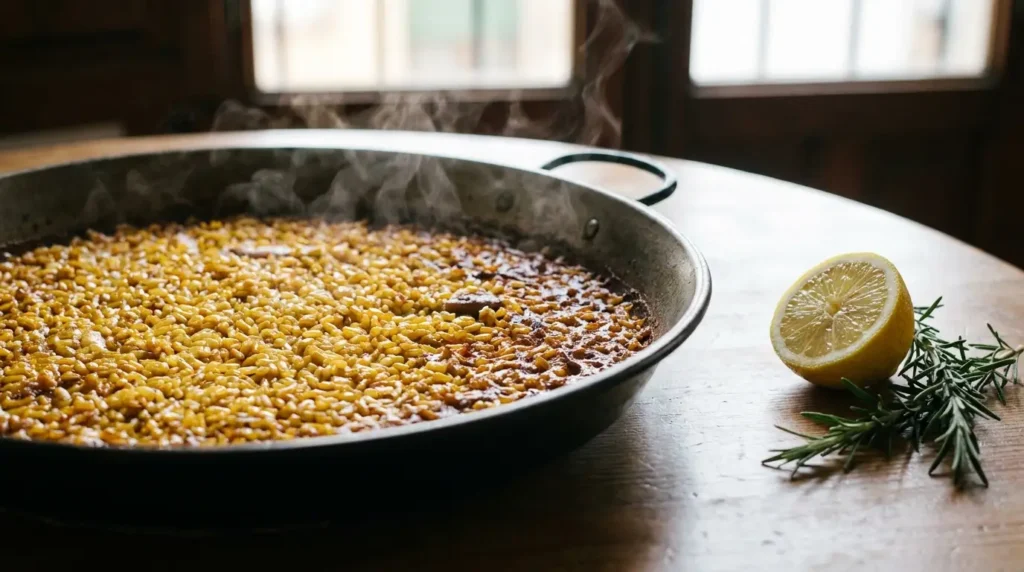
Paella is from Valencia. If your trip includes Valencia, you should try it there, preferably at a specialized rice restaurant or, even better, at a Valencian family's home. But if your itinerary is concentrated in Madrid, you'll also find restaurants with Valencian and Levantine traditions that can prepare a good paella and other rice dishes, provided you know what you're ordering.
Madrid brings together cuisines from all over Spain. This diversity allows you to enjoy Galician, Asturian, Basque, Andalusian, Valencian, or Murcian dishes without leaving the capital.
However, the fact that a Madrid restaurant serves paella does not make the dish from Madrid.
Furthermore, paella is an integral part of Valencian culinary culture, linked to its fertile lands, its rice varieties, the Albufera lagoon, the use of fire, and a tradition of gathering around the table. The Valencian Community Tourism Board presents it as one of the great symbols of its gastronomy and clearly distinguishes traditional paella from the vast array of rice dishes that also form part of Valencian cuisine.
Therefore, before recommending where to eat paella in Madrid, it is worth starting by recognizing its origin.
The best paella is probably not in a restaurant
For many Valencians, the best paella is not the one from a famous establishment.
It's the one prepared by your mother, your father, your grandmother, an uncle, or that friend who controls the fire and doesn't allow anyone near the paella until it's time to add the rice.
Likewise, the official Valencia Tourism website itself acknowledges that, for a large part of the Valencian population, the best paella of their life is the one cooked by someone in their family.
This happens because paella is more than just a recipe.
It is also:
- A shared meal.
- A dish associated with family gatherings.
- A preparation that requires attention.
- A tradition passed down through generations.
- An excuse to gather around the fire.
- A way of cooking in which each household maintains its own small criteria.
In Valencia, eating paella at a friend's house allows you to experience something that can hardly be fully replicated in a restaurant: the discussion about the rice's doneness, who controls the fire, when to add the rosemary, and who has the right to keep the socarrat.
If you have that opportunity, take it.
If you go to Valencia, eat paella there.
When Valencia is part of your itinerary, our recommendation is clear: save the paella for Valencia.
Furthermore, its origin is linked to the Albufera area and the produce available in the Valencian orchards. The traditional version is prepared with rice, chicken, rabbit, green beans, garrofó beans, tomato, oil, water, saffron or natural coloring, and, depending on the family recipe or the season, ingredients such as rosemary or snails.
In fact, the experience can be completed in:
- A family home.
- A beach hut or restaurant near the Albufera lagoon.
- A traditional rice restaurant.
- A town near Valencia.
- An establishment that cooks with wood.
- A specialized gastronomic experience.
Visit Valencia places the birth of the dish precisely in the Albufera area and recommends discovering it in its place of origin.
On the other hand, that doesn't mean every paella prepared in Valencia is automatically good. There are tourist restaurants and mediocre experiences there too.
But the context, the product and the tradition make Valencia the natural place to discover it.
What if Valencia isn't on the trip?
On the other hand, not all travelers can add another city to the itinerary.
Perhaps you'll spend three days in Madrid. Maybe afterward you'll continue on to Toledo, Segovia, or Andalusia. And you might even want to try paella without turning your trip into a culinary tour of Spain.
In that case, Madrid offers reasonable alternatives.
The key is to search:
- Restaurants serving Valencian cuisine.
- Specialized rice restaurants.
- Houses with Levantine tradition.
- Establishments that differentiate paella from other rice dishes.
- Menus that indicate ingredients and minimum number of diners.
- Rice dishes prepared fresh.
- Restaurants that allow you to order the dish when making a reservation.
Madrid does not replace Valencia, but it does allow you to find chefs, families and specialized businesses that maintain real links with Valencian and Alicante cuisine.
Madrid, Spain's great inland "port"
It may also seem strange to talk about quality fish and seafood in a city located hundreds of kilometers from the coast.
However, Madrid has one of the largest food distribution platforms in Europe.
In fact, Mercamadrid's Central Fish Market is a European leader in the marketing of fish and aquaculture products. Specifically, the City Council described Mercamadrid as a state-of-the-art "fishing port" and highlighted its enormous volume and variety of products.
Today, Mercamadrid continues to be the largest Spanish platform for the distribution, processing and logistics of fresh food, with an area of influence of millions of consumers.
That's why you hear people say that Madrid is "the port of Spain" or a large inland market.
On the other hand, it shouldn't be interpreted literally: Madrid has neither a coastline nor a seaport. Rather, the expression refers to its logistical and commercial capacity to receive fish and seafood from various Spanish ports and distribute it quickly.
Mercamadrid identifies Guipúzcoa as one of the main entry points for fresh fish and Pontevedra as a reference in the supply of fresh seafood, followed by A Coruña and Guipúzcoa.
Furthermore, this network explains why Madrid restaurants can access:
- Prawns.
- Prawns.
- Langoustines.
- Squid.
- Sepia.
- Mussels.
- Clams.
- Rockfish.
- Lobster.
- Carabineros.
- Fresh produce sourced from various coasts.
In fact, the final quality will still depend on the supplier, the preservation methods, and the chef. Furthermore, the distance from the sea doesn't prevent Madrid from receiving top-quality fish and seafood.
Paella is not the name of all rice dishes
On the other hand, this is one of the most important points.
Likewise, not every rice dish cooked in a wide container is a Valencian paella.
Furthermore, Valencian cuisine boasts a much wider repertoire of rice dishes. Specifically, the official tourism website distinguishes between traditional paella and preparations such as dry rice dishes, soupy rice dishes, baked rice dishes, and rice with a crust.
Calling any rice dish with seafood "paella" simplifies a much richer gastronomic tradition.
What is Valencian paella?
On the other hand, Valencian paella is a specific recipe.
Its most recognizable ingredients are:
- Chicken.
- Rabbit.
- Green bean.
- Garrofó.
- Tomato.
- Rice.
- Olive oil.
- Water.
- Saffron or coloring.
- Salt.
- Rosemary and snails, according to the version.
It's cooked in a paella, the wide, shallow metal container with two handles that gives the dish its name.
The rice is spread in a thin layer and cooked without stirring after being added.
On the other hand, a traditional Valencian paella does not include prawns, mussels, chorizo, or an indiscriminate mix of meats and seafood. Specifically, the Valencian Community acknowledges that there are family and seasonal variations, but maintains a core set of identifiable ingredients and cooking techniques.
What is a seafood paella?
In addition, seafood paella or marinera uses seafood products.
It may include:
- Prawns.
- Prawns.
- Mussels.
- Squid.
- Sepia.
- Langoustines.
- Fish stock.
It is a valid and very popular preparation, but it should not be presented as traditional Valencian paella.
Likewise, it can be an excellent choice in Madrid precisely because of the availability of fish and seafood that arrive in the capital through its powerful distribution network.
What is a mixed paella?
On the other hand, mixed paella usually combines meat and seafood.
It is common to find:
- Chicken.
- Prawns.
- Mussels.
- Squid.
- Vegetables.
It is a widespread version in restaurants geared towards a broad audience, but it does not correspond to the traditional Valencian recipe either.
On the other hand, there's no problem ordering it if that's what you're craving. Specifically, the important thing is to call it by its name and not confuse it with Valencian paella.
What is arroz a banda?
Furthermore, arroz a banda belongs to the maritime tradition of Alicante.
In fact, it is cooked with a fish stock and its name is related to the historical way of serving the fish separately from the rice.
It is also usually presented as a dry rice dish and can be accompanied by aioli.
It's not a Valencian paella, although it can be cooked in a paella pan.
What is arroz del senyoret?
On the other hand, arroz del senyoret is an Alicante preparation with peeled fish and seafood.
It may include:
- Prawns.
- Sepia.
- Squid.
- Prawns.
- Fish stock.
It is especially convenient because the diner does not have to peel the seafood or remove shells.
What is black rice?
Similarly, black rice gets its color from squid or cuttlefish ink.
It is usually prepared with:
- Squid.
- Sepia.
- Baby squid.
- Fish stock.
- Alioli as an accompaniment.
It is a dry rice dish with Mediterranean tradition, but not a Valencian paella.
What is baked rice?
Baked rice is cooked, as its name suggests, inside the oven.
It may also include ingredients such as:
- Ribs.
- Black pudding.
- Chickpeas.
- Tomato.
- Potato.
- Garlic.
- Broth.
In fact, its technique and result are completely different from those of a paella.
What is a soupy rice dish?
On the other hand, soupy rice retains a significant amount of liquid.
It can be prepared with:
- Lobster.
- Fish.
- Seafood.
- Meat.
- Vegetables.
Furthermore, it is served with a spoon and does not aim for the dry result of a paella.
What is a creamy rice dish?
Likewise, creamy rice falls between dry rice and soupy rice.
The broth reduces, but enough moisture remains to achieve a creamy texture.
It shouldn't be called paella either.
How to tell if a Madrid restaurant takes paella seriously
The menu differentiates each preparation.
Furthermore, a good rice restaurant does not use "paella" as a generic name.
You should differentiate between:
- Valencian paella.
- Seafood paella.
- Mixed paella.
- Arroz a banda.
- Black rice.
- Arroz del senyoret.
- Baked rice.
- Soupy rice.
- Creamy rice.
Paella needs time.
In fact, a freshly prepared paella doesn't appear in five minutes.
Cooking usually takes between twenty and forty minutes, depending on the recipe, the size and organization of the kitchen.
On the other hand, some restaurants require that certain rice dishes be ordered in advance. Madrid Tourism It indicates, for example, that at Samm some preparations require prior order.
The price is shown per person.
On the other hand, many rice restaurants display the price per person and require a minimum of two diners.
For example:
Valencian paella: 25 euros per person. Minimum two people.
That means the minimum price will be 50 euros.
Before booking, ask:
- If the price is per person.
- How many people should order the same rice?.
- If there is a minimum.
- If bread is charged separately.
- There is a terrace supplement.
- If drinks are included.
- If the rice needs to be ordered.
The rice forms a thin layer
In dry rice, the grain should be distributed in a shallow layer.
Similarly, a large mound of rice inside a small paella pan makes even cooking difficult.
The grain retains its structure
The rice should not be a soft mass or have a risotto texture, unless it is specifically a creamy rice dish.
Has to:
- To be cooked.
- Absorb the bottom.
- Keep the grain.
- To remain relatively loose.
- Preserve texture.
The flavor comes from the bottom
Furthermore, a good paella does not depend solely on the yellow color.
The base, the sofrito, the product, and the cooking are essential.
Lemon can be offered, but it shouldn't be used to mask tasteless rice.
The socarrat is not burnt
In fact, the socarrat is the toasted layer that can form at the base.
It must be:
- Fine.
- Crunchy.
- Tasty.
- Toast.
Not black, bitter or completely charred.
Where to eat paella and good rice dishes in Madrid
Likewise, this selection does not intend to decide which is "the best paella in Madrid".
It brings together restaurants with Valencian or Levantine traditions and recognizable rice restaurants where paella and rice dishes have a real presence on the menu.
1. The Shack
Area: Gran Vía and Chueca.
Address: Queen Street, 29.
On the other hand, La Barraca was founded in 1935 by the Solís family and specializes in Valencian cuisine and rice dishes. Madrid Tourism highlights its Valencian paella and the use of bomba rice with the Valencia Designation of Origin.
Also, their menu includes paellas and other rice dishes from the Levant region.
Good option for
- For those looking for Valencian cuisine in the city center.
- A first experience.
- Travelers staying near Gran Vía.
- Groups that want to choose between different preparations.
What should you ask?
- What ingredients does Valencian paella contain?.
- What is the minimum number of people?.
- Which rice dishes should be ordered?.
- If the same menu is served on the terrace and inside.
2. Valencia House
Area: Moncloa and Parque del Oeste.
Casa de Valencia is culturally and gastronomically linked to the Valencian Community.
Likewise, it is a logical alternative for anyone looking for Valencian paella within a regional context, not simply a rice dish added to a tourist menu.
Good option for
- Those who want to try Valencian cuisine.
- Travelers staying in Moncloa or Argüelles.
- Families.
- Meals after visiting Plaza de España or the Temple of Debod.
Before going, it's advisable to confirm the menu, opening hours, and whether reservations are required.
3. Samm
Area: Chamartín.
Samm has been working with Levantine cuisine, especially rice dishes, for over four decades. Furthermore, Madrid's official tourist information highlights the Asunción family's history and the importance of rice in their menu.
Good option for
- Someone who prioritizes the cuisine over the tourist location.
- People interested in Valencian and Alicante recipes.
- Groups.
- Diners who want to order a specific rice dish.
On the other hand, some dishes must be ordered in advance, so it's advisable to call when making a reservation.
4. The Royal Paella
Area: Opera and Royal Palace.
Address: Arrieta Street, 2.
Furthermore, its location allows you to combine a meal with a visit to the Royal Palace, the Almudena Cathedral, Plaza de Oriente or the Habsburg Madrid.
Their menu differentiates between paellas, soupy rice dishes, baked rice, and other preparations.
Good option for
- Travelers who want to eat near the Royal Palace.
- Families.
- Groups.
- People with little time to travel.
5. The Peñalver Tavern
Zones: Salamanca district and Madrid city center.
The Taberna de Peñalver specializes especially in rice dishes inspired by Alicante and distinguishes between dry rice dishes, creamy rice dishes and seafood preparations.
Good option for
- Those who want to try Alicante rice dishes.
- Lovers of socarrat.
- Travelers staying near Gran Vía or the Salamanca district.
- People who want to compare paella with other types of rice.
It's especially important here not to call the entire menu "paella." Part of its appeal lies precisely in trying Alicante rice dishes with their own distinct character.
6. Other rice restaurants in Madrid
The official selection of Madrid Tourism includes restaurants dedicated to Valencian, Alicante and Mediterranean rice dishes in different neighborhoods of the city.
This allows you to search for alternatives based on the itinerary:
- Historic center.
- Gran Vía.
- Salamanca district.
- Chamartín.
- Castilian.
- Chamberí.
- Withdrawal.
Likewise, the best choice isn't always the closest restaurant. Sometimes it's worth traveling twenty minutes to eat at a truly specialized establishment.
How much does it cost to eat paella in Madrid?
In a specialized rice shop, it's reasonable to estimate approximately between 25 and 40 euros per person once drinks, bread or a starter have been added.
Rice alone may cost less, but the final bill will depend on:
- Type of paella.
- Seafood used.
- Minimum number of diners.
- Starters.
- Drinks.
- Terrace.
- Dessert.
- Service.
Rice dishes with lobster, scarlet prawns or special seafood can easily exceed that amount.
Before booking, please confirm the total cost of the paella for the entire group.
Is it possible to order paella for one person?
Not always.
Many rice restaurants require a minimum of two people because:
- The paella pan needs a suitable diameter.
- The rice should be in a thin layer.
- Individual processing modifies the process.
- The cost of preparing the stock and using the fire is not always worth it.
Additionally, solo travelers can search for:
- Individual paella.
- Menu with rice.
- Portion of rice.
- Rice to go.
- Shared gastronomic experience.
- Restaurant that allows you to order an individual paella.
It's advisable to call before traveling.
Is it better to eat it at midday?
Yes, usually.
In Valencia, paella is much more associated with lunch than with dinner.
It's also usually easier to find in Madrid:
- Greater variety of rice.
- Full kitchen service.
- Custom orders.
- Enough time to eat without rushing.
Reserving it for lunch makes it easier to respect cooking times and avoids arriving close to kitchen closing time.
How to avoid a mediocre tourist paella
Don't rely solely on photographs
In fact, the images may be generic or not correspond to the dish served.
Check if the restaurant specializes in that area.
A menu that offers paella, sushi, hamburgers, tacos, and pasta may indicate that rice is not the priority.
Ask about the ingredients.
If you order Valencian paella, it should be possible to clearly explain what it contains.
Confirm the preparation time
On the other hand, a paella made to order requires waiting or prior ordering.
Check the full price
Ask for:
- Price per person.
- Minimum number.
- Bread.
- Drink.
- Terrace.
- Starters.
- Supplements.
Don't confuse bright yellow with quality
Color does not guarantee:
- Use of saffron.
- Good background.
- Fresh product.
- Correct point.
- Proper cooking.
Taste before adding lemon
On the other hand, lemon can completely change the flavor.
First taste the rice and evaluate its consistency, texture, and doneness.
Don't order too many starters
Also, paella is usually plentiful.
In addition, one starter to share is usually enough.
Seafood paella or Valencian paella?
It depends on what you want to try.
Choose Valencian paella if…
- You want to get closer to the traditional recipe.
- You like chicken, rabbit, and vegetables.
- You want to better understand the origin of the dish.
- The restaurant is truly specialized.
Choose seafood paella if…
- You prefer fish and seafood.
- You want to take advantage of the quality of the product that arrives in Madrid.
- You're looking for seafood flavors.
- You don't mind straying from the traditional Valencian recipe.
Both can be well prepared.
In fact, the important thing is not to confuse them.
Is it worth eating paella during a trip to Madrid?
Yes, when Valencia isn't on the itinerary and a serious rice restaurant is chosen.
But Madrid also has its own dishes that are worth trying:
- Madrid stew.
- Madrid-style tripe.
- Calamari sandwich.
- Ear.
- Pavia Soldiers.
- Chicken giblets and offal.
- Doughnuts.
- Churros with chocolate.
On the other hand, a balanced gastronomic visit should acknowledge the origin of each dish.
On the other hand, paella speaks of Valencia.
Likewise, cocido and callos speak of Madrid.
Furthermore, the wealth of the capital lies precisely in allowing these cuisines to coexist without erasing their origins.
Discover Madrid and choose wisely where to eat
At 4U Madrid we believe that recommending a dish also involves explaining where it comes from.
Therefore, if your trip continues to Valencia, we recommend booking a paella experience there. And if Valencia isn't on your itinerary, we can point you to Madrid restaurants that take Valencian cuisine and Levantine rice dishes seriously.
After a visit to the Royal Palace, Gran Vía, the Literary Quarter or the historic center, you can choose a rice restaurant based on:
- The area.
- The budget.
- The number of people.
- The type of rice.
- The available time.
- The need to book.
Frequently asked questions about eating paella in Madrid
Price, reservations and opening hours
Paella is Valencian. Its origins are linked to the Albufera lagoon, the surrounding farmland, local rice, and the culinary culture of the Valencian Community. Therefore, in Madrid, it can be found in Valencian restaurants and specialty rice restaurants.
On the other hand, the traditional recipe mainly uses rice, chicken, rabbit, green beans, lima beans, tomato, oil, water, saffron or coloring, and salt. It may include rosemary or snails depending on the season and family tradition.
No. In fact, the traditional Valencian recipe includes meat and vegetables. Rice dishes with prawns, mussels, or squid are seafood paellas or other similar preparations.
No. There are different types of rice dishes, including arroz a banda, arroz negro, arroz del senyoret, arroz al horno, melosos rice dishes, and caldosos rice dishes. They are all different preparations, even though some are cooked in the same type of pan.
Types of rice and recommendations
Madrid has Mercamadrid, whose Central Fish Market is a European leader in the marketing of fish products and receives merchandise from important Spanish ports.
When possible, try Valencia, especially in a family setting or at a specialty rice restaurant near the Albufera lagoon. If Valencia isn't part of your trip, Madrid offers restaurants with traditional Valencian and Levantine cuisine.
Rice dishes can cost approximately between 20 and 35 euros per person, although the final bill usually increases with drinks, bread, and appetizers. Specifically, dishes made with seafood can be more expensive.
Yes, especially on weekends, for groups, or when you want a Valencian paella or a specific rice dish. Also, some dishes require advance notice.
