
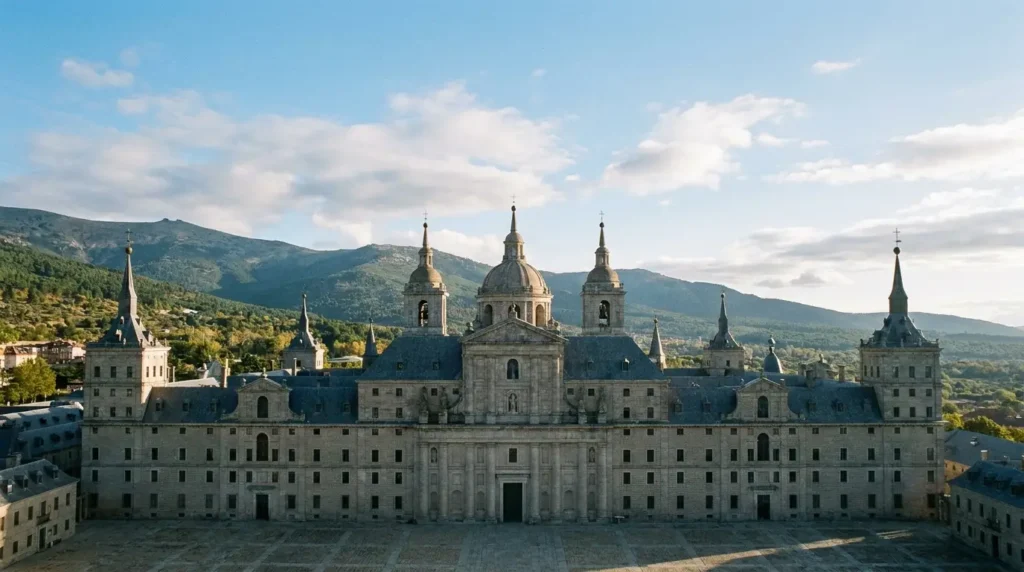
San Lorenzo de El Escorial is one of the most interesting historical excursions from Madrid. It can be reached by Surroundings, By bus, car, or organized tour. In one day, it is possible to visit the Royal Monastery, the basilica, the pantheons, the library, and the town center, although it is advisable to book in advance and dedicate at least two or three hours to the monumental complex.
Located on the southern slope of Mount Abantos, at an altitude of over 1,000 meters, the Royal Monastery of San Lorenzo de El Escorial brings together in a single complex a monastery, a palace, a basilica, a library, a school, and the pantheons linked to the Spanish monarchy. Patrimonio Nacional (National Heritage) presents a visit as a way to explore the history of Spain and, especially, the reign of Philip II. Furthermore, the complex has been a World Heritage Site since 1984.National Heritage)
Its proximity to Madrid also makes it easy to plan a day trip, but it's not advisable to limit your visit solely to the interior of the Monastery. San Lorenzo de El Escorial also boasts a charming historic center, gardens, spaces linked to the court, and nature trails in the surrounding Sierra de Guadarrama mountains.
Are El Escorial and San Lorenzo de El Escorial the same thing?
Not quite.
Similarly, there are two distinct municipalities:
- The Escorial, where the commuter rail station is located.
- San Lorenzo de El Escorial, where the Royal Monastery and most of the tourist route are located.
Furthermore, this difference is important when organizing transportation.
On the other hand, the train arrives at the station called The Escorial, located in the neighboring municipality. From there you have to continue on foot, by city bus or by taxi to San Lorenzo de El Escorial. In particular, the station has a connection with city bus line 1 and a taxi rank.Renfe)
In contrast, intercity buses from Madrid arrive directly at the San Lorenzo de El Escorial bus station, which is closer to the Monastery.Alsa)
Is it possible to visit El Escorial from Madrid in one day?
Yeah.
A day's workday also allows for the inclusion of:
- Transfer from Madrid.
- Visit to the Royal Monastery.
- Basilica.
- Royal pantheons.
- Library.
- Palace of the Habsburgs.
- Friars' Garden.
- A stroll through San Lorenzo de El Escorial.
- Meal.
- Casita del Príncipe or complementary space, if the schedules allow.
- I'm returning to Madrid.
To enjoy the excursion at a leisurely pace, it is advisable to allow between seven and nine hours from the departure point in Madrid.
Furthermore, a half-day stay may be enough to visit the Monastery and take a short walk around the village, but it will not allow for the inclusion of many additional spaces.
How to get from Madrid to El Escorial
In fact, the main options are:
1. Commuter rail.
2. Intercity bus.
3. Car.
4. Organized excursion or private tour.
The choice depends on the starting point, the budget, the number of participants, and the need to adapt the schedule.
From Madrid to El Escorial by commuter train
On the other hand, El Escorial station is currently part of the C-3a line of the Madrid commuter rail network. Renfe recommends checking timetables and any disruptions using its official search engine before traveling.Renfe)
On the other hand, the journey from the center of Madrid usually takes approximately one hour, depending on the origin station, the service and any possible disruptions.
Advantages of the train
- Avoid traffic.
- It allows departure from different stations.
- It is convenient for individual travelers or couples.
- It doesn't require you to look for parking.
- It allows you to organize an independent excursion.
Disadvantages
- The station is not next to the Monastery.
- The journey to San Lorenzo must be completed.
- Schedules may be affected by construction or incidents.
- The total time may be longer than expected when adding local travel.
How to get from the station to the Monastery
Also, from El Escorial station you can continue:
- Walking.
- By city bus.
- By taxi.
Furthermore, the walking distance is manageable for someone accustomed to walking, but it does include an incline. If traveling with children, the elderly, or people with reduced mobility, it may be preferable to use the bus or a taxi.
From Madrid to San Lorenzo de El Escorial by bus
In fact, the intercity lines 661 and 664 connect the Moncloa interchange with San Lorenzo de El Escorial.
Line 661 travels through Galapagar, while line 664 goes through Collado Villalba and Guadarrama. Timetables vary depending on the day and time of year, so they should be checked with Alsa before traveling.Alsa)
Advantages of the bus
- It goes directly to San Lorenzo de El Escorial.
- The station is located near the historic center.
- Avoid traveling from the train station.
- It has several frequencies throughout the day.
- It may be more practical for those staying near Moncloa.
Disadvantages
- The route depends on traffic.
- Some routes make more stops.
- The duration may vary.
- It is necessary to check which line is most convenient according to the time of day.
From Madrid to El Escorial by car
On the other hand, the car offers greater flexibility for:
- Leave at the desired time.
- Visit the Chair of Philip II.
- Combine the Monastery with natural spaces.
- Traveling with children.
- Transport luggage.
- Make stops in other places.
However, it's advisable to check beforehand:
- Parking areas.
- Access restrictions.
- Distance from the parking lot.
- Events or specific outages.
- Availability during weekends.
On the other hand, the center of San Lorenzo can receive a high influx on holidays and tourist seasons.
From Madrid to El Escorial on an organized excursion
An organized tour may also include:
- Round trip transportation.
- Guide.
- Entrance to the Monastery.
- Interior tour.
- Leisure.
- Visit to the village.
- Stop at another destination, such as the Cuelgamuros Valley, depending on the product.
- Collection from a point in Madrid.
Before booking, it's advisable to check:
- How many hours are actually spent in San Lorenzo?.
- If the entrance fee is included.
- Which interior spaces are visited.
- If there is free time.
- Group size.
- Language.
- Turning point.
- Whether the tour is shared or private.
- If combined with another destination.
An excursion that includes too many stops can considerably reduce the effective time inside the Monastery.
What's the best way to get there?
Choose the train if…
- You want to avoid traffic.
- Are you traveling alone or as a couple?.
- You don't mind completing the journey from the station.
- You prefer to organize the visit yourself.
- You can walk or use local transport.
Choose the bus if…
- Sales from Moncloa.
- You prefer to go directly to San Lorenzo.
- You don't want to arrange another transfer.
- You're looking for a simple option without a car.
Choose this car if…
- Are you traveling as a family or group?.
- Do you want to visit the Chair of Philip II?.
- You need flexibility.
- You want to combine heritage and nature.
- You have specific mobility needs.
Choose a private tour if…
- Do you want to leave Madrid with someone?.
- You prefer to avoid organizing transportation and tickets.
- You're looking for a deep historical explanation.
- You need to adjust your pace.
- Are you traveling with children or elderly people?.
- You want to combine several points.
- You have little time.
What to see in San Lorenzo de El Escorial in one day
1. Royal Monastery of San Lorenzo de El Escorial
It's the main visit.
Furthermore, the complex occupies more than 33,000 square meters and was built during the reign of Philip II. Its location, on the slopes of Mount Abantos, is an essential part of the experience.National Heritage)
In fact, the building was not conceived solely as a monastery. It also served religious, palatial, educational, funerary, cultural, and political functions.
Depending on the spaces open that day, the following may be found along the route:
- Palace of the Habsburgs.
- Bourbon Palace.
- Basilica.
- Library.
- Pantheon of Kings.
- Pantheon of Infants.
- Battle Room.
- Sacristy.
- Gallery.
- Chapter rooms.
- Grounds.
Availability may vary due to events, restorations, or conservation needs.
2. Palace of the Habsburgs
On the other hand, the Palace of the Habsburgs allows one to learn about the life of Philip II and the functioning of the complex during the 16th century.
On the other hand, its rooms are more austere than some visitors expect. Furthermore, this austerity helps to understand the image of power, religiosity, and discipline associated with the monarch and the building.
In fact, during the visit it is worth noting:
- Room dimensions.
- Furniture.
- Communication between rooms.
- Relationship with the basilica.
- Exterior views.
- Differences with respect to the Bourbon spaces.
One of the best-known aspects is the proximity of Philip II's apartments to the main altar, although any specific explanation must be integrated within the official tour and open spaces.
3. Basilica
The basilica occupies the symbolic center of the complex.
On the other hand, its position organizes a good part of the building and expresses the importance of religion within Philip II's project.
Furthermore, it is worth noting the following about its interior:
- Dome.
- High altar.
- Altarpiece.
- Sculptures.
- Fresh.
- Royal stands.
- Relationship with pantheons.
- Space layout.
Access may also be restricted by religious services. If a service is being held, tourists must respect the rules of the temple.
4. Pantheon of Kings
In addition, the Pantheon of Kings is one of the best-known spaces.
In fact, numerous monarchs and consorts of the Houses of Austria and Bourbon are buried there.
On the other hand, their visit allows us to explain:
- Dynastic continuity.
- Funeral function of the Monastery.
- Relationship between monarchy and religion.
- Selection of those who could be buried there.
- Organization of burials.
- Symbolism of space.
Furthermore, it should not be treated merely as a list of names. Rather, its significance lies in understanding how the monarchy used the collection to construct dynastic memory.
5. Pantheon of Infants
The Pantheon of Infantes houses burials of members of the royal family who did not ascend to the throne, as well as other relatives linked to the dynasty.
Likewise, its layout and decoration are different from those of the Pantheon of Kings.
Furthermore, the tour allows one to understand that the funerary function of the Monastery went beyond the reigning monarchs.
6. Royal Library
In fact, the library is one of the most outstanding spaces in the complex.
It was conceived as a great center of knowledge and preserves historical collections, manuscripts, printed books and scientific materials.
On the other hand, its main hall stands out for:
- Painted vault.
- Shelving.
- Balloons and spheres.
- Tools.
- Pavement.
- Thematic organization.
- Relationship between religion, science and humanism.
Furthermore, the library helps to dismantle an overly simplistic view of Philip II's reign. The El Escorial project was not solely religious or funerary: it also had a significant intellectual dimension.
7. Battle Room
Likewise, the Battle Hall is decorated with large mural paintings related to military campaigns and victories of the monarchy.
In addition, the space allows us to talk about:
- Propaganda.
- Military memory.
- Representation of power.
- Construction of dynastic stories.
- Relationship between art and history.
In fact, not all the details should be interpreted as a photographic reproduction of the events. Furthermore, they are representations designed to convey a specific vision of power and victory.
8. Sacristy
Furthermore, the Sacristy preserves works and liturgical elements of great value.
One of his main interests is religious painting and the relationship between works of art, ceremonies, and monastic life.
Access may also depend on the available route.
9. Art Gallery and Art Collections
In addition, the Monastery preserves works from different European schools and artists.
In fact, the collection allows us to relate the building to royal collecting, diplomacy, and the circulation of works during the Modern Age.
The selection on display may change, so it is not advisable to guarantee that a specific painting will be visible without checking the official information.
10. Friars' Garden
On the other hand, the Friars' Garden allows you to observe the exterior of the complex from a different perspective.
Furthermore, its geometric layouts and its relationship with the facades help to understand the scale of the building.
It can be a good stop after the indoor visit, especially on nice weather days.
You should check if access is included and which areas are open.
How long does the visit to the Monastery last?
Likewise, a general visit takes approximately two to three hours.
In addition, the duration will depend on:
- Rhythm.
- Influx.
- Use of audio guide.
- Guided tour.
- Open spaces.
- Interest in collections.
- Waiting time.
- Participation of children or older people.
National Heritage establishes that the last entry is before closing time; in the case of the Monastery of San Lorenzo de El Escorial, during free admission periods, access is permitted until one hour and fifteen minutes before closing time.National Heritage)
In fact, it's not advisable to arrive close to the last minute if you want to make a complete visit.
Which ticket should I buy?
On the other hand, the ticket must be purchased on the official website of National Heritage or through authorized channels.
Furthermore, the official website allows you to consult:
- General rate.
- Reduced rate.
- Free access conditions.
- Guided tours.
- Availability.
- Schedules.
- Modalities.
- Group access.National Heritage)
Prices may change, so it's best not to include them in the article without checking them just before publishing.
General Admission
Furthermore, it is suitable for a first visit.
It also allows visitors to explore the spaces included in the itinerary open that day.
Guided tour
Similarly, it can add value if you want to understand:
- Philip II's project.
- Building functions.
- History of the monarchy.
- Architecture.
- Pantheons.
- Library.
- Art collections.
Before booking, please confirm:
- Entry included or not.
- Duration.
- Language.
- Group size.
- Use of headphones.
- Meeting point.
- Cancellation policy.
Audio guide
Additionally, it can work for a standalone visit.
It must be verified:
- Available languages.
- Format.
- Price.
- Need for a telephone.
- Use of headphones.
- Battery.
Is it worth buying the ticket in advance?
Yeah.
Furthermore, advance purchase allows:
- Choose a strip.
- Avoid relying on the box office.
- Organize transportation.
- To better ensure the visit on days of high demand.
- Compare modalities.
- Know the conditions.
Patrimonio Nacional maintains a specific official platform for tickets to the Royal Site of San Lorenzo de El Escorial.National Heritage)
It is also advisable to check for any issues on the same day.
What to see outside the Monastery
1. Historic center of San Lorenzo de El Escorial
Likewise, the town developed in close relation to the Royal Site.
In addition, while walking through its streets you can observe:
- Historic buildings.
- Houses linked to the court.
- Places.
- Shops.
- Restaurants.
- Slopes.
- Views towards the Monastery.
- Cultural spaces.
In fact, the tourist office is currently located at 4 Grimaldi Street, and publishes different opening hours for weekdays and Sundays.San Lorenzo de El Escorial)
Similarly, it may be helpful to go at the start of the day to get a map and check temporary activities.
2. Constitution Square
Furthermore, it is one of the central spaces of San Lorenzo.
Also in its surroundings are administrative buildings, shops and access points to different streets of the historic center.
It serves as a point of reference and a place to rest.
3. House of the Infantes and House of the Queen
Furthermore, these buildings are part of the historical environment related to the court and the organization of the Royal Site.
In fact, its interior visit is not always available, but the exteriors can be incorporated into an urban route.
4. Royal Coliseum of Charles III
On the other hand, the theater is linked to the cultural and courtly development of San Lorenzo.
Their schedule and possible visits should be checked before going.
It may also be of interest to those who want to learn about the Bourbon era and the cultural life after Philip II.
5. Prince's Cottage
The Prince's Little House, also known as the Lower Little House, was built as a recreation pavilion.
It is also located in a garden area near El Escorial and may require additional travel from the Monastery.
Availability, tickets and schedules should be checked with Patrimonio Nacional.
6. Little House of the Infant
Likewise, it is situated in an elevated environment and offers a different perspective of the Monastery and the landscape.
In fact, access may depend on specific schedules and conditions.
It is not advisable to try to visit the two houses and the Monastery in a single day if you have little time.
7. Chair of Philip II
On the other hand, the Chair of Philip II is located in a nearby natural environment and is traditionally associated with the observation of the works of the Monastery.
On the other hand, the popular attribution must be treated with caution: tradition has linked the place with Philip II, but there are different archaeological interpretations about its origin and function.
The area can also be visited by car or on foot, depending on the starting point and physical fitness.
Furthermore, the City Council highlights the variety of natural and heritage routes in the area surrounding San Lorenzo.San Lorenzo de El Escorial)
8. Mount Abantos
In fact, Mount Abantos is an inseparable part of the landscape of the Royal Site.
It can also be incorporated into a multi-day getaway or a nature-focused excursion.
It is not advisable to add a long mountain hike after an extensive visit to the Monastery, unless the group is prepared.
Recommended one-day route
8:30 — Departure from Madrid
Furthermore, the time will depend on the chosen mode of transport.
It is advisable to arrive in San Lorenzo before 10:00.
9:45 — Arrival and orientation
If you arrive by bus, walk towards the centre.
If arriving by train, complete the journey from El Escorial station.
10:15 — Royal Monastery
Interior visit of between two and three hours.
13:00 — Gardens and exterior
Tour of the surroundings and photographs.
13:30 — Lunch
Book between one hour and one and a half hours.
3:00 PM — Historic Center
A stroll through:
- Constitution Square.
- Nearby streets.
- Buildings linked to the Royal Site.
- Exterior of the Colosseum.
- Urban viewpoints.
16:30 — Supplementary space
Choose an option:
- Prince's Cottage.
- Little House of the Infant.
- A walk around the area.
- Tourist office and exhibition.
- Short nature route.
- Leisure.
18:00 — Return to the station or bus
Leave enough margin.
7:00 PM — Return to Madrid
The schedule must be confirmed before the start of the workday.
What to see if you only have half a day
Prioritize:
1. Royal Monastery.
2. Basilica.
3. Library.
4. Pantheons.
5. Outdoor walk.
6. Constitution Square.
Don't try to add the Chair of Philip II, the two little houses and a nature trail.
What to choose if you have a full day
A balanced combination would also be:
1. Monastery.
2. Food.
3. Historic center.
4. A small house or additional space.
5. Outdoor walk.
What to do if you have two days
It may be added:
- Chair of Philip II.
- Mount Abantos.
- Prince's Cottage.
- Little House of the Infant.
- A stroll through El Escorial.
- Nature trail.
- Cultural activity.
- Visit another nearby Royal Site.
Where to eat in San Lorenzo de El Escorial?
In addition, the center has numerous restaurants and cafes.
It can be found:
- Castilian cuisine.
- Barbecues.
- Meats.
- Stews.
- Large white beans.
- Mushrooms, depending on the season.
- Tapas.
- Menus.
- Local bakery.
In fact, the City Council has promoted initiatives related to local products and sweets, such as the San Lorenzo sponge cakes.San Lorenzo de El Escorial)
Specific recommendations should be updated frequently, as prices, schedules and businesses may change.
For a quick meal
Seeks:
- Menu of the day.
- Portions.
- Snacks.
- Cafeterias.
- Restaurants located a few meters away from the main entrance.
For a traditional meal
It is advisable to book, especially:
- Weekends.
- Holidays.
- Peak season.
- Groups.
- Days with events.
El Escorial with children
The tour can work with children, but the indoor visit needs to be adapted.
On the other hand, some topics that may pique their interest are:
- Why is the building so big?.
- How many functions did it have?.
- Where the king lived.
- How monarchs were buried.
- What books does the library have?.
- What do the frescoes represent?.
- How to build with granite.
- What are the differences between a palace, a monastery, and a basilica?.
On the other hand, for young children it may be sufficient:
- Selective visit.
- Exterior tour.
- Grounds.
- Meal.
- Short walk.
It is not advisable to add a long mountain hike after several hours inside the Monastery.
Is the visit accessible?
Likewise, the conditions must be checked beforehand with National Heritage.
Similarly, it may be necessary to consider:
- Uneven terrain.
- Stairs.
- Elevators.
- Long stretches.
- Historic pavement.
- Standing time.
- Access to cemeteries.
- Transportation from the station.
- Distance to complementary spaces.
Before booking, please inform us:
- Use of a wheelchair.
- Difficulty walking.
- Need for breaks.
- Participation of older people.
- Visual or hearing impairment.
- Need for a companion.
In fact, a private visit can allow for better organization of transportation and reduce travel time.
What to bring on the excursion
- Comfortable shoes.
- Water.
- Clothing adapted to a cooler area than the center of Madrid.
- A light coat, even on certain summer days.
- Sun protection.
- Tickets downloaded.
- Banknotes.
- Battery for the phone.
- Headphones if using a digital audio guide.
- Umbrella or raincoat depending on the forecast.
San Lorenzo is at a higher altitude than Madrid and the weather can be different.
Common mistakes when visiting El Escorial
Confusing the station with the Monastery
The train arrives at El Escorial, not at the door of the Royal Monastery.
Do not check the last section
In addition, you need to plan how to get from the station to San Lorenzo.
Arriving too late
The Monastery requires at least two hours, and the last entry is before closing time.National Heritage)
Do not buy tickets in advance
It can also limit options on days with high demand.
Trying to visit too many places
Monastery, cottages, Philip II's Chair and town can be too much for a single day.
Reduce visits to cemeteries
The library, the architecture, the palace, and the collections are equally important.
Not checking open spaces
The rooms may change due to conservation, events or restorations.
To think that everything belongs to Philip II
Furthermore, the complex was transformed and used by different generations and dynasties.
Don't set aside time for the town
San Lorenzo deserves at least a stroll after the visit.
Underestimating the climate
In fact, altitude can cause lower temperatures or rapid changes.
Is it worth visiting El Escorial with a guide?
Yes, especially because the complex brings together many functions and historical periods.
Without context, the visitor can walk through halls, pantheons, and corridors without understanding how they relate to one another.
A guide can explain:
- Why did Philip II choose this place?.
- What functions did the building serve?.
- How the monastery was organized.
- What role did the basilica play?.
- How the palaces worked.
- Why the library was essential.
- How dynastic memory was constructed.
- What changes did the Bourbons introduce?.
- Which elements are religious, political, or cultural?.
- Which stories belong to tradition?.
Shared visit
It may also be suitable if:
- Are you traveling alone or as a couple?.
- You're looking for a general introduction.
- You adapt to a schedule.
- You don't need to modify the route.
Private tour
Similarly, it can add more value if:
- You are traveling as a family.
- You are part of a group.
- Do you want to leave Madrid with someone?.
- You have a specific interest in Philip II.
- You need to adjust your pace.
- You want to combine a village and a monastery.
- There are mobility needs.
- Do you wish to visit complementary spaces?.
- You have little time.
From Madrid to El Escorial with 4U Madrid
The Royal Monastery can be visited independently, but a well-organized tour helps to understand why Philip II brought together in one place a royal residence, a basilica, a monastery, a library and a dynastic pantheon.
Furthermore, at 4U Madrid we can progressively incorporate private excursions from Madrid adapted to the size, interests and pace of each group.
The experience could also include:
- Departure or coordination of transport from Madrid.
- Historical introduction.
- Visit to the Royal Monastery.
- Tour of San Lorenzo.
- Time for lunch.
- Small house or additional space.
- Adaptation for families.
- I'm returning to Madrid.
Frequently Asked Questions about El Escorial
How to get there and how long the visit lasts
Furthermore, the commuter train journey usually takes around an hour, depending on the departure station and the service. Then you must add the journey from El Escorial station to San Lorenzo. In particular, buses from Moncloa go directly to San Lorenzo, but their duration depends on traffic.Renfe)
The train avoids traffic, but it goes to the town of El Escorial and requires completing the journey. Furthermore, the bus departs from Moncloa and goes directly to San Lorenzo. Therefore, the best option depends on the accommodation and the group's mobility.
A general visit typically takes between two and three hours. If you include the village, a cottage, gardens, or a meal, it's best to reserve the entire day.
It is recommended, especially during weekends, holidays and peak season. In fact, official tickets can be purchased on the National Heritage website.National Heritage)
What to see inside and in the surrounding area
The priority spaces are the Palace of the Habsburgs, the basilica, the library, the pantheons and the Hall of Battles, provided they are part of the tour open that day.
Yes. Specifically, the Royal Site has been part of the World Heritage List since 1984.National Heritage)
Patrimonio Nacional (National Heritage) considers periods and cases of free admission subject to conditions, accreditation, and availability. Free admission usually applies to self-guided visits, while certain guided services may require an additional charge.National Heritage)
