
Antonio Mingote made Madrid one of the great settings for his work. For almost six decades, he observed its streets, its transport, its customs, and its inhabitants from the pages of ABC. Today, his influence can be found on Calle de la Sal, the Retiro and Rubén Darío train stations, Retiro Park, and the plaques of century-old businesses.
Mingote was not born in Madrid.
Born in Sitges in 1919, he spent part of his childhood and youth in Aragon and arrived in the capital while still young. However, Madrid ended up becoming his place of work, residence, observation, and creation.
Moreover, the city was not merely the background of his cartoons. It was one of his main themes.
His drawings feature:
- The Subway.
- The cafes.
- The parks.
- The buildings.
- The cars.
- The couples.
- The officials.
- Tourists.
- Social changes.
- Traffic problems.
- Fashions.
- The neighbors.
- The contradictions of urban life.
Furthermore, the City Council went so far as to define Madrid as an artistic and literary genre within his work and recalled that the city served as the setting for a considerable part of the more than 100,000 drawings he made.
Furthermore, it is currently possible to follow part of that relationship through a route that combines original works moved to the public space, reproductions, monuments and places linked to his professional life.
Who was Antonio Mingote?
Antonio Mingote Barrachina was a cartoonist, graphic humorist, writer, academic, and observer of Spanish society.
He was born in Sitges on January 17, 1919 and died in Madrid on April 3, 2012.
Her professional career was especially linked to the newspaper *ABC*, where she published for more than half a century. Furthermore, Royal Spanish Academy It is noted that he was a regular contributor to the newspaper, directed the magazine *Don José* and created the Mingote Prize.
He also developed works such as:
- Writer.
- Novelist.
- Playwright.
- Illustrator.
- Poster designer.
- Scenographer.
- Screenwriter.
- Mural creator.
- Academic.
Furthermore, in 1987 he was admitted to the Royal Spanish Academy and occupied seat "r". In particular, in 2011 he received the title of Marquis of Daroca.
Although he is primarily known for his cartoons, his output was much broader.
Mingote illustrated books, designed decorations, intervened in public spaces, and created a unique way of telling stories through drawing and irony.
Why is Mingote so closely associated with Madrid?
Mingote found in Madrid an enormous catalog of characters and situations.
Likewise, the city was changing rapidly:
- Traffic was increasing.
- The subway was being expanded.
- New neighborhoods were appearing.
- Fashions were changing.
- Social relations were being transformed.
- New technologies were arriving.
- Businesses were disappearing.
- The streets were being modified.
- The language changed.
- The contradictions between tradition and modernity were multiplying.
Furthermore, all of that became material for his drawings.
In fact, he didn't need to depict a famous monument to talk about Madrid. A bus shelter, a couple arguing, a traffic jam, or a traveler waiting on the platform was enough.
On the other hand, his humor didn't just consist of telling a joke.
He also observed:
- Vanity.
- Bureaucracy.
- Loneliness.
- Inequality.
- The passage of time.
- Lack of communication.
- Couple relationships.
- Political transformations.
- The loss of customs.
- The absurdity of everyday life.
That's why his drawings remain recognizable even when the clothes, cars, or buildings belong to another era.
Antonio Mingote's route through Madrid
On the other hand, the route can be divided into two parts.
Part One: Historic Center
1. Salt Street.
2. Plaza Mayor.
3. Centenary businesses.
4. Possible references in nearby streets.
Part Two: Metro and Retiro
1. Rubén Darío Station.
2. Retiro Station.
3. Monument to Mingote in the park.
4. Music Pavilion and surroundings represented in its murals.
Furthermore, it is not a completely linear route. To connect the city center, Rubén Darío, and Retiro, it is practical to use the Metro.
1. Calle de la Sal: Mingote's balconies
In addition, Calle de la Sal is a small street located next to the Plaza Mayor.
Although many people walk through it to head towards Sol, it's worth stopping and looking up.
In fact, on one of its buildings you can see reproductions of characters drawn by Antonio Mingote, placed on the balconies as if they were observing the street.
On the other hand, the ensemble includes figures that recall different eras of Madrid and transforms an ordinary facade into a small urban scene.
Furthermore, the City Council installed a tribute there in 1993 and decorated the upper part of the balconies with reproductions of the cartoonist's paintings.
What to observe
- The variety of characters.
- Clothing from different eras.
- The way they seem to peek out.
- The relationship between the drawings and the royal balconies.
- The contrast with the shops on the street.
- The proximity to the Plaza Mayor.
The intervention works especially well because it is not isolated in a museum room.
Likewise, the characters visually participate in street life, just as many of Mingote's figures observed the transformations of Madrid from his cartoons.
How to locate it
In addition, Calle de la Sal connects the area around Plaza Mayor with Calle de Postas.
In fact, the facade can go unnoticed if you walk around looking only at the shop windows.
It is also worth walking down the street in both directions and observing the upper floors.
2. Plaza Mayor: historic Madrid seen with humor
On the other hand, the Plaza Mayor does not preserve a large permanent work by Mingote comparable to the Metro stations, but it is a logical stop within the route.
It is also located next to Calle de la Sal and represents many of the themes that appeared in his works:
- History of Madrid.
- Popular people.
- Shops.
- Urban transformations.
- Tourists.
- Ceremonies.
- Traditions.
- Contrast between past and present.
Mingote illustrated the history of Madrid from a very different perspective than that of academic textbooks.
In addition, the municipal exhibition *Madrid is written with M for Mingote* brought together drawings with which he narrated political, urban, literary and social events of the city.
In fact, his illustrations were not limited to reproducing buildings. They showed how the people who built, inhabited, or transformed them might behave.
What does Mingote contribute to the history of Madrid?
On the other hand, his perspective allows us to recount the past through:
- Anachronisms.
- Imaginary conversations.
- Supporting characters.
- Human errors.
- Domestic scenes.
- Irony.
- Contrasts between eras.
Instead of presenting history as a solemn succession of kings and battles, Mingote included those who do not normally star in the great stories.
3. The plaques of century-old businesses
One of Mingote's legacies most widespread in Madrid can be found at ground level.
Since 2006, the City Council has recognized establishments over one hundred years old by placing a plaque on the public road in front of the business.
Furthermore, the design of that plaque was done by Antonio Mingote.
Therefore, when walking through the historic center, you might find your work in front of:
- Restaurants.
- Taverns.
- Pharmacies.
- Pastry shops.
- Bookstores.
- Hat shops.
- Traditional shops.
- Family-run stores.
How to recognize them
In addition, the plaques are integrated into the pavement and display an illustrated design that identifies the establishment as a century-old business.
Furthermore, many people step on them or walk past them without knowing who made them.
This makes Mingote a discreet but recurring presence within the urban landscape.
Why they fit with his work
In fact, the century-old shops represent a part of the Madrid that Mingote observed for decades:
- Family businesses.
- Trades.
- Shop windows.
- Dependents.
- Customers.
- Changes in consumption.
- Resistance to modernization.
- Customs that survive.
On the other hand, its design links the institutional tribute with a form of illustration accessible to anyone walking through the city.
Where to find them
In addition, there are plaques distributed throughout different neighborhoods, but the historic center has numerous examples.
They can also be found around:
- Main Square.
- Puerta del Sol.
- Main street.
- Literary Quarter.
- Malasaña.
- Chueca.
- La Latina.
- Footbath.
Furthermore, a complete route could combine Mingote's footprints with several traditional establishments.
4. The commemorative plaque of Mingote
Madrid also remembers the cartoonist through a municipal plaque installed as part of the Memory of Madrid program.
The tribute identifies him in a particularly simple way: as a "draftsman", the profession that appeared on his identity document, as his wife recalled during the inauguration.
In fact, this detail sums up his relationship with the profession well.
Despite having been an academic, writer, marquis and recipient of numerous awards, Mingote continued to define himself primarily through drawing.
On the other hand, the plaque should not be confused with the decorated balconies on Calle de la Sal or with the monument in El Retiro Park. They are also different tributes.
5. Rubén Darío Station: Mingote and the Madrid Metro
The Rubén Darío station, corresponding to line 5, is one of the essential stops on the route.
Likewise, in 2019 it was themed with reproductions of cartoons that Mingote had dedicated to Madrid Metro throughout his career.
Furthermore, the intervention coincided with two centenaries:
- The centenary of the birth of Antonio Mingote.
- The centenary of the Madrid Metro.
Mingote and the Madrid subway were born in 1919.
What can be seen
In fact, enlarged vignettes depicting the following appear on the platforms and in the station's spaces:
- Travelers.
- Wagons.
- Platforms.
- Passenger relations.
- Everyday situations.
- Technological changes.
- Urban behaviors.
On the other hand, the illustrations come from the Antonio Mingote Foundation and from the funds linked to the former ABC Museum.
Metro de Madrid explains that the station was also chosen for its proximity to the former headquarters of *ABC* on Serrano Street, where Mingote developed a good part of his professional career.
Why the Subway was a perfect subject for Mingote
On the other hand, the Metro brings together in a confined space people who would not normally meet.
They all happen to be in the same train car:
- Workers.
- Students.
- Tourists.
- Older people.
- Families.
- Readers.
- Tired people.
- Travelers in a hurry.
Furthermore, that group offered ideal situations for his humor.
Mingote could observe:
- Who occupies the seat.
- Who avoids looking.
- Who arrives late.
- Who gets lost.
- Who invades the space?.
- How technology changes.
- How strangers behave when forced to share a journey.
Rubén Darío's cartoons show that public transport can also become a social chronicle.
Do we have to leave the station?
In addition, the illustrations are located within the Metro space.
Therefore, you need a valid transport ticket to access the platforms and then continue towards Retiro.
6. Retiro Station: the murals of the underground park
The Retiro station, on line 2, preserves one of Mingote's most important public works in Madrid.
In fact, in 1997 three tile murals were inaugurated in which the artist recreated scenes linked to the park.
On the other hand, the works represent different spaces and activities of the Retiro and turn the station into an underground extension of the historic garden.
What appears in the murals
Furthermore, among the recognizable elements are:
- The pond.
- The Music Pavilion.
- Strollers.
- Trees.
- Everyday scenes.
- Characters typical of Mingote.
- Activities related to the park.
Madrid Metro identifies these compositions as recreations of typical corners and scenes of the Retiro Park.
Two or three murals?
Some Metro information pages mention two large murals visible in certain areas, while the institutional note from 2019 recalls that the set inaugurated in 1997 consisted of three tile murals.
To avoid confusion, it is more accurate to speak of Mingote mural set in Retiro station, originally formed by three ceramic scenes.
Likewise, the specific visibility may depend on the platform, the access used, and the current organization of the station.
What makes them special
Furthermore, the murals do not present the Retiro Park as an exact photograph.
Mingote turns it into an inhabited stage.
In fact, the main characters are not only:
- The pond.
- The monuments.
- The gardens.
This also applies to people who are walking, resting, talking, or observing each other.
Furthermore, this way of representing the park coincides with the personal relationship he had with it.
7. The Retiro Park: Mingote's territory
Furthermore, the Retiro Park was one of the most important places in Antonio Mingote's life in Madrid.
He lived nearby and regularly strolled through the park.
The City Council recalled that he walked its paths almost every day and that he was even interested in the condition of its trees.
Furthermore, their connection became a symbolic title.
Furthermore, Mayor Enrique Tierno Galván appointed him honorary mayor of El Retiro.
According to the municipal speech given during the inauguration of his monument, Mingote had remarked that his political aspiration was to be mayor of something that didn't exist: El Retiro Park. Tierno Galván responded by granting him an honorary mayoral staff.
What did it mean to be an honorary mayor?
In fact, it was not an actual administrative or political position.
Furthermore, it was an affectionate and humorous tribute to:
- His relationship with the park.
- His walks.
- His concern for the trees.
- His drawings.
- Their daily presence.
- The city's affection.
Moreover, the title fit perfectly with his understanding of humor: an imaginary institution for someone who knew the park as if he had to govern it.
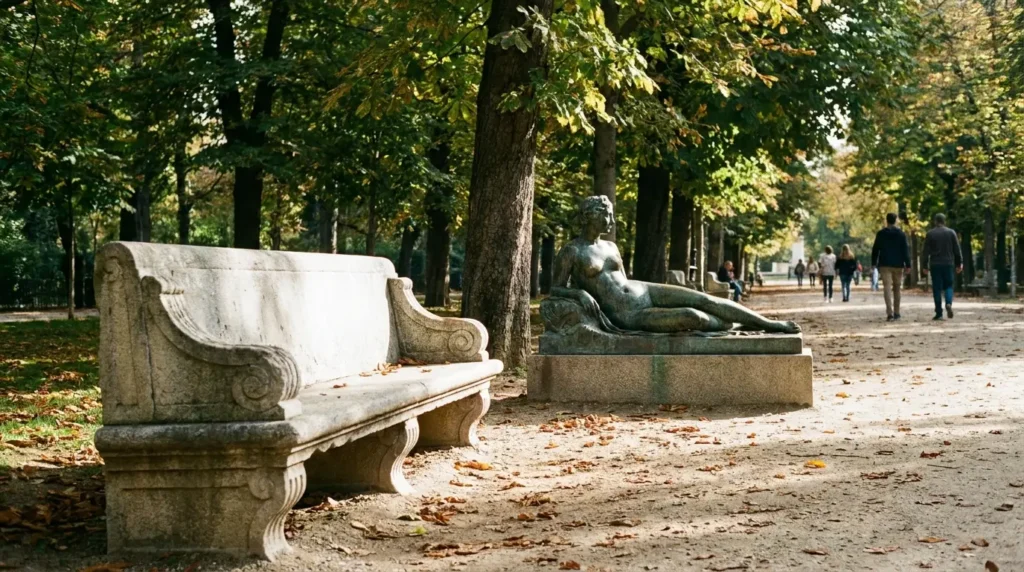
8. Monument to Mingote in the Retiro Park
After his death, Madrid installed a sculpture dedicated to the cartoonist inside the park.
The work, created by Alicia Huertas, is located near the Music Pavilion.
The sculpture also represents Mingote and commemorates his status as honorary mayor of El Retiro.
It was conceived as a tribute integrated into the environment he frequented.
What to observe
- The character's posture.
- The expression.
- Elements related to drawing.
- The location next to the roads.
- The proximity to the Music Pavilion.
- The relationship with the station's murals.
Furthermore, it is neither an equestrian statue nor a large, solemn monument.
In fact, its scale and location make Mingote seem to continue being part of the daily life of the park.
Who was Alicia Huertas?
On the other hand, the Madrid-based sculptor Alicia Huertas won the competition held to create the monument.
Furthermore, the Retiro Environmental Education Center highlights that she was the first female sculptor represented within this collection of public art in the park.
The work thus allows us to talk about both the person being honored and the presence of women within Madrid's public sculpture.
9. The Bandstand
Likewise, the Music Pavilion appears represented within Mingote's graphic universe associated with the Retiro Park.
It also serves as a reference point for locating his monument.
In addition, the area allows for comparison:
- Real space.
- The drawn version.
- The imagined characters.
- The current use of the park.
- The permanence of certain elements.
This comparison is one of the most interesting parts of the route.
First, you observe the murals in the station. Then you go out to the park and locate the scenes that Mingote transformed through his drawings.
10. ABC's former professional environment
In fact, the Rubén Darío station was chosen because of its proximity to the former headquarters of *ABC* on Serrano Street.
Mingote began publishing regularly in the newspaper in 1953 and continued to do so until his death in 2012.
Their collaboration lasted for almost six decades.
Why was it so important?
On the other hand, daily or frequent publication allowed him to build a continuous chronicle of Spanish society.
Through his cartoons he recorded:
- Political changes.
- Economic crises.
- Traditions.
- Evolution of language.
- Family transformations.
- Technological advances.
- New trends.
- Urban problems.
- International relations.
- Collective contradictions.
Moreover, he didn't just draw the news of the day.
He also frequently used that news to talk about behaviors that were repeated over and over again.
Is it possible to visit the old newsroom?
Furthermore, it is not part of a permanent museum dedicated to Mingote.
It should be considered a point of historical context within the route, not a guaranteed interior visit.
In fact, the main stop is still the Rubén Darío station, where his cartoons can be seen in a public space.
Other tributes to Mingote in Madrid
Antonio Mingote Municipal Senior Center
On the other hand, the Chamberí district has a municipal senior center that bears its name, located at 47 Vallehermoso Street.
Furthermore, the cartoonist's family donated books and reproductions of illustrations to decorate his spaces.
The City Council also reported the delivery of 57 books and the installation of more than 80 reproductions belonging to its series on *Don Quixote* and the history of Madrid.
Furthermore, it should not be confused with a museum open to tourists on a permanent basis. It is also a municipal facility intended for senior citizens.
Antonio Mingote Public Library
There is also a public library named after him in the Latina district.
On the other hand, the space functions as a general library and not as a monographic center on his work.
Street dedicated to Mingote
After his death, the City Council promoted the naming of a street in Madrid after him in recognition of his career and his relationship with the capital.
The name must be verified in the municipal street directory before incorporating it into a physical route, since the names, boundaries and access points can be consulted through the City Council's Geoportal.
Temporary exhibitions
Madrid has organized several exhibitions dedicated to Mingote.
Among them:
- *A Brief History of the People*.
- *Madrid is spelled with an M for Mingote*.
- Samples of his cartoons.
- Tributes for the centenary of his birth.
- Activities related to *Don Quixote*.
- Exhibitions at the History Museum and the former ABC Museum.
Furthermore, these exhibitions are not permanent.
Before including any in an itinerary, the current schedule should be checked.
How did Mingote represent the people of Madrid?
Mingote did not create a single type of Madrileño.
Likewise, their characters could be:
- Elegant.
- Clueless.
- Loners.
- Conceited.
- Tired.
- In love.
- Grumpy.
- Resigned.
- Modern.
- Outdated.
- Poor people.
- Powerful.
Furthermore, the city appeared as a space where different eras and social classes coexisted.
The couples
In fact, romantic relationships were one of his regular topics.
Through them he observed:
- Lack of communication.
- Expectations.
- Boredom.
- Jealousy.
- Changes in social roles.
- The distance between romanticism and everyday life.
The powerful
Politicians, officials, businessmen, and figures of authority frequently appeared subjected to irony.
Mingote showed the distance between:
- What they were saying.
- What they were doing.
- What they believed they represented.
- What the citizens perceived.
Ordinary people
His drawings also paid attention to people who rarely occupied the center of the historical narrative.
On the other hand, the RAE has highlighted this perspective on those who remain outside the grand narratives and on the everyday characters who observe the world with perplexity.
Mingote as a graphic historian of Madrid
Mingote was not an academic historian in the traditional sense.
However, he used drawing to tell the story of Madrid's evolution from Prehistory to the Modern Age and the contemporary era.
His vision combined:
- Historical data.
- Imagination.
- Humor.
- Anachronisms.
- Social criticism.
- Invented characters.
On the other hand, the municipal exhibition dedicated to the history of Madrid displayed 125 original illustrations that explained the process of the city's formation.
Are his drawings historical sources?
Likewise, his illustrations should not be used as literal documents of each event.
Furthermore, they do not necessarily show:
- Exact attire.
- Documented scenes.
- Real conversations.
- Archaeological perspectives.
In fact, its value lies in the interpretation.
Mingote helped to understand history by turning it into a human situation.
Mingote's summarized route in Madrid
Short option: city center and Retiro
1. Salt Street.
2. Plaza Mayor.
3. Plaques of century-old businesses.
4. Subway to Retiro.
5. Station murals.
6. Monument within the park.
7. Music Pavilion.
Approximate duration: between two and a half and three hours.
Full option
1. Salt Street.
2. Plaza Mayor.
3. Centenary businesses.
4. Metro to Rubén Darío.
5. Station Vignettes.
6. Reference to the former headquarters of *ABC*.
7. Subway to Retiro.
8. Ceramic murals.
9. Monument to Mingote.
10. Bandstand.
11. Walk in the park.
Approximate duration: between four and five hours, including travel and breaks.
How to organize the route
Best time
On the other hand, the exterior works better:
- In the morning.
- Early afternoon.
- With enough light to observe the facades.
- On a day without heavy rain.
On the other hand, Metro stations can be visited during normal service hours.
What do you need
- Ticket.
- Comfortable shoes.
- Phone with map.
- Time to enter and exit the Metro.
- Battery.
- Camera, if you wish to photograph the permitted areas.
Accessibility
The route can be adapted, but the following must be checked:
- Operational elevators.
- Station entrances.
- Distances within the Retiro Park.
- Road conditions.
- Possible park closures.
- Need to stand.
Likewise, Calle de la Sal and Plaza Mayor feature historic paving and busy areas.
Is there an entrance fee?
In addition, the exterior works and the Retiro monument can be viewed free of charge.
In fact, to see the murals and cartoons inside the stations, it is necessary to access the Metro with a valid ticket.
On the other hand, temporary exhibitions may have their own rates or reservation systems.
Common mistakes when creating the route
To think that there is only one Mingote museum
Furthermore, there is currently no permanent museum in Madrid that brings together all of his work.
His legacy is also divided among:
- Urban space.
- Metro.
- Sights.
- Collections.
- Files.
- Temporary exhibitions.
- Institutions.
Find his drawings only in galleries
Some of his most accessible work is found in stations, facades, and sidewalks.
Walk down Calle de la Sal without looking up
In addition, the characters are on the balconies.
Walking on the plates without observing them
The design of the century-old shops is also the work of Mingote.
To confuse direct work and homage
In fact, different elements appear on the route:
- Designs created by Mingote.
- Reproductions of his cartoons.
- Murals made from his drawings.
- Monuments dedicated to him.
- Spaces that bear his name.
On the other hand, not everything was installed during his lifetime or drawn directly onto the current support.
Guarantee temporary exhibitions
The schedule changes and should be checked before the visit.
Is it worth taking a guided tour about Mingote?
Yes, especially for those who want to understand the relationship between graphic humor, urban history, and everyday life.
On the other hand, a visit can explain:
- Who was Mingote?.
- How he observed Madrid.
- What relationship did he have with *ABC*?.
- How the Subway was represented.
- Why was it linked to the Retiro?.
- What elements remain visible.
- Which works are original and which are reproductions.
- How he used humor to tell the story.
- What changed in Madrid during his career.
The route can also be combined with other themes:
- Centenary businesses.
- History of the Plaza Mayor.
- Art in the Subway.
- Spanish Illustration.
- The Retreat.
- Graphic humor.
- Urban transformations of the 20th century.
Discover Mingote's Madrid with 4U Madrid
Antonio Mingote did not limit himself to drawing Madrid.
He observed it for decades, recorded its changes, and turned its inhabitants into protagonists of an extensive graphic chronicle.
Likewise, his characters continue to appear on a facade next to the Plaza Mayor, traveling on the Metro and strolling through the Retiro Park.
Furthermore, at 4U Madrid we can incorporate these footprints into a private route dedicated to drawing, humor and the transformation of the city.
In fact, the tour may include:
- Salt Street.
- Main Square.
- Centenary businesses.
- Rubén Darío Station.
- Retiro Station.
- Park monument.
- History of graphic humor.
- Former relationship with *ABC*.
- 20th century urban context.
Frequently Asked Questions about Antonio Mingote
Who was Mingote and what did he leave behind in Madrid?
In addition, reproductions can be seen on Calle de la Sal, vignettes in the Rubén Darío station, ceramic murals in the Retiro station and designs on the plaques of century-old businesses.
It is located in Retiro Park, near the bandstand. The sculpture was created by Alicia Huertas.
It was an honorary title bestowed by Enrique Tierno Galván due to his close connection with the park. Mingote frequented it and had jokingly expressed his desire to be its mayor.
The station is also decorated with cartoons dedicated to the Madrid Metro. The project was inaugurated in 2019, coinciding with the centenary of Mingote's birth and the centenary of the Metro itself.
Where to see his work around the city
It preserves a set of ceramic murals inaugurated in 1997 in which Mingote recreated scenes and places characteristic of the park.
Furthermore, there is currently no permanent museum in Madrid dedicated exclusively to his entire body of work. Therefore, his works are distributed among public spaces, collections, archives, and temporary exhibitions.
No. He was born in Sitges in 1919, but developed most of his professional career in Madrid and died in the city in 2012.
He published in *ABC* from 1953 until his death in 2012. The collaboration lasted for almost six decades.
