
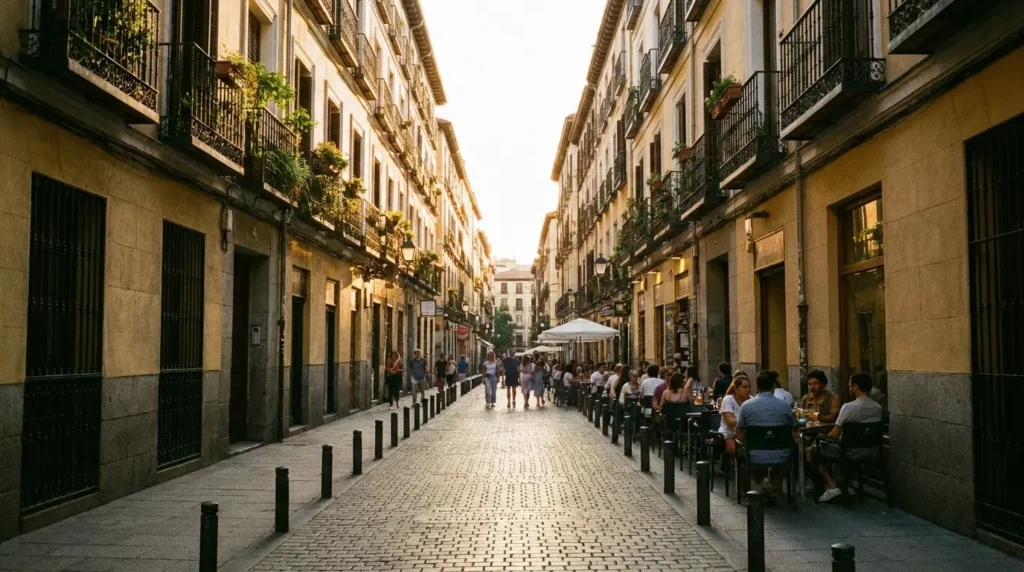
This route through the Literary Quarter takes you to the places most closely linked to Madrid's literary history. Authors such as Miguel de Cervantes, Lope de Vega, Francisco de Quevedo, and Luis de Góngora lived or wrote part of their work in its streets. It can be explored on foot in about two hours, from Plaza de Santa Ana to Paseo del Prado.
Furthermore, this route through the Literary Quarter is detailed and goes stop by stop. In fact, if you're looking for an overview of the neighborhood, its history, and its cafes, you'll find it in our guide. Guide to the Literary Quarter.
Located between Sol, Atocha Street and the Paseo del Prado, the Literary Quarter allows you to discover a part of Madrid where literature is not only preserved within books.
The names of its streets, the verses engraved on the pavement, the houses of writers, the theaters and the churches recall the period in which some of the main authors of the Golden Age lived practically next door to each other.
Furthermore, the route through the Literary Quarter that we propose begins in Plaza de Santa Ana and ends at Paseo del Prado. It is a short, entirely urban route and easy to combine with the Prado Museum, the Retiro Park or the historic center.
Where does the route through the Literary Quarter begin and end?
In fact, the Literary Quarter is located in the Centro district, between the Sol-Gran Vía areas and the Paseo del Prado.
On the other hand, its tourist boundaries are usually located between:
- The Street of the Cross.
- The San Jerónimo Race.
- The Prado promenade.
- Atocha Street.
It is not an independent administrative district, but a historical and cultural designation used to identify the area where numerous writers lived and worked during the 16th and 17th centuries. Madrid Tourism places the area precisely between Calle de la Cruz, Carrera de San Jerónimo, Paseo del Prado, and Calle de Atocha.EsMadrid)
It is also traditionally known as the Literary Quarter, the Muses' Quarter, or the Parnassus Quarter. In particular, the Madrid City Council describes it as the place where great writers lived, where works by authors such as Tirso de Molina and Calderón de la Barca were performed, and where part of the cultural life related to the Golden Age developed.Madrid City Council)
Why is it called the Literary Quarter?
Likewise, the name comes from the concentration of writers, playwrights, actors, printing presses and corrales de comedias that existed in this part of Madrid.
Furthermore, during the Spanish Golden Age, authors such as the following lived in or frequented the area:
- Miguel de Cervantes.
- Lope de Vega.
- Francisco de Quevedo.
- Luis de Góngora.
- Tirso de Molina.
- Calderón de la Barca.
Madrid was then the seat of the court and one of the main political and cultural centers of the monarchy. In fact, the theater achieved enormous popularity, and plays were performed before very diverse audiences.
These streets were home to writers admired by their contemporaries, but also to literary rivals who criticized each other through poems, satires, and personal comments.
On the other hand, the proximity of their homes helps us understand that the Golden Age was not merely a later literary category. It was also a cultural scene comprised of authors who knew each other, competed, worked for theaters, and depended on the favor of patrons and readers.
How long does the route through the Literary Quarter take?
On the other hand, an outdoor route through the main places of the Literary Quarter can be done in approximately two hours.
Likewise, the duration will depend on the number of visits you wish to include:
- Quick route: between 60 and 90 minutes.
- Exterior historical tour: about 2 hours.
- Route with a visit to the Lope de Vega House Museum: between 2 and a half hours and 3 hours.
- Tour with lunch or visit to the Ateneo: noon.
- Combined route with the Prado Museum: practically a whole day.
The distances are short, but it's best to walk slowly to observe the verses, the facades, and the side streets.
The route through the Literary Quarter, step by step
1. Santa Ana Square
Santa Ana Square is a good starting point because it contains several references related to theater and literature.
In addition, the following can be seen in the square:
- The Spanish Theatre.
- The statue of Federico García Lorca.
- The statue of Calderón de la Barca.
- The building of the former Hotel Victoria.
- The terraces occupy a large part of the space.
In fact, the square was created after the demolition of the old Santa Ana convent at the beginning of the 19th century, so its current configuration is later than the time of Cervantes and Lope de Vega.
However, the surrounding area was closely linked to theatrical activity. Nearby was the Corral del Príncipe, the precursor to the current Teatro Español.
What to observe closely
On the other hand, the two sculptures in the square represent very different stages of Spanish literature:
- Calderón de la Barca belongs to the Golden Age.
- Federico García Lorca represents the literature and theater of the 20th century.
Furthermore, this coexistence summarizes one of the characteristics of the neighborhood: it not only preserves the memory of a period, but a cultural tradition that continued to develop for centuries.
2. Spanish Theatre
Likewise, the Teatro Español occupies the site of the former Corral del Príncipe, one of the main theater spaces of Golden Age Madrid.
Furthermore, the corrales de comedias were interior courtyards adapted for the performance of plays. The audience was distributed in different areas according to their social standing and economic means.
In fact, texts by authors such as Lope de Vega, Tirso de Molina and Calderón de la Barca were performed in these spaces.
On the other hand, the current building has undergone numerous renovations, so it shouldn't be imagined as a 17th-century courtyard preserved unchanged. Its importance also lies in the continued use of theatrical functions.
Before publishing schedules, interior tours or programming, it is advisable to check the theater's official listings and information.
3. Prince Street
Also, from Santa Ana Square you can briefly walk along Príncipe Street.
Likewise, this street connects the neighborhood with the Carrera de San Jerónimo and allows you to get closer to one of the main cultural centers of contemporary Madrid: the Ateneo.
In fact, the following coexisted in the area during different periods:
- Theaters.
- Cafes.
- Printing presses.
- Bookstores.
- Editorials.
- Spaces for debate.
- Cultural associations.
On the other hand, the neighborhood's literary activity did not end with the Golden Age. In fact, during the 19th and 20th centuries, it continued to be a place associated with writers, journalists, politicians, and artists.
4. Ateneo of Madrid
The Scientific, Literary and Artistic Athenaeum of Madrid is located on Prado Street.
Likewise, the institution's origins date back to 1820 with the purpose of disseminating knowledge and educating the public. Similarly, the Ateneo de Madrid was established in 1835 and became one of Spain's main spaces for intellectual, scientific, political, and artistic debate.Ateneo Madrid)
Its halls have hosted writers, scientists, presidents, artists and thinkers of different persuasions.
Although it belongs to a later period than the Golden Age, its inclusion in the route shows the cultural continuity of the neighborhood.
What to check before entering
The Ateneo organizes activities, exhibitions and visits, but access to certain spaces may depend on the schedule.
Before including an interior visit, the following must be verified:
- Schedules.
- Visit options.
- Reservation required.
- Available exhibitions.
- Access to the library or the auditorium.
5. Calle de las Huertas
In fact, Calle de las Huertas is one of the main thoroughfares of the neighborhood.
Furthermore, its paving incorporates fragments of works by Spanish-language writers. Moreover, the texts transform the ground itself into a small literary trail.
Madrid Tourism specifically highlights the verses engraved on the cobblestones of the street and their connection with the Plaza de Santa Ana and the Paseo del Prado.EsMadrid)
The street name is a reminder of the orchards that once existed in the area, before urban growth transformed the surroundings.
How to get around it
Likewise, it's not advisable to walk around looking only at the facades. Part of the experience involves reading the quotes on the pavement and identifying their authors.
Also worth noting:
- The balconies.
- The shops.
- The streets that lead down towards the Paseo del Prado.
- The differences between the buildings.
- The coexistence of homes, bars, bookstores and cultural spaces.
Furthermore, it can have a much livelier atmosphere at night and on weekends than in the morning. Madrid Tourism currently presents it as one of the most active leisure areas in the city center.EsMadrid)
6. Lion Street
In fact, León Street runs through a central part of the Literary Quarter and connects several points related to writers and cultural institutions.
On the other hand, Miguel de Cervantes lived in this area during his final years. The exact house no longer exists, but a plaque marks the spot where the house in which he died once stood.
This point should not be confused with the Cervantes House Museum in Alcalá de Henares, traditionally linked to his birth.
Cervantes in Madrid
Miguel de Cervantes spent different stages of his life in Madrid and resided in several homes in the neighborhood.
He died in 1616 and was buried in the nearby convent of the Barefoot Trinitarians.
Furthermore, the location of his remains has been the subject of investigations and debates, so it is important to explain the matter precisely and avoid exaggerated claims.
7. Lope de Vega House Museum
Likewise, the Lope de Vega House Museum It is located on Cervantes Street.
Furthermore, the writer acquired the house in 1610 and resided there until his death in 1635. The house allows one to get closer to the daily life of a writer from the Golden Age, although its current contents are the result of research, restorations and museum recreations.
In fact, the institution is part of the official museum network and holds collections related to the writer and his era.Culture)
Why it's worth visiting
On the other hand, the house helps to understand aspects that an exterior route cannot show with the same clarity:
- How a 17th-century house was laid out.
- What spaces could be used for work?.
- What was family life like?.
- What furniture and objects were common.
- What social position did Lope de Vega achieve?.
- How domestic life was related to literary production.
Practical aspects
Furthermore, access is usually organized through guided tours and limited capacity.
Before going, it is necessary to check the official website:
- Schedules.
- Opening days.
- Reservation required.
- Languages.
- Accessibility.
- Duration.
- Conditions for groups.
Availability may change, so it is not advisable to present the visit as a free entry without confirmation.
8. Cervantes Street
It is also significant that the Lope de Vega House Museum is located on a street that is currently named after Cervantes.
The two writers maintained a complex literary relationship. There were accolades, criticisms, and rivalries within a cultural environment where competition for theatrical and publishing success was intense.
Furthermore, the street allows us to talk about one of the most attractive characteristics of the neighborhood: many of the authors who appear together in literature manuals today were contemporaries and walked the same streets.
In fact, not everyone was a friend or shared the same ideas.
9. Convent of the Discalced Trinitarians
On the other hand, the San Ildefonso convent of the Discalced Trinitarians is located on Lope de Vega street.
Miguel de Cervantes was buried in this convent after his death. In particular, a commemorative plaque recalls his connection to the place. Madrid Tourism identifies the convent as the space where his remains rest.EsMadrid)
Cervantes' relationship with the Trinitarian order also has a biographical dimension: the Trinitarians historically participated in the rescue of Christian captives, and Cervantes had remained a captive in Algiers for several years.
What should be taken into account
Furthermore, the convent continues to be used for religious purposes. Therefore:
- Silence must be respected.
- It is not always possible to access it freely.
- Schedules may be limited.
- Cultural visits may depend on specific activities.
- It should not be treated as a permanently open attraction.
10. Church of San Sebastián
Furthermore, the church of San Sebastián is located on Atocha Street, very close to the edge of the neighborhood.
It is also linked to the history of numerous writers, actors, and other prominent figures in Madrid. In fact, its parish archives record baptisms, marriages, and deaths of individuals associated with literature and theater.
Furthermore, the original church suffered serious damage during the Civil War and was subsequently rebuilt, so the current building does not retain all of its historical configuration intact.
Its cemetery, now gone, was associated with one of the best-known legends of Madrid's Romantic period: the story of José Cadalso and the actress María Ignacia Ibáñez. However, this tale should be presented as a literary tradition and not as a fully documented fact.
11. Jacinto Benavente Square
Furthermore, from Atocha Street you can proceed towards Jacinto Benavente Square.
In fact, the square is named after the Spanish playwright who received the Nobel Prize for Literature in 1922.
Although its configuration dates from after the Golden Age period, it functions as a connection between the Literary Quarter, the Plaza Mayor and the Puerta del Sol.
He also recalls that Madrid's connection with the theatre continued long after Lope, Calderón or Tirso de Molina.
12. Congress of Deputies
On the other hand, the Carrera de San Jerónimo marks one of the boundaries of the neighborhood.
Furthermore, the Congress of Deputies is located there, a building dating from the 19th century and related to the contemporary political life of Spain.
Furthermore, it is not a literary stop in the strict sense, but it can be incorporated to explain how this part of Madrid maintained its intellectual, journalistic, and political importance during the following centuries.
Furthermore, from here you can continue towards:
- The Puerta del Sol.
- Canalejas Square.
- The Prado promenade.
- The Thyssen-Bornemisza Museum.
- The Fountain of Neptune.
13. Paseo del Prado
In fact, the route can end at the Paseo del Prado.
On the other hand, this space connects the Literary Quarter with the so-called Art Walk, where the Prado Museum, the Thyssen-Bornemisza Museum and the Reina Sofía Museum.
The proximity between literature, theater, politics and art makes this area one of the most culturally dense in Madrid.
On the other hand, from here it is possible to continue towards:
- Prado Museum.
- Neptune Fountain.
- Botanical garden.
- Retiro Park.
- CaixaForum Madrid.
- Atocha Station.
Summary of the route through the Literary Quarter
Likewise, a route through the Literary Quarter with a logical order can follow these stops:
- Santa Ana Square.
- Spanish Theatre.
- Prince Street.
- Ateneo de Madrid.
- Calle de las Huertas.
- Lion Street.
- Lope de Vega House Museum.
- Cervantes Street.
- Convent of the Trinitarians.
- Church of San Sebastián.
- Jacinto Benavente Square.
- San Jerónimo Street.
- Paseo del Prado.
The route can be adapted according to the time, the opening hours of the Lope de Vega House Museum and the point from which you arrive.
What was the Golden Age?
Furthermore, the Golden Age is the name used to refer to one of the periods of greatest development in Spanish literature and arts.
In fact, it doesn't correspond exactly to a chronological century. It extends, roughly, from the end of the 15th century to the end of the 17th century.
On the other hand, during this period fundamental works were produced by:
- Narrative.
- Theater.
- Poetry.
- Paint.
- Architecture.
- Religious and political thought.
Furthermore, among the authors associated with the neighborhood are Cervantes, Lope de Vega, Quevedo, Góngora, Tirso de Molina, and Calderón de la Barca. Madrid Tourism identifies the area as the space where many of these great names had their homes during the 17th century.EsMadrid)
Why did so many writers live in this area?
The proximity to the corrales de comedias, the printing presses, the court and certain patrons favored the concentration of writers and theater professionals.
Likewise, for a playwright it was important to be close to:
- The places of representation.
- Actors' companies.
- The printers.
- The booksellers.
- Potential patrons.
- Other writers.
- The centers of power.
Literature was also a job. Authors needed to sell works, obtain commissions, negotiate publications, and maintain relationships with theater companies.
Were Cervantes and Lope de Vega enemies?
The relationship between the two was changeable and complex.
There were praises, criticisms, and literary differences. Lope achieved extraordinary success as a playwright, while Cervantes expressed his opinions on the evolution of theater in various texts.
Reducing their entire relationship to a personal enmity oversimplifies the context.
The most interesting thing is to understand that both were competing within a very active cultural scene, in which prestige, sales and public favor were of enormous importance.
Why were Quevedo and Góngora at odds?
Furthermore, the rivalry between Francisco de Quevedo and Luis de Góngora is one of the most famous in Spanish literature.
They exchanged satirical texts and personal attacks. Their differences have also been associated with distinct literary styles, although the opposition between conceptismo and culteranismo does not fully explain the rivalry.
In fact, some poems attributed to these clashes contain very direct insults. It is important to contextualize them within a literary culture in which satire and competition played a central role.
Details that go unnoticed on the route through the Literary Quarter
The verses of the ground
Many visitors walk along Calle de las Huertas looking at the buildings and do not notice the inscriptions on the pavement.
The intersecting street names
Lope's house is located on Cervantes Street and the convent related to Cervantes is on Lope de Vega Street.
This urban paradox helps to remind us of the close relationship between the two writers.
The old theater spaces
Modern buildings don't directly reflect what a corral de comedias (open-air theater) was like. It's necessary to imagine interior courtyards, balconies, and audiences distributed according to their social standing.
The plates
Many facades include plaques commemorating homes, events, or people.
Not all of them point to buildings preserved exactly as they were in their time. Some only mark the historical site.
Cultural continuity
The neighborhood is not just a Golden Age set. It preserves theaters, bookstores, institutions, galleries, bars, and current cultural activities. The City Council continues to promote initiatives that combine heritage, culture, commerce, and neighborhood life.Madrid City Council)
What is the best time to do the route through the Literary Quarter?
The best time depends on the type of experience you are looking for.
In the morning: the best time for the route through the Literary Quarter
It is the most suitable option for:
- Walk calmly.
- Read the verses on the pavement.
- Taking photographs.
- Visit the Lope de Vega House Museum.
- Combine the route with a visit to the Prado Museum.
In the afternoon
It allows you to link the walk with:
- A cultural visit.
- A theatrical performance.
- An exhibition.
- A dinner.
- The atmosphere of Santa Ana Square.
At night
The area has significant restaurant and leisure activity.
It may be attractive for going out, but it's not the best time to take a detailed historical tour due to the noise and the greater influx of people on certain streets.
Where to eat during the route through the Literary Quarter?
The area offers numerous options around:
- Santa Ana Square.
- Calle de las Huertas.
- Lion Street.
- Prado Street.
- Moratín Street.
- Jesus Square.
It's advisable to compare the menus and not choose solely because you're facing a tourist square.
For a more peaceful experience, it may be helpful to move a few streets away from Santa Ana Square and explore the surroundings of Moratín, Santa María or León.
Restaurant recommendations change rapidly, so they should be reviewed before publishing a specific selection.
Is it possible to do the route through the Literary Quarter with children?
Yes, although it's advisable to adapt the content.
With children, the following can be used:
- Searching for verses on the ground.
- Stories about rivalries.
- Theatrical characters.
- Games with street names.
- Comparisons between an old house and a modern one.
- Questions about how the plays were performed.
A family tour should not include overly long explanations about literary movements.
The recommended duration can be between 60 and 90 minutes, depending on age.
Is the route through the Literary Quarter accessible?
Much of the neighborhood is pedestrianized or has limited traffic. However, there are:
- Uneven pavements.
- Sloping streets.
- Narrow sidewalks.
- Busy areas.
- Historic buildings with access restrictions.
The specific conditions of the Lope de Vega House Museum, the Ateneo and other interiors must be checked beforehand.
For a person with reduced mobility, an outdoor route can be designed avoiding some slopes and reducing the distance.
Is it worth doing the Literary Quarter tour with a guide?
The route through the Literary Quarter can be done on your own, but much of its interest is not visible at first glance.
Many original homes have disappeared, theaters have been transformed, and some places can only be understood by relating them to their former uses.
A guided tour allows you to understand:
- Why did writers concentrate in this area?.
- How the corrales de comedias worked.
- What was the relationship between literature, money, and power?.
- How literary rivalries developed.
- Which buildings are original and which were reconstructed?.
- Which stories are documented?.
- Which stories belong to tradition or legend?.
It is not just about identifying where each writer lived, but about reconstructing the cultural atmosphere of Golden Age Madrid.
Take the route through the Literary Quarter with 4U Madrid
The Literary Quarter preserves a fundamental part of Madrid's cultural history, but many of its places go unnoticed when visited without context.
At 4U Madrid we can incorporate this area into a cultural visit or prepare a private tour focused on the Golden Age, the theater and the writers who lived in its streets.
Frequently asked questions about the route through the Literary Quarter
Where does the route through the Literary Quarter begin?
The main stops are Santa Ana Square, the Spanish Theatre, Huertas Street, the Lope de Vega House Museum, the Trinitarian Convent, the Church of San Sebastián and the Ateneo of Madrid.
An outdoor tour can last between one and a half and two hours. If you visit the Lope de Vega House Museum, the Ateneo, or stop for lunch, it's advisable to set aside at least half a day.
Cervantes lived in several houses in Madrid. During his later years, he resided in what is now the Literary Quarter, near León Street. The house no longer exists, but a plaque marks its location.
Visits and schedules on the route through the Literary Quarter
Miguel de Cervantes was buried in the Convent of the Barefoot Trinitarians, located on what is now Lope de Vega Street. Access to the convent may be restricted due to its religious activities.
Lope de Vega lived in that house from 1610 until his death in 1635. The building has been restored and its interior incorporates pieces and recreations intended to show what a 17th-century home might have been like.
Wandering through its streets and squares on your own is free. Some indoor spaces, visits, or activities may require reservations or tickets, so you should check their official terms and conditions. Our guided tours operate on a pay-what-you-want basis: there is no deposit to book, and each participant decides their contribution at the end of the tour.
