
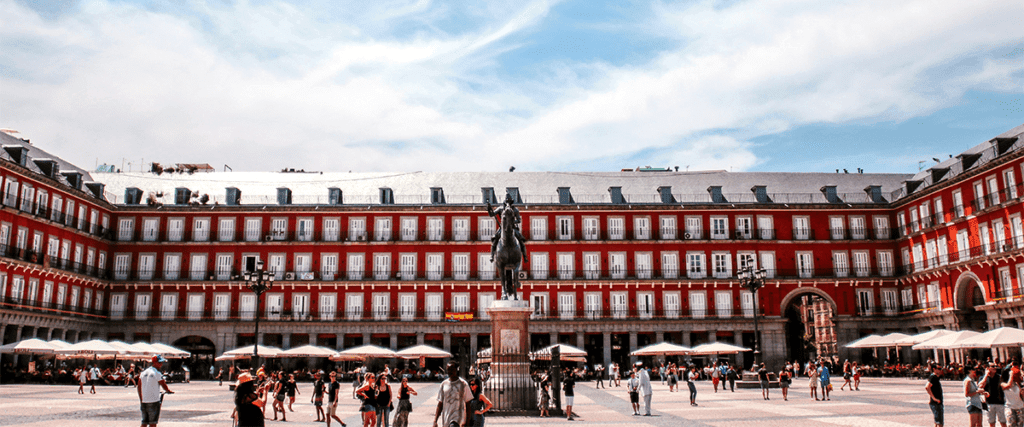
The Plaza Mayor of Madrid It has stood in the city center for four centuries and has changed its name seven times. Furthermore, its 12,000 square meters have hosted coronations, bullfights, autos-da-fé, markets, and concerts.
In this article we tell you its history, its curiosities and everything practical you need to visit it: how to get there, what to see there and what is around it.
Madrid's Plaza Mayor at a glance
- Construction: designed by Juan de Herrera and completed by Juan Gómez de Mora in 1619.
- Surface: about 12,000 square meters, with proportions based on the golden section.
- Access: 10 entrance arches, including the famous Arco de Cuchilleros.
- Location: about 600 steps from Puerta del Sol, next to Calle Mayor.
- Metro: Sol (lines 1, 2 and 3), Opera (2 and 5) and Tirso de Molina (line 1).
- CostIt is a public space with free access at any time.
History of the Plaza Mayor in Madrid
Originally, the space was the Plaza del Arrabal, a market on the outskirts of the medieval town. When Philip II moved the court to Madrid in 1561, the city needed a venue befitting a capital city.
Therefore, Philip III commissioned the project to Juan de Herrera, the architect of El Escorial, although it was Juan Gómez de Mora who completed it in 1619. However, since then the square has suffered three major fires, in 1631, 1670 and 1790. After the last one, Juan de Villanueva rebuilt it with the enclosed shape and arcades that we know today.
A place with many names
The square has changed its name several times depending on the occasion: Plaza del Arrabal, Plaza de la Constitución, Plaza de la República, Plaza de la República Federal, Plaza de Calvo Sotelo, and Plaza Real. Finally, the name that best defines its origins and current eclecticism prevailed: Plaza Mayor of Madrid.
Everything that has happened here
In fact, few places in Spain have hosted such diverse uses. Madrid's Plaza Mayor has been the setting for:
- Royal proclamations and coronations, with the nobility looking out from the balconies.
- Autos-da-fé of the Inquisition, the darkest page in its history.
- Bullfights, until the activity was moved to specific squares.
- Markets and fairs, its original function and the one it has never completely lost.
- The Christmas market, which has been set up every December for more than a century.
- San Isidro Festival, with chotis, carnations and chulapo suits.
What to see in the Plaza Mayor
The Bakery House It overlooks the north side and today houses offices of Madrid City Council. Its facade, covered in murals, is the most photographed in the square. The current frescoes, painted in 1992 by Carlos Franco, depict mythological figures linked to the city's history.
In the center, moreover, stands the equestrian statue of Philip III, The work was started by Giambologna and finished by Pietro Tacca in 1616. However, it did not reach the square until 1848, after passing through the Casa de Campo.
For his part, the Arch of Cutlers, The entrance, located in the southwest corner, is the most monumental. In fact, its steps overcome the slope of the terrain and lead directly to the area of historic taverns in the Cava de San Miguel.
Also, under the arcades you will find traditional shops, philately and numismatics on Sunday mornings, and the terraces that occupy a good part of the center.
What's around
Just under a minute away is the San Miguel Market, with food stalls in an elegant 1916 iron building. These are the other immediate points of interest:
- Main Street and Town Square, on the way to the Royal Palace.
- Cava Baja and La Latina, the most traditional tavern area in the city.
- Puerta del Sol and Preciados Street, a five-minute walk away.
- The Madrid of the Habsburgs, the walking route that links all these points.
Frequently asked questions about the Plaza Mayor in Madrid
The Plaza Mayor, according to those who walk through it every day
Every time I tour Habsburg Madrid and reach the point where the square comes into view, I stop to ask my travelers who knows it and who doesn't. This way, I ensure a memorable moment, observing the expressions of those who are visiting it for the first time.
Then, once inside, I leave them to their own devices for a while. That place holds so much energy that it seems to whisper a personalized welcome to every passerby.
If the Plaza Mayor came to life, it would be like Sybil, the character from that book about a woman with multiple personalities who transformed herself depending on the situation.
She is an impeccable young lady with a perfect figure, whose exact proportions are a product of the golden ratio. But she is also a noblewoman who adorns herself to receive the nobility and witness the coronation of a king.
She's the bohemian girl who lets herself be decorated with artificial turf and readily embraces conceptual art installations. And she's the woman who, with shame, endured the cries of the innocent and withstood the barbarities of the Inquisition.
She's the boisterous teenager who smells of cold beer and constant celebration. She's the cheerful girl who chases after all sorts of characters to the sound of whistles. And she's also the traditional Madrid woman who adorns herself with carnations and dresses as a chulapa to dance a chotis in San Isidro.
This "woman" with diverse identities has inhabited the city for 400 years and has a history long and fascinating enough to warrant a leisurely visit. Shall we introduce her to you?
History and construction of the Plaza Mayor in Madrid
Specifically, it was planned during the reign of Philip III, with initial designs by Juan de Herrera, and completed in 1619 under the direction of Juan Gómez de Mora. Its current appearance, however, comes from the reconstruction by Juan de Villanueva after the fire of 1790.
It is the building that dominates the north side of the square, so named because the price of bread was regulated there. Today it houses municipal offices and its facade is covered with murals painted in 1992.
In total, it covers approximately 12,000 square meters, with a rectangular floor plan of roughly 129 by 94 meters. Its proportions correspond to the golden ratio.
Visit the square today
The nearest metro stations are Sol (lines 1, 2 and 3), Ópera (2 and 5) and Tirso de Molina (line 1). From Puerta del Sol, it's about a five-minute walk along Calle Mayor.
Ten entrances in total. Among them, the most well known is the Arco de Cuchilleros, in the southwest corner, which descends by steps to the Cava de San Miguel.
It is usually set up from the end of November until December 31st. It is a tradition with more than a century of history and one of the busiest times of the year.
