
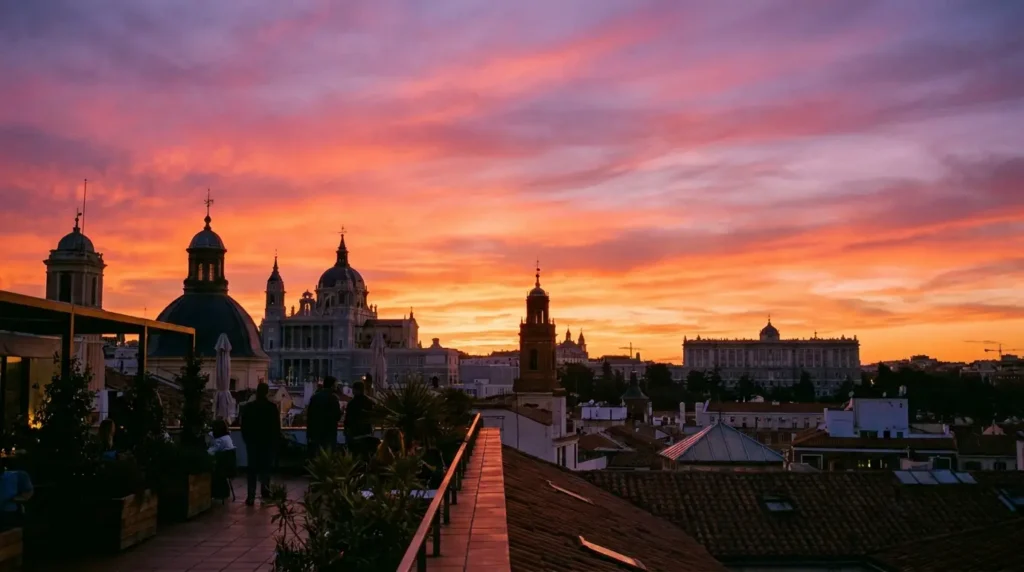
“From Madrid to Heaven” is an expression of Madrid pride that presents the city as the best possible place before reaching paradise. Its exact origin is not entirely clear, but there are literary references to it dating back to the Golden Age. The phrase was later associated with the transformation of Madrid during the reign of Charles III and eventually became one of its most recognizable slogans.
In addition, there are cities that are described through their monuments, their gastronomy, or their history.
Madrid can also be explained through its phrases.
“From Madrid to heaven” appears in songs, posters, tourism campaigns, conversations, establishments, terraces, and souvenirs for travelers. It can be read as a declaration of love, a typical Madrid exaggeration, or a way of stating that, after experiencing Madrid, the only way to go is up to paradise.
Its popular version is usually expanded as follows:
“"From Madrid to heaven, and in heaven a little hole to see it through.".
Likewise, the phrase sums up a very Madrileño way of talking about the city: with pride, humor and a certain amount of exaggeration.
However, its origin cannot be reduced to a single, fully proven story.
There are ancient literary references, theories related to Charles III, and popular explanations that were added over time.
What does “From Madrid to Heaven” mean?
The expression means, in simple terms, that Madrid is the best possible place on Earth.
After Madrid, only the sky would remain.
Furthermore, it should not be interpreted literally. It is also a hyperbole: a deliberate exaggeration used to highlight the city's qualities.
It can express:
- Pride in Madrid.
- Affection for the city.
- Sense of belonging.
- Admiration for their cultural life.
- Attachment to its streets and customs.
- Satisfaction from living or having been there.
- A humorous way of presenting it as unsurpassable.
On the other hand, the continuation —“and in the sky a little hole to see it”— further reinforces the idea.
Even from the sky, one shouldn't have to give up on seeing Madrid.
What is the complete sentence?
On the other hand, the most well-known form is:
“"From Madrid to heaven, and in heaven a little hole to see it through.".
Other possible variations include:
- From Madrid to heaven.
- From Madrid to heaven and a hole to see it through.
- From Madrid to heaven, and from there contemplate it.
- From Madrid to heaven, and in heaven a little window to see it.
Likewise, the short version functions as a slogan.
Furthermore, the longer version adds the humorous punchline that turns the phrase into something more than just a simple comparison.
The second part does not have a clearly established authorship. It appears to correspond to a later popular expansion, transmitted through speech, folk literature, and urban culture.
Who invented “From Madrid to Heaven”?
In fact, it cannot be stated with certainty that a single person invented the expression exactly as it is used today.
On the other hand, the most cited literary reference is found in some verses attributed to Luis Quiñones de Benavente, playwright and author of short plays from the Golden Age.
The verses say:
“Well, winter and summer
In Madrid they're all good,
from the cradle to Madrid
and from Madrid to heaven.”.
Madrid Tourism This text is cited as one of the possible roots of the famous saying, although it acknowledges that there are different theories about its origin.
Quiñones de Benavente lived between the late 16th and 17th centuries. This is important because it demonstrates that the association between Madrid and the sky existed before the urban reforms of Charles III.
Therefore, Charles III may have contributed to popularizing or reinforcing the praise of the city, but it does not seem rigorous to present him as the author of a phrase that already had previous literary antecedents.
Luis Quiñones de Benavente and the oldest reference
Luis Quiñones de Benavente was one of the most outstanding authors of interludes in the Golden Age.
Interludes were short theatrical pieces, usually humorous, that were performed between the acts of longer plays.
His texts reflected:
- Traditions.
- Popular people.
- Ways of speaking.
- Everyday problems.
- Urban life.
- Social behaviors.
Madrid was a frequent setting because it had become the seat of the court and brought together a very diverse population.
On the other hand, the reference "from Madrid to heaven" fits within that urban literature, capable of praising and criticizing the capital at the same time.
He Madrid City Council He has also publicly attributed the phrase to the poet Luis Quiñones, which reinforces his presence within the institutional interpretation of the saying.
However, it is necessary to distinguish between two statements:
- Yes, there is an old literary reference linked to Quiñones de Benavente.
- It cannot be proven that he created exactly all of today's popular expressions.
Likewise, the phrase probably evolved through collective use.
What does Charles III have to do with it?
Furthermore, another widespread theory links "From Madrid to Heaven" with the urban transformation promoted during the reign of Charles III.
Charles III reigned in Spain between 1759 and 1788 and promoted numerous reforms in Madrid.
In fact, during his time the following were developed or promoted:
- The Puerta de Alcalá.
- The Prado promenade.
- The fountains of Cybele, Neptune and Apollo.
- The Royal Botanical Garden.
- The building intended for the Cabinet of Natural History, now the Prado Museum.
- Paving improvements.
- Public lighting.
- Urban cleaning.
- Sanitation works.
- Organization of access and walkways.
His performance later earned him the popular nickname of “best mayor of Madrid”, although naturally he was king and not mayor.
According to one of the theories collected by Madrid Tourism, the expression may have gained popularity after these reforms, when the city began to be presented as a more monumental, orderly and modern capital.
Did Charles III create the phrase?
It doesn't seem likely.
On the other hand, the verses of Quiñones de Benavente predate the reign of Charles III.
On the other hand, the most prudent relationship would be this:
1. Furthermore, the comparison between Madrid and heaven already existed in the literature of the Golden Age.
2. In fact, the reforms of Charles III profoundly changed the image of the city.
3. Specifically, this newfound prestige may have helped to solidify the saying.
4. Popular culture later added other versions and explanations.
Charles III is part of the history of the phrase, but he should not be presented as its inventor without proof.
Madrid before it was “heaven”
On the other hand, the expression may seem even more striking if one remembers that Madrid was not always a comfortable, clean or monumental city.
After becoming the permanent seat of the court in 1561, it grew rapidly.
On the other hand, this growth generated problems such as:
- Narrow streets.
- Lack of modern sewage system.
- Accumulation of waste.
- Poor lighting.
- Overcrowded housing.
- Car traffic.
- Irregular supply.
- Very visible social differences.
Likewise, the city could be at the same time:
- Center of power.
- Court headquarters.
- Cultural capital.
- Place of opportunities.
- Uncomfortable and messy space.
Therefore, the phrase should not necessarily be understood as an objective description.
It can also be read as a display of local pride: the people of Madrid defended their city even when they were fully aware of its problems.
Does it have anything to do with the sky in Madrid?
Over time, the expression also began to be interpreted visually.
Madrid is known for:
- Its vast skies.
- The dry light of the plateau.
- Sunsets towards the west.
- The views of the mountains.
- The luminosity of its facades.
- The color changes at the end of the day.
The sky occupies an important part of the cityscape, especially from the higher areas and from the western cornice.
Furthermore, the City Council currently uses the expression for projects literally related to the city's sky and landscape. In 2026, for example, the Museum of the History of Madrid He launched a photography competition entitled "From Madrid to Heaven", focused on images where the sky and the urban landscape were the main focus.
This shows that the phrase is no longer interpreted solely as an abstract compliment.
It has also become an invitation to look up.
Why does Madrid have such famous sunsets?
In fact, the city is located on a high plateau and has several open spaces to the west.
From areas such as:
- Temple of Debod.
- Royal Palace.
- Cornice of the Almudena.
- Vistillas Park.
- Uncle Pio's Hill.
- Moncloa Lighthouse.
- Cottage.
You can see wide skies and, on clear days, distant outlines of the Sierra de Guadarrama.
The environment of Temple of Debod It is one of the most popular spots. Its gardens offer views of the Manzanares River, the Royal Palace, the Casa de Campo park, and some of Madrid's most famous sunsets.
On the other hand, it is not necessary to attribute the historical origin of the phrase to the quality of the sky to recognize that this visual reading has ended up forming part of its contemporary meaning.
“From Madrid to heaven” as a traditional motto
Furthermore, the phrase shares several features with other expressions associated with Madrid's identity:
- It's exaggerated.
- She is proud.
- It has a humorous ending.
- It can be said by someone born in Madrid as well as someone who adopted the city.
- It does not need a literal demonstration.
- It works best when spoken with a certain complicity.
Madrid has historically been built through the arrival of people from different regions and countries.
That's why Madrid pride doesn't always depend on where you were born.
Similarly, someone can feel like a Madrileño if:
- He was born in the city.
- He came to study.
- He moved for work.
- He started a family there.
- He lived through an important period.
- He comes back frequently.
- He found his own place in Madrid.
The phrase sums up an open urban identity, although it is not free of contradictions.
A city that embraces exaggeration
“From Madrid to Heaven” does not aim to convince through data.
Furthermore, it does not say that Madrid has:
- The best weather.
- The best architecture.
- The best food.
- The best landscapes.
- The best quality of life.
He simply states that there is nothing after, except heaven.
In fact, that excess is part of its charm.
It's similar to saying:
- Life here is like nowhere else.
- Madrid is not to be traded for anything.
- Those who know Madrid always return.
- Everything is in Madrid.
On the other hand, these are not scientific claims. Furthermore, they are expressions of affection and belonging.
The phrase in popular culture
Over time, “From Madrid to Heaven” has appeared in:
- Literature.
- Songs.
- Cinema.
- Theater.
- Posters.
- Tourism campaigns.
- Exhibitions.
- Competitions.
- Bars and restaurants.
- Hotels.
- Stores.
- Memories.
- Cultural events.
Likewise, the Community of Madrid and the City Council frequently use it in the titles of itineraries, artistic activities and projects related to the city.
It has also inspired public works of art.
The “Transparencies” monument”
Furthermore, on Felipe II Avenue there is a sculpture called Transparencies, a work by Manolo Paz.
In fact, the City Council presented it as an allegory of the expression "From Madrid to Heaven" and as a tribute to the city. Specifically, it is located in the intermodal space on Felipe II Avenue, between Narváez and Alcalá streets.
Furthermore, the piece demonstrates how a popular phrase can be transformed into:
- Sculpture.
- Urban identity.
- Public art.
- Element of a cultural route.
It is not one of Madrid's most famous monuments, but it fits perfectly into a tour dedicated to the contemporary meaning of the saying.
“"From Madrid to Heaven" and the Gran Vía
In addition, the Gran Vía offers another visual interpretation of the expression.
In fact, many of its buildings are crowned by:
- Sculptures.
- Domes.
- Quadrigas.
- Mythological figures.
- Temples.
- Pinnacles.
- Historical advertising elements.
Madrid Tourism links the famous saying to the observation of these figures located on the buildings of Gran Vía and Alcalá. In this context, they again cite the verses of Quiñones de Benavente and the theory that connects the popularization of the slogan with the reforms of Charles III.
On the other hand, among the most recognizable figures are:
- The Winged Victory of the Metropolis building.
- The goddess Minerva of the Circle of Fine Arts.
- The phoenix of some historic buildings.
- The sculptures of the old Union and Phoenix building.
- The archer located on the building at Gran Vía 60.
- The Diana the Huntress at Gran Via 31.
- The quadrigas of the old Bank of Bilbao, on Alcalá Street.
Likewise, Gran Vía forces you to look up.
Thus, the phrase takes on an architectural dimension: Madrid is also in its rooftops.
The best places to go “from Madrid to heaven”
In addition, the expression can inspire a route through some of the city's main viewpoints.
1. Rooftop of the Círculo de Bellas Artes
In fact, the rooftop is located at the confluence of Alcalá and Gran Vía.
Likewise, it is located approximately 56 meters above Alcalá Street and offers a wide view of the city center, with the sculpture of Minerva as one of its most recognizable elements.
Furthermore, from there you can observe:
- Metropolis Building.
- Gran Vía.
- Cibeles.
- Salamanca district.
- Northern towers.
- Roofs of the center.
- Mountain range on clear days.
Entry is not free and does not guarantee a table in the restaurant area. Opening hours, prices, and conditions should be checked before visiting.
2. Moncloa Lighthouse
The Moncloa Lighthouse is a tower built in 1992, when Madrid was the European Capital of Culture.
In addition, its panoramic elevator ascends 92 meters to the viewpoint, from which a large part of the city can be seen.
It allows you to observe:
- University City.
- Royal Palace.
- Almudena Cathedral.
- Sierra de Guadarrama.
- Buildings of the financial district.
- Cottage.
- Urban expansion of Madrid.
Currently, tickets are tied to a specific time slot, and access depends on capacity. Specifically, the viewpoint is normally open from Tuesday to Sunday, with special opening and closing times that need to be reviewed.
3. Temple of Debod
The area around the Temple of Debod offers one of the most popular sunsets in Madrid.
Furthermore, from its gardens you can see:
- Cottage.
- Cornice of the Royal Palace.
- Almudena Cathedral.
- West Park.
- Western sky.
Furthermore, the temple was rebuilt maintaining the east-west orientation of its original site, which reinforces its visual relationship with the sunset.
Access to the outside is free, but entry to the inside may require a reservation due to limited capacity.
4. Cornice Viewpoint
Furthermore, it is located between the Royal Palace and the Almudena Cathedral.
It offers views towards:
- Campo del Moro.
- Cottage.
- Saw.
- West of Madrid.
- Manzanares River area.
Madrid Tourism includes it among the main viewpoints in the city.
It is a particularly logical stop within a route through Habsburg Madrid and the Royal Palace.
5. Vistillas Park
In fact, Las Vistillas offers an open view to the west from historic Madrid.
On the other hand, the area is linked to:
- Festivals.
- The Dove.
- Traditional Madrid.
- Sunsets.
- Slopes and gardens.
- View over the ancient Manzanares valley.
It can be combined with:
- Basilica of San Francisco el Grande.
- Vistillas Garden.
- Segovia Viaduct.
- La Latina.
- Straw Square.
6. Uncle Pio's Hill
Popularly known as the Seven Tits Park, it offers one of the most complete panoramic views of the urban skyline.
Furthermore, from its hills one can see:
- Towers of Madrid.
- Center.
- Castellana axis.
- Saw.
- Different layers of urban growth.
It's not on the main tourist circuit, which allows you to discover a different side of the city.
7. Monument of Ariadne's Head
In the Manzanares Linear Park, the sculpture known as the Lady of the Manzanares is located on an artificial hill designed as a viewpoint.
The sculpture measures 13 meters and the hill raises it 21 meters above the level of the park.
Furthermore, it is an alternative way to observe Madrid from the south and get away from the usual axis of the historic center.
"From Madrid to Heaven" Route“
A cultural tour combining history, architecture, and views can also be organized.
Stop 1: Puerta de Alcalá
It also allows the introduction of the theory related to Charles III and the transformation of Madrid.
Stop 2: Cibeles
On the other hand, the following can be explained from here:
- Paseo del Prado.
- Enlightened reforms.
- Cibeles Palace.
- Monumental axis.
- Building the modern image of the capital.
Stop 3: Circle of Fine Arts
Likewise, the figure of Minerva and the rooftop allow the phrase to be taken literally to the heights.
Stop 4: Gran Vía
A tour to observe sculptures, domes, and figures located on top of the buildings.
Stop 5: Plaza de España
It connects the modern center with the western area and the great viewpoints.
Stop 6: Temple of Debod
Finale at sunset with views towards the Casa de Campo and the cornice of the Royal Palace.
Approximate duration: between two and a half and three and a half hours, not including a prolonged stay on the rooftop.
A second route through historic Madrid
A version focused on the old town could also be considered.
Stop 1: Plaza Mayor
Introduction to Madrid during the Golden Age and Quiñones de Benavente.
Stop 2: Plaza de la Villa
Historical context of the city before the great Bourbon reforms.
Stop 3: Segovia Viaduct
View over Segovia Street and the slope of historic Madrid.
Stop 4: Las Vistillas
Relationship between traditional identity, local festivals and western landscape.
Stop 5: San Francisco el Grande
Continue along the historic ledge.
Stop 6: Royal Palace and Almudena
Access to the Cornisa viewpoint.
Stop 7: Temple of Debod
It ends at sunset.
Similarly, this route allows you to connect three dimensions of the phrase:
- The literary one.
- The historic one.
- The visual.
Myths and truths about “From Madrid to Heaven”
“The phrase was invented by Charles III”
In fact, It has not been proven. There are verses by Luis Quiñones de Benavente that predate the reign of Charles III. Furthermore, the monarch's reforms may have contributed to their popularization, but they do not appear to be their initial origin.
“The complete sentence always included the little hole”
Besides, It cannot be guaranteed. The continuation appears to be a later, popular addition. Specifically, the most frequently cited early reference ends with “from Madrid to heaven.”.
“It refers only to sunsets”
Besides, No. Originally, it functioned as a tribute to the city. Likewise, its connection to the skies and viewpoints is a later visual interpretation.
“Luis Quiñones de Benavente wrote the exact current version”
On the other hand, not quite. His verses contain "from Madrid to heaven", but not the extension of the little hole.
“It is the official motto of Madrid”
It is not the official heraldic motto of the city, but it is one of its most used popular and institutional expressions.
“Only people born in Madrid use it”
No. It is also used by those who live in Madrid, have adopted it, or feel a special connection with the city.
Why does the phrase still work?
It is still used because it is:
- Brief.
- Easy to remember.
- Positive.
- Exaggerated.
- Adaptable.
- Visual.
- Affective.
- Recognizable.
It also allows for many reinterpretations:
- From Madrid to gastronomic heaven.
- From Gran Vía to heaven.
- Madrid from above.
- From Madrid to cultural heaven.
- From Madrid to heaven and cinema.
- From Madrid to the night sky.
Furthermore, each generation can appropriate it without losing its main meaning.
Is it worth including in a guided tour?
Yes, because it allows you to connect very different topics:
- Literature of the Golden Age.
- Charles III.
- Town planning.
- Gran Vía.
- Rooftop art.
- Viewpoints.
- Madrid identity.
- Popular culture.
- Landscape.
- Sunsets.
Likewise, a good explanation should not be limited to repeating the phrase.
I should clarify:
1. That its exact authorship is not settled.
2. That there is an old reference to Quiñones de Benavente.
3. That Charles III appears in a later theory.
4. That the version of the little hole belongs to popular development.
5. That today is also interpreted through the sky and the viewpoints of Madrid.
From Madrid to heaven with 4U Madrid
“From Madrid to heaven” is not just a slogan to put on a t-shirt.
Furthermore, the phrase spans different stages of the city's history: the Madrid of the Golden Age, the reforms of Charles III, the architecture of Gran Vía, the traditional festivals, and the current viewpoints.
At 4U Madrid we can incorporate this story into a cultural route through:
- Main Square.
- Puerta de Alcalá.
- Paseo del Prado.
- Gran Vía.
- Circle of Fine Arts.
- Royal Palace.
- Cornice Viewpoint.
- Temple of Debod.
The tour can end at sunset, when the phrase ceases to be merely a metaphor and the sky becomes part of the visit.
Frequently Asked Questions about From Madrid to Heaven
Origin and meaning of the phrase
It means that Madrid is the best possible place on Earth and that, after the city, the only thing left to do is reach heaven.
The most well-known popular version is: “From Madrid to heaven, and in heaven a little hole to see it through.”.
The most frequently cited literary reference is to Luis Quiñones de Benavente, a Golden Age author, who wrote verses ending with “from Madrid to heaven.” It has not been proven that he was the originator of the current popular version.
This seems unlikely because Quiñones de Benavente's reference is earlier. The reforms of Charles III may have helped to popularize the praise of Madrid.
Viewpoints to see the sky of Madrid
Madrid stands out for its light, its wide skies and its sunsets, especially from the western cornice, the Temple of Debod and other viewpoints.
Among the most well-known spots are the Moncloa Lighthouse, the Círculo de Bellas Artes (Fine Arts Circle), the Temple of Debod, the Mirador de la Cornisa (Cornisa Viewpoint), and the Cerro del Tío Pío (Uncle Pio Hill). Madrid Tourism includes these and other locations in its official selection of viewpoints.
It is not the official heraldic motto, but it is one of the most recognizable and widely used popular expressions by Madrid institutions.
The sculpture *Transparencies*, by Manolo Paz, is located on Felipe II Avenue and was conceived as an allegory of “From Madrid to Heaven”.
