
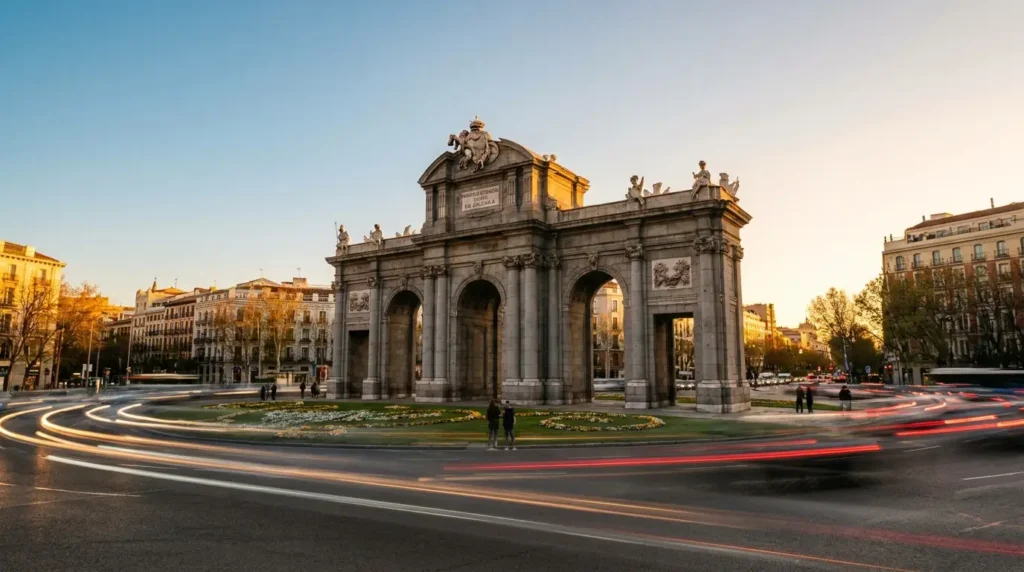
Charles III is known as “the best mayor of Madrid” because during his reign he promoted a profound urban transformation: public lighting, paving, cleaning, sanitation, grand promenades, monumental gates, fountains, and scientific buildings. He was never mayor, but rather King of Spain between 1759 and 1788, and many of the reforms were planned and carried out by ministers, architects, and engineers of his government.
On the other hand, the current image of Madrid still retains an important part of the project developed during the reign of Charles III.
The Puerta de Alcalá, the Cibeles and Neptune fountains, the Paseo del Prado, the Royal Botanical Garden, and the building that would later become the Prado Museum They belong to that reformist impulse.
That is why, when talking about Charles III, one phrase almost inevitably appears:
“The best mayor of Madrid.”.
The nickname is effective, but it also needs some clarification.
Charles III never held the position of mayor of the city. Furthermore, he was an absolute monarch, and the works were not the result of a modern municipal administration. Moreover, he did not work alone: ministers such as the Count of Aranda and Floridablanca, along with architects like Francesco Sabatini, Ventura Rodríguez, and Juan de Villanueva, were fundamental in transforming reformist ideas into concrete buildings, promenades, and services.
His legacy was not without conflict either.
The measures of order, cleanliness and modernization affected daily life, provoked resistance and were part of a policy that sought to improve the city, but also to control its inhabitants more closely.
Who was Charles III?
Charles III was born in Madrid in 1716.
Before becoming King of Spain he was:
- Duke of Parma and Piacenza.
- King of Naples and Sicily.
- Governor with administrative experience in Italy.
- Member of the Bourbon dynasty.
He came to the Spanish throne in 1759, after the death without issue of his half-brother Ferdinand VI.
Furthermore, his time as king extended until 1788 and is related to the so-called enlightened despotism, traditionally summarized by the expression:
“Everything for the people, but without the people.”.
In fact, the phrase wasn't necessarily uttered by Charles III, but it describes a form of government based on:
- Reform the economy.
- Promote science.
- Improve management.
- Modernizing cities.
- Expand useful education.
- Promote public works.
- Maintaining political power in the hands of the monarchy.
On the other hand, the objective was to promote progress without allowing broad political participation of the population.
Why is he called "the best mayor of Madrid"?
On the other hand, the nickname is due to the quantity and visibility of the reforms implemented in the capital.
During his reign, Madrid underwent an architectural and urban development program that transformed its appearance and improved some basic services. Furthermore, the City Council directly links this transformation to monuments and spaces such as the Puerta de Alcalá, the Salón del Prado, the Botanical Garden, the Observatory, the building that now houses the Prado Museum, and the Cibeles and Neptune fountains. The public lighting, paving, and the creation of grand boulevards are also noteworthy.
Furthermore, his fame stems from two different dimensions.
The great monumental works
Likewise, these are the ones that can still be seen and photographed:
- Puerta de Alcalá.
- Cibeles Fountain.
- Neptune Fountain.
- Fountain of Apollo.
- Paseo del Prado.
- Royal Botanical Garden.
- Prado Museum building.
- Royal Observatory of Madrid.
Everyday renovations
They were less spectacular, but they transformed the urban experience:
- Street lighting.
- Paving.
- Cleaning.
- Waste collection.
- Regulation of carriage traffic.
- Sanitation.
- Regulation of establishments.
- Improved access.
- Construction control.
On the other hand, the combination of monumentality and public services explains the strength of the nickname.
Was Charles III really a mayor?
No.
Charles III was King of Spain.
Furthermore, he was not elected by the people of Madrid nor did he lead a municipal corporation comparable to the current City Council.
Likewise, the nickname should be understood as a popular formula of recognition for his intervention in the capital.
It also simplifies a much more complex reality: the reforms depended on a network of people that included ministers, architects, engineers, civil servants, artisans, and workers.
That's why it would be more accurate to say that Charles III was the great political driving force behind a collective transformation.
When did he start being called “the best mayor”?
Furthermore, the nickname became established after his reign and is part of the popular and institutional memory of Madrid.
In fact, the City Council itself currently uses that name when describing the statue dedicated to the monarch and other elements of its heritage.
On the other hand, it should not be confused with an official title awarded during his lifetime.
Furthermore, it is a historical assessment built from the works he left in the city.
What was Madrid like before Charles III?
Likewise, to understand the scope of the reforms, it is helpful to imagine a capital city very different from the current one.
Madrid had become the permanent seat of the court in 1561 and had grown rapidly.
Furthermore, that growth was not always accompanied by adequate planning.
In fact, the city suffered from problems such as:
- Narrow and irregular streets.
- Poor pavements.
- Mud during the rain.
- Dust in dry periods.
- Poor lighting.
- Waste in public areas.
- Dirty water.
- Bad smells.
- Disorderly car traffic.
- Overcrowded housing.
- Fires.
- Complex supply.
- Lack of monumental public spaces.
Madrid was the capital of a powerful monarchy, but it did not always project an image in accordance with its political position.
The court, convents, aristocratic residences, and popular houses coexisted in an uneven urban fabric.
Charles III and his ministers aspired to turn it into just another capital city:
- Clean.
- Illuminated.
- Orderly.
- Monumental.
- Representative.
- Scientist.
- Healthy.
- Easy to control.
Cleaning and sanitation reforms
On the other hand, one of the most important areas was urban hygiene.
For centuries, the disposal of household waste had been a problem.
On the other hand, the sewage and waste could end up in:
- Streets.
- Courtyards.
- Streams.
- Wells.
- Peripheral areas.
Likewise, the monarchy promoted new rules and systems to reduce this situation.
Garbage collection
In addition, the obligation to remove waste and transport it away from the main inhabited areas was reinforced.
The measure sought to:
- Reduce bad odors.
- Avoid accumulations.
- Improve traffic.
- Reduce sources of infection.
- Organize the cleaning work.
In fact, one should not imagine a modern municipal service identical to the current one, but rather an advance in the organization of public hygiene.
Cesspools and drains
On the other hand, solutions were promoted to prevent liquid waste from being thrown directly onto public roads.
On the other hand, the sanitation projects had technical limitations and their application was not uniform, but they were part of a new idea of the city: health should no longer depend solely on private decisions.
The myth of “water is coming!”
The expression “¡agua va\!” is used to represent the custom of giving a warning before throwing dirty water out of a window.
Similarly, it is possible that such notices existed in different cities, but it should not be presented as if all Madrid residents were constantly throwing buckets from their balconies or as if Charles III had single-handedly eliminated that practice overnight.
The cleanup was a long, uneven, and technically complex process.
Public lighting
In addition, street lighting is another of the reforms associated with Charles III.
Before the expansion of a regular system, a circular route at night could result in:
- Difficult.
- Insecure.
- Slow.
- Dependent on specific lights.
- Dangerous in narrow streets.
In fact, during his reign, street lighting was reinforced with lanterns.
This allowed:
- Facilitate nighttime transit.
- Increase surveillance.
- Improve street identification.
- Extending urban life after dark.
- Reduce certain risks.
On the other hand, the lighting was still limited compared to the current level, but it represented an important change in the management of public space.
It also had a control dimension: a lit city was easier to monitor.
Paving and tidying the streets
Furthermore, the cobblestone paving was another central element.
In addition, the streets without proper paving accumulated:
- Mud.
- Dust.
- Potholes.
- Stagnant water.
- Waste.
In addition, the soil improvement facilitated:
- Carriage traffic.
- Freight transport.
- Pedestrian movement.
- Cleaning.
- Water evacuation.
In fact, the City Council expressly includes the cobblestone paving among the main urban legacies from the period of Charles III.
The reforms also attempted to bring order to:
- Entrances to the city.
- Car traffic.
- Facade alignment.
- Building construction.
- Use of common areas.
- Commercial activities.
The Puerta de Alcalá
On the other hand, the Puerta de Alcalá is probably the most recognizable monument associated with Charles III.
It was designed by Francesco Sabatini and built between 1769 and 1778.
It replaced a previous gate that did not reflect the monumental image that the king wanted for one of the main entrances to Madrid.
What was it used for?
Madrid was surrounded by fiscal and administrative fences, not by a great defensive wall comparable to that of other medieval cities.
The doors allowed:
- Control access.
- Register goods.
- Collect taxes.
- Organize routes.
- To symbolically represent the entrance to the court.
The new Puerta de Alcalá fulfilled a practical, but above all monumental, function.
It conveyed a clear idea: whoever arrived from the east entered a renewed capital.
Why does it have two different facades?
Furthermore, each side is decorated differently.
This can be seen in:
- Columns.
- Pilasters.
- Shields.
- Trophies.
- Sculptural elements.
- Auctions.
Likewise, the difference is due to the architectural design and the representative function of each facade.
What is his connection to Charles III?
In addition, the main inscription includes his name:
King Charles III
In fact, the gate remains one of the most direct testimonies of his urban program.
The Paseo del Prado and the Salón del Prado
On the other hand, one of the most ambitious reforms was the transformation of the old Prado de San Jerónimo.
Furthermore, the project created a large, tree-lined, and monumental promenade on the eastern edge of the city.
The space combined:
- Nature.
- Circulation.
- Leisure.
- Science.
- Architecture.
- Political representation.
Likewise, the so-called Prado Hall was structured using fountains and buildings.
Furthermore, it wasn't just an avenue.
Likewise, it was an urban planning statement of the Enlightenment: the capital should offer public spaces where knowledge, strolling, beauty and order coexisted.
The monumental fountains
On the other hand, the axis was marked by three main sources:
1. Cybele.
2. Apollo.
3. Neptune.
They were designed within the program directed by Ventura Rodríguez.
Each one contributed to building a promenade inspired by classical culture.
The Cibeles Fountain
Cybele represents a deity related to the earth, nature, and fertility.
Furthermore, he appears on a chariot pulled by lions.
Today it is one of the great symbols of Madrid, but originally it was part of a larger complex.
Furthermore, it was not conceived as a football monument nor as an isolated element of a roundabout.
Furthermore, its meaning is better understood by relating it to:
- Paseo del Prado.
- Neptune.
- Apollo.
- Mythological program.
- Transformation of the eastern entrance.
Over time, the fountain changed position and the urban environment was modified.
The Neptune Fountain
Neptune represents the Roman god of the sea.
He also appears on a chariot pulled by sea horses.
Their presence on the promenade reinforced the classical and allegorical program.
Furthermore, it is currently associated with sporting celebrations, just like Cibeles, but its origin belongs to the enlightened project of the 18th century.
The Fountain of Apollo
Apollo occupies a central position between Cybele and Neptune.
It represents a figure associated with:
- Light.
- Arts.
- Knowledge.
- Harmony.
- Reason.
In fact, its location allows the whole to be interpreted as a composition related to balance and the enlightened ideal.
It is less known to many visitors, but it is fundamental to understanding the original structure of the Prado Hall.
The Royal Botanical Garden
On the other hand, the Royal Botanical Garden It was not initially created by Charles III.
It had been founded by Ferdinand VI in 1755 and was located in the Migas Calientes area.
Charles III ordered its relocation to the Paseo del Prado starting in 1774. Specifically, the new garden was inaugurated in 1781 and was designed by Sabatini and Juan de Villanueva.
Furthermore, this precision is important.
In fact, it is not correct to simply state that Charles III "founded" the Botanical Garden.
His role was to move it, expand it and integrate it into the Prado's great scientific project.
What was it for?
On the other hand, it was not just an ornamental garden.
Its functions included:
- Investigation.
- Teaching.
- Species classification.
- Training of doctors and pharmacists.
- Study of medicinal plants.
- Scientific exchange.
- Reception of species from expeditions.
On the other hand, the garden embodied the enlightened confidence in science and the practical utility of knowledge.
The building of the current Prado Museum
One of the most frequent historical errors is saying that Charles III built the Prado Museum to exhibit paintings.
That wasn't the case.
Also in 1785, he commissioned Juan de Villanueva to design a building to house the Cabinet of Natural History and the Academy of Sciences. Furthermore, the project formed part of the scientific complex along the Paseo del Prado.
In fact, the building did not become a painting museum until 1819, during the reign of Ferdinand VII.
Therefore:
- Charles III promoted the building.
- Juan de Villanueva designed it.
- Its original function was scientific.
- The transformation into a museum came later.
- Charles III never visited the Prado Museum there as we know it.
Why was it built in that area?
On the other hand, the building was integrated into an area dedicated to knowledge.
Nearby were located or planned:
- Botanical garden.
- Observatory.
- Cabinet of Natural History.
- Walks.
- Scientific institutions.
Furthermore, the intention was to create a true axis of science and culture.
The Royal Observatory of Madrid
Likewise, the Royal Observatory was built on the old hill of San Blas, within the Retiro area.
It was designed by Juan de Villanueva during the reign of Charles III.
Furthermore, its function responded to the Enlightenment interest in:
- Astronomy.
- Mapping.
- Navigation.
- Time measurement.
- Scientific observation.
- Technical training.
The building began to be constructed at the end of the reign, so its development continued after the monarch's death.
This shows that Charles III's project was not limited to beautifying Madrid.
He also sought to turn it into a scientific capital.
The General Hospital
In fact, the current Reina Sofía National Art Centre Museum occupies part of the former General Hospital of Madrid.
On the other hand, the hospital reorganization had begun earlier, but Charles III promoted the construction of a large building designed by José de Hermosilla and continued by Sabatini.
The goal was to centralize and modernize hospital care.
The original project was much larger than the part that was finally built.
Furthermore, this building allows the Charles III route to be extended beyond the most well-known tourist monuments.
His legacy also appears in spaces related to:
- Medicine.
- Charity.
- Administration.
- Public services.
The Royal Customs House
Likewise, the current headquarters of the Ministry of Finance, located on Alcalá Street, was built during the reign of Charles III.
Francesco Sabatini designed the building to centralize customs and tax functions.
Furthermore, the work represents another dimension of the reforms:
- Greater administrative control.
- Collection.
- Goods management.
- Centralization of the State.
- Institutional architecture.
In fact, not all of Charles III's legacy consists of fountains and gardens.
It also includes buildings linked to the functioning of power.
The Royal Factories
Charles III promoted or protected royal manufactories aimed at reducing imports, improving production and increasing the prestige of the monarchy.
On the other hand, among them stood out the Royal Porcelain Factory of Buen Retiro, founded after his arrival in Madrid and related to the experience he had acquired during his Neapolitan period.
On the other hand, the royal factories produced items such as:
- Porcelain.
- Hangings.
- Glass.
- Fabrics.
- Decorative objects.
They were looking to combine:
- Art.
- Industry.
- Technical training.
- Courtly prestige.
- Economic development.
Likewise, the Buen Retiro factory was destroyed during the War of Independence, so it can no longer be visited as a preserved building.
Cemeteries outside of churches
Furthermore, during the 18th century, concern began to spread about burials within temples and densely populated areas.
In fact, the accumulation of graves in churches could generate:
- Bad smells.
- Health problems.
- Saturation.
- Space conflicts.
On the other hand, the enlightened reforms progressively promoted the creation of cemeteries outside the most populated areas.
On the other hand, the process unfolded over several reigns and cannot be attributed exclusively to Charles III, but it fits with his concern for public health and urban order.
The numbering of houses and the organization of the city
Likewise, administrative modernization required a better understanding of the urban territory.
Furthermore, during the 18th century, mechanisms such as the following were strengthened:
- House numbering.
- Apple identification.
- Register of owners.
- Fiscal control.
- Neighborhood organization.
- Drafting plans.
These measures could facilitate public services, but also increase the State's capacity to:
- Collect taxes.
- Watch.
- Recruit.
- Control population and property.
The enlightened city was more orderly, but also more administered.
The ministers behind the reforms
Presenting Charles III as solely responsible erases the work of essential figures.
The Marquis of Esquilache
Leopoldo de Gregorio, Marquis of Esquilache, was one of the most influential ministers at the beginning of the reign.
He promoted measures related to:
- Cleaning.
- Lighting.
- Catering.
- Public order.
- Outfit.
- Administration.
In fact, his policies provoked strong resistance and culminated in the Esquilache Riots.
The Count of Aranda
After Esquilache's fall, Aranda assumed an important role.
He was linked to:
- Public order.
- Administrative reorganization.
- Riot control.
- Reformist policy.
- Expulsion of the Jesuits.
The Count of Floridablanca
Floridablanca was one of the great ministers of the final period.
Impulse:
- Public works.
- Diplomacy.
- Scientific development.
- Administrative reforms.
- Science Cabinet Project.
On the other hand, the Prado Museum points out that the initiative for the Prado's science building was related to the first Count of Floridablanca.
The architects of Madrid during the reign of Charles III
Francesco Sabatini
Sabatini was one of the main architects of the court.
He worked in:
- Puerta de Alcalá.
- Royal Customs House.
- Royal Palace.
- General Hospital.
- Botanical garden.
- Urban and palatial works.
His name is now associated with the Sabatini Gardens, although these gardens were created in the 20th century on the site of the royal stables he designed.
Therefore, the current gardens are not a work of Sabatini.
Ventura Rodríguez
Ventura Rodríguez played a prominent role in:
- Monumental fountains.
- Organization of the Prado Hall.
- Religious architecture.
- Urban projects.
- Supply systems.
Moreover, his work was essential to the monumental image of the promenade.
John of Villanueva
Juan de Villanueva represents Spanish neoclassical architecture.
Also among his works linked to the Enlightenment project are:
- Building of the current Prado Museum.
- Royal Observatory.
- Interventions in the Botanical Garden.
- Scientific and academic buildings.
Furthermore, the Prado-Retiro axis cannot be understood without its architecture.
The Esquilache Riots: the limits of reform
In fact, the image of Charles III as a reforming ruler must include one of the biggest conflicts of his reign.
On the other hand, in March 1766 the Esquilache Riots broke out.
What caused it?
On the other hand, the most well-known immediate cause was the prohibition of certain garments:
- Long layers.
- Wide-brimmed hats.
Authorities also argued that they could conceal weapons and hinder identification.
However, reducing the riot to a fashion discussion would be incorrect.
Also influential were:
- Bread price increase.
- Shortage.
- Social unrest.
- Rejection towards foreign ministers.
- Distrust of the reforms.
- Supply problems.
- Political tension.
What happened
There were protests, riots, and demands directed at the king.
Charles III temporarily left Madrid and moved to Aranjuez.
Esquilache was dismissed and sent out of Spain.
What does the mutiny demonstrate?
The reforms could aim for urban improvement, but they could also be imposed without the participation of the population.
Furthermore, a measure presented as modernizing could be perceived as:
- Authoritarian.
- Foreign.
- Humiliating.
- Inopportune.
- Disconnected from more urgent problems.
In fact, this episode forces us to qualify the idealized image of the "best mayor".
The expulsion of the Jesuits
In 1767, Charles III ordered the expulsion of the Society of Jesus from the territories of the monarchy.
On the other hand, the decision had important consequences in:
- Education.
- Properties.
- Religious institutions.
- Policy.
- Relations with Rome.
- Balance of power.
On the other hand, the measure was presented as part of a policy to strengthen the State, but it remains one of the most controversial episodes of his reign.
Furthermore, it is not directly related to Madrid's urban planning, but it helps to understand that the reformism of Charles III was not solely a policy of beautification.
It also involved centralization and control.
Was Charles III an enlightened king?
Yes, although with some nuances.
Promoted:
- Science.
- Expeditions.
- Technical education.
- Agriculture.
- Industry.
- Public works.
- Academies.
- Town planning.
- Administrative reforms.
But he did not defend:
- Democracy.
- Popular sovereignty.
- Modern political freedom.
- Full social equality.
- Citizen participation in government.
His project sought a more effective monarchy, not to replace it.
That is why it is called enlightened despotism.
Which works of Charles III are still visible in Madrid
Furthermore, among the most important elements are:
- Puerta de Alcalá.
- Paseo del Prado.
- Cibeles Fountain.
- Neptune Fountain.
- Fountain of Apollo.
- Royal Botanical Garden.
- Prado Museum building.
- Royal Observatory.
- Royal Customs House.
- Old General Hospital.
- Interiors of the Royal Palace.
- Elements related to the royal factories.
- Layout of walkways and access points.
In fact, the City Council summarizes this heritage through the monuments, scientific buildings and urban improvements that still structure a large part of the center.
The statue of Charles III in the Puerta del Sol
On the other hand, in the center of the Puerta del Sol there is an equestrian statue of Charles III.
Furthermore, the artwork was installed in the 1990s.
The City Council also consulted the people of Madrid about its location and the Puerta del Sol was the most voted option, ahead of the Puerta de Alcalá.
Is it an 18th-century statue?
No.
Furthermore, it is a contemporary monument inspired by historical models.
Therefore, it was not contemplated by Charles III nor was it part of the original reform of the square.
What appears on the pedestal
In fact, the pedestal includes inscriptions and references to:
- Life of the monarch.
- Works.
- Reforms.
- Reign.
- Relationship with Madrid.
It can also be used as a starting point for a route dedicated to his legacy.
Charles III at the Royal Palace
Charles III was the first monarch to permanently inhabit the new Royal Palace of Madrid, built after the fire that destroyed the old Alcázar.
Their rooms are one of the most important parts of the visit.
National Heritage highlights:
- King's chambers.
- Decoration directed by Sabatini.
- Gasparini Chamber.
- Throne Room.
- Private offices.
- Furniture and decorative arts.
On the other hand, Charles III's office has been restored with furniture designed specifically for his use, including tables, an armchair, and a ministerial stool. It was also the place where he worked with his ministers.
This visit allows you to discover a different dimension of the monarch: not only the promoter of streets and monuments, but also the king within his sphere of government.
Charles III Route through Madrid
In addition, the king's legacy can be explored on foot via a route that connects the center with the Paseo del Prado.
Stop 1: Puerta del Sol
In fact, the equestrian statue allows for the introduction of:
- Who was Charles III?.
- Why is he called the “best mayor”?.
- Difference between a king and a mayor.
- Urban reforms.
- Subsequent construction of his memory.
Stop 2: Royal Customs House
Following Alcalá Street you will reach the building designed by Sabatini.
They can be explained here:
- Fiscal centralization.
- Administration.
- Trade.
- Architecture of power.
Stop 3: Cibeles
The source allows the introduction of the Prado Hall project and the use of classical references.
Stop 4: Puerta de Alcalá
It is also the great monumental work that serves as the entrance to the city.
It is worth noting:
- Two facades.
- Five openings.
- Shields.
- Trophies.
- Registration.
- Historical damages.
- Relationship with the old road to Alcalá.
Stop 5: Fountain of Apollo
Likewise, it allows us to understand the original composition of the promenade and the importance of reason and the arts in the enlightened imagination.
Stop 6: Neptune Fountain
Complete the mythological program of the Prado Salon.
Stop 7: Prado Museum
It should be explained that the building was designed as a scientific institution, not as a painting museum.
Stop 8: Royal Botanical Garden
It represents:
- Science.
- Medicine.
- Expeditions.
- Classification.
- Education.
- Ordered nature.
Stop 9: Royal Observatory
Furthermore, it allows you to conclude the tour with astronomy and the scientific vision of the enlightened city.
Approximate duration without interiors: between two and a half and three hours.
Extended route with interiors
Additionally, a more complete version may include:
1. Royal Palace.
2. Puerta del Sol.
3. Royal Customs House.
4. Puerta de Alcalá.
5. Paseo del Prado.
6. Prado Museum.
7. Botanical Garden.
8. Observatory.
9. Old General Hospital.
Furthermore, to visit all the interiors it would be necessary to divide the tour into several days.
Common mistakes when talking about Charles III
“Charles III was mayor of Madrid”
Fake. He was King of Spain. Likewise, the title of "best mayor" is both popular and honorary.
“He personally built all the monuments”
Fake. The works depended on ministers, architects, engineers and workers.
“He founded the Prado Museum”
Inaccurate. He commissioned the building as a Cabinet of Natural Sciences. In particular, the painting museum opened in 1819.
“He founded the Royal Botanical Garden”
Inaccurate. It was created by Ferdinand VI. Charles III ordered it to be moved to the Paseo del Prado and incorporated it into his scientific project.
“He created the Sabatini Gardens”
Fake. The current gardens date from the 20th century, although they occupy the space of the former stables designed by Sabatini.
“All of his reforms were accepted”
Fake. The Esquilache Riots revealed a deep social opposition.
“Modernizing meant democratizing”
Fake. The reforms were carried out within an absolute monarchy.
“All of enlightened Madrid was the exclusive work of Charles III”
Fake. Some initiatives had started before and others ended after his death.
Was he really the best mayor of Madrid?
On the other hand, the answer depends on how the phrase is interpreted.
Yes, as a symbol of transformation
His reign left:
- Recognizable monuments.
- A great public promenade.
- Scientific institutions.
- Cleaning improvements.
- Lighting.
- Paving.
- New entries.
- Administrative architecture.
- A renewed image of the capital.
No, not if it's taken literally.
Charles III:
- He was not mayor.
- He was not elected.
- He did not act alone.
- He ruled in an authoritarian manner.
- He encountered resistance.
- It did not solve all urban problems.
- He continued previous projects.
- He left behind works that were finished by his successors.
Therefore, the nickname functions as popular recognition, not as an objective administrative evaluation.
A more precise formulation would be:
Charles III was the monarch who promoted one of the greatest urban transformations in the history of Madrid.
The legacy of Charles III in present-day Madrid
His influence remains because many of his works are not ruins or isolated pieces.
They continue to be part of everyday life.
In addition, Madrid residents and visitors:
- They cross the Puerta de Alcalá.
- They meet in Cibeles.
- They walk along the Paseo del Prado.
- They visit the Prado Museum.
- They enter the Botanical Garden.
- They celebrate next to Neptune.
- They use administrative buildings.
- They travel along the axis declared Landscape of Light.
In fact, the contemporary city reuses spaces conceived during the Enlightenment.
Some have changed function, but they retain the structure of the original project.
On the other hand, the most obvious example is the Prado Museum: it was born as a scientific building and ended up becoming one of the great art galleries in the world.
Charles III and the Landscape of Light
Furthermore, the Paseo del Prado and the Buen Retiro currently form what is known as the Landscape of Light.
This set includes:
- Art.
- Science.
- Nature.
- Public space.
- Sights.
- Cultural institutions.
Furthermore, the idea has a direct relationship with the enlightened project of the 18th century.
Charles III did not use the expression "Landscape of Light", but he contributed decisively to creating the axis where the following were integrated:
- Botanical garden.
- Science Cabinet.
- Observatory.
- Sources.
- Tree-lined walkways.
- Withdrawal.
The concentration of culture, nature and knowledge constitutes one of its most important legacies.
Is it worth taking a guided tour about Charles III?
Yeah.
Furthermore, the topic allows us to understand that Madrid was not built in a single era.
In fact, a guided tour can show:
- What was the city like before the reforms?.
- What problems were they trying to solve?.
- Who participated.
- How the Prado Hall was designed.
- Why the Prado was not born as a museum.
- What role did science play?.
- How the inhabitants reacted.
- Which elements are still alive.
- Which myths need to be corrected.
It also allows us to relate the 18th century to the present-day city.
Discover the Madrid of Charles III with 4U Madrid
Charles III was not mayor, but he left such a visible transformation that Madrid ended up granting him that title in popular memory.
On the other hand, his legacy is not limited to a door or a fountain.
Similarly, it appears in the way of understanding the city as a space that should be:
- Habitable.
- Clean.
- Illuminated.
- Monumental.
- Scientist.
- Tidy.
- Open to strolling.
Furthermore, at 4U Madrid we can incorporate this story into a private tour of Enlightenment-era Madrid.
The tour may also include:
- Puerta del Sol.
- Alcalá Street.
- Royal Customs House.
- Cibeles.
- Puerta de Alcalá.
- Paseo del Prado.
- Fountains of Apollo and Neptune.
- Prado Museum.
- Royal Botanical Garden.
- Royal Observatory.
Frequently asked questions about Charles III and Madrid
#
Who was Charles III and what reforms did he implement?
Because during his reign he promoted reforms in cleaning, lighting, paving, sanitation and urban planning, in addition to great works such as the Puerta de Alcalá, the Paseo del Prado, the monumental fountains and scientific buildings.
No. He was King of Spain between 1759 and 1788. “The best mayor of Madrid” is a popular nickname.
Furthermore, during his reign, the Puerta de Alcalá, the Salón del Prado, the Cibeles, Apollo and Neptune fountains, the building of the current Prado Museum, the Royal Observatory, the Royal Customs House and the relocation of the Botanical Garden were promoted.
No. He commissioned the building as a Cabinet of Natural Sciences. The Royal Museum of Paintings opened there in 1819, during the reign of Ferdinand VII.
Not exactly. Ferdinand VI founded it in 1755. Charles III ordered it moved to the Paseo del Prado, where it opened in 1781.
What remains in the city today
Francesco Sabatini, one of the main architects in the service of Charles III.
It was a revolt that occurred in 1766, related to the prohibition of long capes and wide-brimmed hats, but also to the price of bread, shortages and rejection of some reforms and ministers.
In fact, the most famous equestrian statue is in the Puerta del Sol. It was installed in the 20th century after a consultation regarding its location.
In fact, some of his apartments are preserved in the Royal Palace of Madrid. Patrimonio Nacional (National Heritage) includes the Gasparini Room and other royal chambers among its highlights.
