
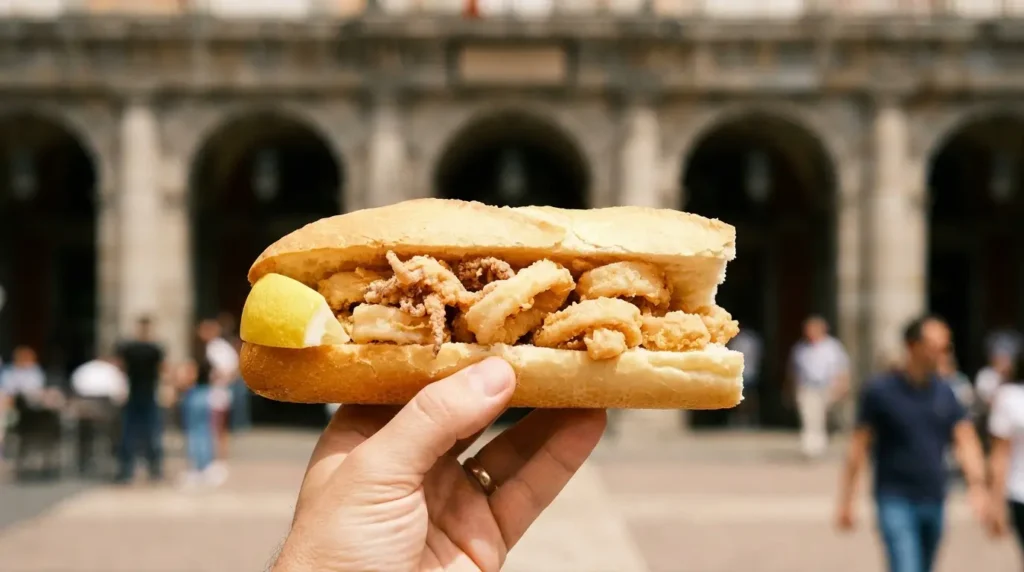
The calamari sandwich is one of Madrid's most recognizable flavors: simple bread, battered and freshly fried calamari, usually served without any other accompaniments. Its exact origin isn't fully documented, but its popularity is linked to the arrival of fish in the capital, the tradition of fried fish shops, and the bars located around the Plaza Mayor.
Madrid has no sea.
Even so, one of their most famous dishes is prepared with squid.
The contradiction is part of the sandwich's appeal, but it also raises a logical question: how did a city located in the center of the peninsula end up turning fried squid into one of its great gastronomic symbols?
Furthermore, the answer is not found in a single date or in a specific inventor.
Likewise, the calamari sandwich appears to be the result of several processes:
- The religious obligation to eat fish on certain days.
- The gradual arrival of fish from the coasts.
- Improving transportation.
- The emergence of markets and distribution networks.
- The tradition of frying fish.
- The growth of popular bars.
- The concentration of fried food shops around the Plaza Mayor.
- The need to offer a fast, plentiful, and easy-to-eat meal.
Today, Madrid Tourism It is recommended to try it in the Plaza Mayor as one of the city's characteristic gastronomic experiences, and the City Council has expressly promoted it as a Madrid tourist icon.
What exactly is a calamari sandwich?
Furthermore, the most traditional version is very simple.
Carry:
- Bread.
- Squid cut into rings or strips.
- Flour or light batter.
- Frying oil.
- Salt.
In fact, it doesn't necessarily need to:
- Mayonnaise.
- Alioli.
- Spicy sauce.
- Lettuce.
- Tomato.
- Onion.
- Cheese.
- Lemon.
There are contemporary versions with sauces, special breads and other ingredients, but the most recognizable Madrid sandwich is based on simplicity.
On the other hand, the result depends on three elements:
1. In particular, the quality and doneness of the squid.
2. Frying.
3. Bread.
If one fails, the sandwich loses much of its appeal.
Did the calamari sandwich originate in Madrid?
Furthermore, there is no fully documented date of birth.
It is also not known for certain:
- Who prepared the first one?.
- In which bar did he appear?.
- In what year did it start being sold?.
- When did it become a regular dish in the Plaza Mayor?.
Official tourist information for Madrid indicates that it is very difficult to pinpoint exactly when this custom originated. However, it does state that fish arrived in Madrid from the north of the Iberian Peninsula at least from the 16th century and that transport conditions improved during the 18th century.
Therefore, it is more accurate to speak of an evolution, not a specific invention.
The sandwich probably became established when several factors coincided:
- Greater availability of fish.
- Popular fried food shops.
- Affordable bread.
- City growth.
- Increased movement of workers and visitors.
- Bars capable of serving food quickly.
How did fish get to a city without a coast?
For centuries, transporting fresh fish to Madrid was complicated.
In fact, the distance from the ports implied:
- Long days of travel.
- Risk of deterioration.
- Temperature dependence.
- Need to preserve the product.
- High costs.
- Less variety available.
On the other hand, to increase its duration, methods such as the following were used:
- Salting.
- Drying.
- Marinade.
- Preservation in ice or snow.
- Night transport.
- Quick consumption upon arrival.
The improvement of roads, the railway and, later, refrigeration completely transformed the supply.
Madrid was able to receive larger quantities of fish from different coasts and make it a common product, not reserved only for consumers with greater purchasing power.
Currently, the Mercamadrid Central Fish Market is the European leader in the marketing of fishery and aquaculture products. It also boasts 33,000 square meters of covered space and serves as a benchmark for prices, trends, and distribution.
Mercamadrid also identifies Guipúzcoa as one of the main entry points for fresh fish, while Pontevedra, A Coruña and Guipúzcoa itself have a significant role in the supply of fresh seafood.
Likewise, this logistical capacity explains why Madrid, despite being far from the sea, maintains such a strong gastronomic relationship with fish and seafood.
Madrid as a great inland port
Madrid has sometimes been called "the port of Spain" or a large inland market.
Furthermore, the expression should not be interpreted literally.
Madrid does not have a seaport, but it acts as a huge center for receiving and distributing food from all over the country.
Mercamadrid is defined as Spain's largest platform for the distribution, marketing, processing, and logistics of fresh food. In addition to fish, it brings together central markets for fruits, vegetables, and meat, along with transportation, storage, and preservation companies.
This allows Madrid restaurants, bars and fishmongers to quickly access products from:
- Galicia.
- Cantabrian.
- The Basque Country.
- Andalusia.
- Valencian Community.
- Murcia.
- Islands.
- International import.
In fact, the final quality will always depend on the supplier, the treatment, the preservation and the cooking, but the absence of a coast does not necessarily mean an absence of good fish.
Why squid specifically?
Madrid could have turned many other fish into sandwiches.
In fact, their traditional cuisine also includes:
- Cod.
- Pavia Soldiers.
- Anchovies.
- Sardines.
- Pickled fish.
- Assorted fried foods.
On the other hand, squid offers several advantages for popular restaurants:
- It can be cut into regular portions.
- It fries quickly.
- It has a recognizable flavor.
- It's easy to put into bread.
- It can be served without cutlery.
- It is filling.
- It allows for continuous preparation during times of high demand.
- It can be consumed standing up or walking.
In addition, the batter helps keep the inside juicy and turns a serving of calamari into an easy-to-carry meal.
The influence of religious tradition
For centuries, Madrid was a city deeply marked by the Catholic calendar.
Abstaining from meat on certain days, especially Fridays and Lent, encouraged the consumption of fish.
On the other hand, this doesn't mean that the calamari sandwich originated directly as a response to a religious rule, but that context did contribute to:
- The fish trade will develop.
- Demand will increase.
- Fried foods will become popular.
- The establishments offered alternatives to meat.
- Fish will be integrated into everyday cooking.
Salted cod was of enormous importance because it could be transported and preserved relatively easily. Over time, logistical improvements allowed other seafood products to become part of everyday consumption.
Why is it associated with the Plaza Mayor?
Likewise, the Plaza Mayor and its nearby streets have for decades concentrated some of the establishments best known for their calamari sandwiches.
Furthermore, the area offers favorable conditions:
- Large influx of people.
- Historical presence of markets and shops.
- Proximity to Puerta del Sol.
- Visitors, workers, and residents.
- Small bars with fast service.
- Narrow streets full of shops.
- Tradition of taverns and fried food shops.
Madrid Tourism expressly identifies the Plaza Mayor as the classic place to have a calamari sandwich, usually accompanied by a beer.
The streets most associated with this tradition are:
- Buttonhole Street.
- Street in Ciudad Rodrigo.
- Post Street.
- Toledo Street.
- Salt Street.
- Immediate surroundings of the Plaza Mayor.
In fact, it is not necessary to sit on a terrace inside the square.
On the other hand, some of the best-known bars are located in the small streets that lead into it.
The sandwich as a popular food
Furthermore, one of the reasons for its success is that it does not require a formal meal.
It can be taken:
- Standing.
- At the bar.
- Walking.
- Before a show.
- After a visit.
- During a shopping trip.
- As a quick lunch.
- As a casual dinner.
- After a celebration.
Historically, the sandwich offered an effective combination:
- Affordable price.
- Sufficient quantity.
- Quick preparation.
- Simple ingredients.
- Intense flavor.
- Ease of consumption.
I didn't need plates, cutlery, or a long wait.
That helped turn it into an urban food.
What makes a good calamari sandwich?
There is no single formula, but there are several useful criteria.
The squid should be tender
Also, the main risk is that it will become rubbery.
This can happen because:
- Poor quality.
- Improper thawing.
- Overcooking.
- Pieces that are too thick.
- Frying at the wrong temperature.
- Reheated product.
The squid should offer some resistance, but not force you to pull on each ring with your teeth.
The batter should be light
Additionally, excessively thick batter can:
- Absorb too much oil.
- To hide the flavor.
- Detach from the squid.
- To become a heavy mass.
- Moisten the bread.
In fact, the ideal is a thin and crispy coating.
The fried food should be fresh.
The sandwich works best when the calamari comes out shortly before serving.
On the other hand, old fried food usually produces:
- Soft texture.
- Oily sensation.
- Wet batter.
- Temperature loss.
- Heavier flavor.
In establishments with high turnover, batches are constantly being sold. In fact, that turnover can be an advantage.
Oil matters
Likewise, a good frying oil should be kept:
- At the appropriate temperature.
- Clean.
- No rancid flavors.
- Without excess waste.
- Properly renovated.
Furthermore, a well-fried squid should not leave the bread completely soggy.
The bread must last
In fact, bread doesn't need to be sophisticated.
Has to:
- To have a light crust.
- Be firm enough.
- It won't break down in humid conditions.
- Allow biting without squashing all the filling.
- Maintain a balanced ratio.
Bread that is too hard is difficult to eat. Bread that is too soft falls apart.
It should be served hot.
On the other hand, the contrast between bread and freshly fried squid is part of the experience.
It shouldn't arrive:
- Cold.
- Tempered inside.
- Reheated.
- With the batter softened.
Rings or straps?
Furthermore, both versions can be found.
Rings
They are also the most recognizable and allow the product to be distributed throughout the bread.
Strips
Likewise, they can be easier to bite if they are cut properly.
In fact, the choice alone does not determine quality. Other factors matter more:
- The thickness.
- Tenderness.
- Frying.
- The proportion.
- The freshness.
With lemon or without lemon?
On the other hand, the traditional version is usually served without lemon inside the sandwich.
On the other hand, some establishments offer a slice to add a few drops to.
Lemon can:
- Add acidity.
- Reduce the feeling of fat.
- Refresh the flavor.
But it can also:
- Moisten the batter.
- To mask the flavor.
- Soften the bread.
- Turn a crispy sandwich into a soft one.
The most sensible thing to do is to test it first and add only a few drops if desired.
Does it come with sauce?
The classic sandwich usually doesn't need it.
Likewise, contemporary versions may incorporate:
- Alioli.
- Lime mayonnaise.
- Spicy sauce.
- Squid ink.
- Spicy mayonnaise.
- Onion.
- Peppers.
- Pickles.
These reinterpretations may be good, but they should be understood as modern versions, not as the simplest historical form.
Madrid Tourism has collected both traditional sandwiches and reinvented proposals or "neo-sandwiches", which shows that the dish continues to evolve.
Where to eat calamari sandwiches in Madrid
The following selection includes establishments particularly associated with this dish. It is not intended to be a definitive ranking.
Prices, schedules and conditions should be checked before going.
1. The Bell
Area: Main Square.
Location: Botoneras Street.
La Campana is one of the names most closely associated with the calamari sandwich in the city center.
Madrid Tourism describes it as a popular brewery located next to the Plaza Mayor, known for its calamari sandwiches and for a simple bar service and small tables.
What to expect
- Informal atmosphere.
- High turnover.
- Fast service.
- Classic sandwich.
- High traffic during peak hours.
Who does it work for?
- First visit.
- Tight budget.
- Fast food.
- People who want the traditional experience of the Plaza Mayor area.
2. The Ideal
Area: Main Square.
Location: Botoneras Street.
In fact, Ideal is another bar specializing in calamari sandwiches, with a traditional aesthetic and an offering focused on tapas and Madrid-style portions.
Madrid Tourism expressly highlights the fame of its sandwiches among residents and visitors.
What to expect
- Traditional sandwich.
- Small place.
- Tiles and a traditional atmosphere.
- Fast consumption.
- Possible queues.
3. Casa Rúa
Area: Main Square.
Casa Rúa is located on a corner of the Plaza Mayor and maintains the calamari sandwich as one of its specialties.
It has a bar downstairs and tables upstairs. Madrid Tourism describes it as a traditional bar especially known for this dish.
Good option for
- Whoever prefers to sit down.
- Families.
- People who want to combine the sandwich with other portions.
- Visitors who do not wish to stray far from the square.
4. Bar Postas
Area: between Sol and Plaza Mayor.
Bar Postas operates as a fried food shop and offers tapas, portions and calamari sandwiches.
On the other hand, its location is convenient for those traveling between:
- Puerta del Sol.
- Main street.
- Main Square.
- San Miguel Market.
Madrid Tourism identifies it as an establishment specializing in this type of fried food.
5. The Brilliant
Area: Atocha.
El Brillante opened in 1961 and became especially famous for its calamari sandwiches.
It is located opposite the Atocha station area, which made it a regular stop for travelers, workers and visitors of the Prado cultural axis.
Who does it work for?
- People arriving at or departing from Atocha.
- Visitors to the Reina Sofía Museum.
- Travelers continuing on to the Prado or the Retiro.
- Those who prefer to avoid the Plaza Mayor.
What to keep in mind
Its style and prices may differ from the smaller bars in the city center. It's a good idea to check the menu before ordering.
6. El Pescador Bar
Area: Toledo Gate.
Address: Ronda de Toledo, 2.
It is also a century-old bar known for its portions and calamari sandwiches.
Madrid Tourism maintains it within its selection of traditional establishments and points out that it is close to Puerta de Toledo and Madrid Río.
A good option to combine with
- The Trail.
- La Latina.
- Toledo Gate.
- Barley Market.
- Madrid Río.
7. Tiétar Valley
Area: Main Square.
Location: street in Ciudad Rodrigo.
This establishment, founded in 1975, maintains a traditional decor and offers calamari sandwiches and Spanish dishes next to the Plaza Mayor.
8. Magerit
Area: Main Square.
Magerit prepares calamari sandwiches and traditional tapas right inside the Plaza Mayor.
Its main advantage is its location, although it's worth checking:
- Price.
- Difference between a bar and a terrace.
- Supplements.
- Sandwich size.
- Cost of the drink.
What is the best calamari sandwich in Madrid?
Furthermore, there is no objective answer.
Furthermore, it depends on what is being valued:
- Tenderest squid.
- Lighter batter.
- Crispier bread.
- Larger quantity.
- Lower price.
- Traditional atmosphere.
- Possibility of sitting down.
- Location.
- Speed.
- Classic or modern version.
In fact, the “best” may not be the same for:
- A tourist with an hour to spare.
- A family with children.
- A man from Madrid seeking tradition.
- Someone who wants a gastronomic version.
- A person arriving at Atocha.
- A group that needs a table.
The most honest recommendation is to choose according to the itinerary and expectations.
How to recognize a good place before ordering
Observe the rotation
On the other hand, an establishment that constantly serves sandwiches usually fries new batches frequently.
Look at the fryer
When the kitchen is visible, observe:
- If the squid keep coming out.
- If they remain accumulated for a long time.
- If the oil appears excessively dark.
- If the product overheats.
Check the bread
It should look fresh, not dry.
Check the price
On the other hand, the price can vary between:
- Bar.
- Table.
- Terrace.
- Takeaway service.
Ask about the drink
Likewise, an inexpensive sandwich can cease to be inexpensive if the drink is expensive.
Note the actual size
Furthermore, the photographs do not always reflect the portion served.
Read recent reviews with discernment.
Look for specific comments about:
- Tenderness.
- Oil.
- Temperature.
- Bread.
- Amount.
- Waiting time.
- Final price.
Common mistakes when ordering
Choose only for the terrace
Sitting inside the Plaza Mayor can be pleasant, but it usually involves paying more for the location.
Order it at a restaurant with low turnover.
If the establishment sells few squid, there is a greater risk of receiving squid that has been prepared in advance.
Confusing quantity with quality
In fact, a huge sandwich can have:
- Too much batter.
- Hard squid.
- Lots of oil.
- Unbalanced bread.
Add sauce before tasting it
First, it's a good idea to check the frying and the taste of the squid.
Expect a sophisticated recipe
The charm of the classic sandwich lies precisely in its simplicity.
Assuming that the entire center has the same price
Two establishments located a few meters apart can charge different amounts.
Do not review supplements
On the other hand, the terrace and table service can change the total.
How much does a calamari sandwich cost?
The price varies greatly depending on:
- Establishment.
- Size.
- Location.
- Bar or terrace.
- Type of bread.
- Quantity of squid.
- Classic or gastronomic version.
- Drink included or not.
On the other hand, in popular bars around the Plaza Mayor it is usually still a relatively inexpensive option, but it is not advisable to publish a fixed price without checking the menus.
Likewise, high-priced items age quickly.
In addition, 4U Madrid would recommend updating this section every three months and registering:
- Price of the sandwich.
- Price of water, soft drink and beer.
- Terrace supplement.
- Schedule.
- Approximate size.
- Possibility of sitting down.
- Payment methods.
Is it possible to eat for less than 10 euros?
Yes, in several establishments it is still possible to buy a sandwich and, depending on the place, add a drink without exceeding that budget by much.
However, it can be more difficult when choosing:
- Terrace.
- Tableware.
- Gourmet version.
- Alcoholic beverage.
- Additional portions.
- Premises located within a prime tourist area.
In fact, the bar or takeaway consumption usually allows for greater control over spending.
Sandwich or roll?
Likewise, both words are correct in everyday use.
“Bocata” is a colloquial form of “bocadillo” and fits well with the popular character of the dish.
In SEO, the main search term is usually formulated as:
- Calamari sandwich Madrid.
- Where to eat calamari sandwiches in Madrid.
- Best calamari sandwich in Madrid.
Likewise, it is advisable to use both expressions naturally within the article.
Is it a dish exclusively from Madrid?
No.
On the other hand, fried calamari and fish sandwiches can be found in other Spanish cities.
On the other hand, what is specifically Madrileño is the cultural force that this combination acquired in the environment of the Plaza Mayor and its integration into the gastronomic identity of the capital.
Madrid Tourism acknowledges that the calamari sandwich is consumed in other places, but presents it as a true Madrid gastronomic icon.
Therefore, it is not a matter of claiming that Madrid invented:
- Fry squid.
- Eat breaded fish.
- Put it in bread.
It also aims to explain how Madrid turned that snack into its own urban tradition.
Calamari sandwich and football
The sandwich has also been associated with match days, celebrations, and trips around the city center.
Furthermore, its ease of consumption makes it suitable for:
- Eating before an event.
- Share a quick stop.
- Avoid a long meal.
- Continue walking.
- Pair it with beer or soda.
In fact, there is no single football tradition exclusively associated with this dish, but it does fit within the culture of bars, gatherings and informal meals in the city.
Calamari sandwich with children
It can work well for families, although several aspects should be considered.
Advantages
- It's easy to share.
- It does not contain complex ingredients.
- It can be ordered for takeaway.
- It's served quickly.
- It's recognizable.
Aspects that should be reviewed
- Frying temperature.
- Size of the pieces.
- Squid toughness.
- Mollusc allergy.
- Possible traces.
- Amount of salt.
- Table availability.
- Bathroom.
- Space for a stroller.
For young children, it may be best to cut the sandwich and check that the rings are not too large or sturdy.
Does it have allergens?
Yeah.
On the other hand, a calamari sandwich typically contains:
- Mollusks.
- Gluten, from the bread and the batter.
It may also contain traces of:
- Fish.
- Crustaceans.
- Egg.
- Milk.
- Other ingredients fried in the same oil.
Furthermore, people with allergies should specifically ask for:
- Type of flour.
- Shared oil.
- Breaded.
- Handling.
- Cross-contamination.
Likewise, it should not be assumed that a simple recipe is safe for all allergies.
Calamari sandwich route through the center of Madrid
Similarly, a short route combining history and gastronomy can be organized.
1. Puerta del Sol
Introduction to the commercial and urban evolution of the city center.
2. Post Street
Entrance on the old axis between Sol and Plaza Mayor.
3. Main Square
Explanation of its historical functions:
- Market.
- Ceremonial space.
- Celebrations.
- Trade.
- Restoration.
4. Buttonhole Street
Stop at one of the traditional bars.
5. Street of Ciudad Rodrigo
Comparison of establishments and atmosphere.
6. San Miguel Market
Explanation of the transformation from a food market to a gastronomic space.
7. Plaza de la Villa
Continue towards historic Madrid.
In fact, the tasting can be done at the beginning or the end, but it is advisable to avoid the busiest times.
What to pair with a calamari sandwich
Drinks
The most common options are:
- Cane.
- Soda.
- Water.
- Vermouth.
Other tapas
It can be accompanied by:
- Patatas bravas.
- Anchovies.
- Potato salad.
- Croquettes.
- Olives.
However, a sandwich is usually sufficient as fast food.
After the sandwich
On the other hand, the area allows you to continue towards:
- Main Square.
- San Miguel Market.
- Plaza de la Villa.
- Main street.
- Royal Palace.
- La Latina.
- Puerta del Sol.
Is it worth including in a visit to Madrid?
Yes, especially for those who want to try a simple experience linked to the daily life of the center.
On the other hand, it is not a refined dish nor a complete representation of Madrid's gastronomy.
Madrid also offers:
- Cooked.
- Tripe.
- Sea bream.
- Pavia Soldiers.
- Ear.
- Chickens.
- Doughnuts.
- Wafers.
- Churros with chocolate.
Likewise, but the calamari sandwich sums up some characteristics of the city well:
- Ability to adopt products from other places.
- Importance of bars.
- Urban rhythm.
- Popular food.
- A mix of residents and visitors.
- Tradition built around a specific space.
Discover the history of the calamari sandwich with 4U Madrid
Furthermore, the calamari sandwich seems like a simple recipe, but behind it lies a story of markets, transport, religion, fried shops, and urban life.
Its connection to the Plaza Mayor is not solely due to the large number of bars located there. It is also linked to the commercial function of the city center and Madrid's capacity to receive products from all over Spain.
In fact, at 4U Madrid we can incorporate this story into a tour of:
- Puerta del Sol.
- Post Street.
- Main Square.
- San Miguel Market.
- Plaza de la Villa.
- Madrid of the Habsburgs.
On the other hand, the visit can end with a recommendation tailored to the budget, the size of the group and the type of experience sought.
Frequently asked questions about the calamari sandwich
#
Origin and history of the calamari sandwich
Furthermore, its popularity is linked to the arrival of fish in the capital, improvements in transportation, the tradition of fried fish shops, and the concentration of bars around the Plaza Mayor. Therefore, there is no exact date or documented inventor.
Furthermore, the most traditional area is the Plaza Mayor and its surrounding streets. In fact, among the establishments associated with this dish are La Campana, La Ideal, Casa Rúa, Bar Postas, and other bars in the area. El Brillante, near Atocha, is also a notable example.
On the other hand, there's no single answer. It also depends on whether you value the tenderness of the squid, the batter, the bread, the price, the quantity, the atmosphere, or the possibility of sitting down.
Bread, battered and fried calamari, and salt. Lemon may be offered, but sauces and other ingredients are mostly found in contemporary versions.
Where to eat it and how much it costs
It can be added, but it's not required. It's best to taste it first because the lemon can make the batter soggy and change the flavor.
The price depends on the establishment, its size, and the type of service. Popular bars in the Plaza Mayor usually have relatively inexpensive options, but terraces and gourmet versions can cost more.
Yes, in many bars, especially at the bar or for takeaway. Drinks, seating on the terrace, and additional snacks can increase the total.
Yes. Mercamadrid houses one of the largest fish markets in Europe and receives product from numerous Spanish ports. However, the specific quality will always depend on the supplier and how the product is handled.
