
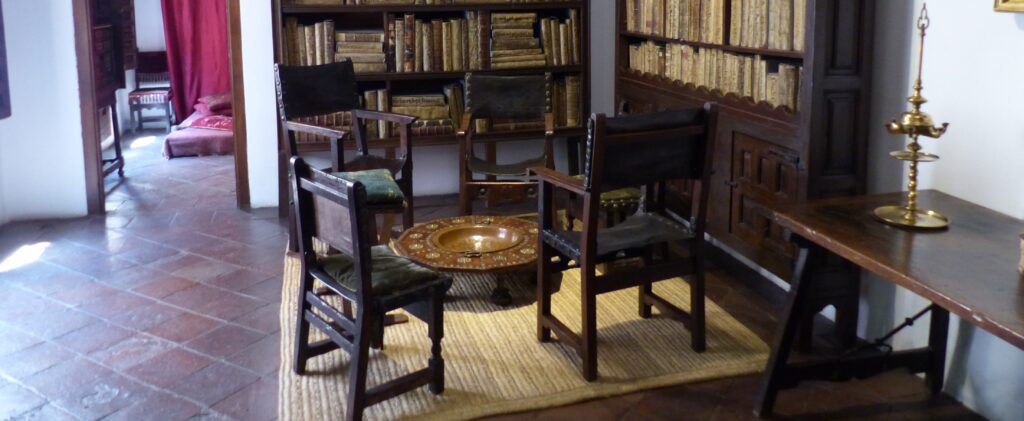
If there's a place that breathes culture from every corner, that's the Literary Quarter. Formerly home to the most important writers of the Spanish Golden Age, this area of the historic center offers an experience where art, history and Madrid life coexist harmoniously.
Furthermore, it's just steps from the Paseo del Prado and the Puerta del Sol, making it ideal for exploring on foot. Its streets are filled with phrases etched into the ground, historic facades, and charming corners that invite you to pause and reflect.
In this guide you'll find what to see, how to get there, how much time to spend, and practical tips you need before your visit. And if you have more time in the city, you can combine it with our Madrid itinerary in 3 days or with the route through Habsburg Madrid.
What to see in the Literary Quarter
These are the eight must-see places in the neighborhood, all within a ten-minute walk of each other:
- Lope de Vega House-Museum, the playwright's home, with free admission and prior reservation.
- Huertas Street, the literary axis with quotes from authors engraved on the floor.
- Santa Ana Square, the liveliest square, presided over by the Spanish Theatre.
- Church of San Sebastián, where Bécquer got married and Lope de Vega was buried.
- Ateneo of Madrid, with its monumental library of more than 200 years.
- Royal Academy of History, a neoclassical building founded in 1738.
- Leon Street, a former theatrical gossip hub, now full of bookstores and galleries.
- Circle of Fine Arts, next to the neighborhood, with one of the best rooftops in the city.
1. Lope de Vega House-Museum
At number 11 Cervantes Street stands the house where the most prolific playwright in Spanish literature spent the last years of his life. Today it is a museum that faithfully recreates the way of life in a 17th-century home.
Visits to the Lope de Vega House-Museum They are free, although prior booking is required. Therefore, it is advisable to book several days in advance, especially during peak season. In addition to its architectural value, the house offers a better understanding of everyday life in Madrid during the Golden Age.
2. Huertas Street
It's the main thoroughfare of the neighborhood and, without a doubt, a literary open-air promenade. Quotes from authors like Cervantes, Bécquer, and Quevedo are inscribed on its sidewalks.
During the day it's quiet and bright; at night, however, it comes alive with its bars, taverns, and terraces. It's also common to find street musicians and impromptu theater groups, giving it a street with its own unique character.
3. Santa Ana Square
One of the liveliest spots in the Literary Quarter, presided over by the Spanish Theatre, one of the oldest in the world still in operation.
The square is adorned with statues of Calderón de la Barca and Federico García Lorca, and surrounded by terraces where locals and tourists mingle at any time of day. Nearby is also the historic Hotel ME Reina Victoria, famous for hosting bullfighters and artists since the 19th century.
4. Church of San Sebastián
This church was a common site for baptisms, weddings, and burials of illustrious figures. Gustavo Adolfo Bécquer was married here, and Lope de Vega was buried here before his remains were lost.
It also houses commemorative plaques that recall the passage of other important figures through this place.
5. Ateneo of Madrid
Located on Prado Street, the Ateneo of Madrid It is a private cultural institution with over 200 years of history. It has been a center of thought, debate, and artistic movements.
It can be visited by appointment or during its public events. Its monumental library and neoclassical halls are, in fact, a little-known gem in the heart of Madrid.
6. Royal Academy of History
Founded in 1738, the Royal Academy of History It occupies a neoclassical building that houses one of the most important documentary collections in Spain. Although access is restricted, its monumental façade is worth a visit.
In addition, since 2021 the Spanish Biographical Dictionary, developed by the institution, can be consulted online: a very useful tool for students and curious people.
7. León Street and surrounding area
This side street also has much to offer. It was once the meeting place for theatrical agents, a space where roles were distributed and performances were finalized.
Today it is a vibrant street, with independent bookstores, art galleries and small cafes where you can read without haste.
8. Circle of Fine Arts
Although the Circle of Fine Arts Although technically outside the neighborhood, its proximity makes it worth a visit. Its rooftop offers some of the best views of Madrid, and its cultural program is one of the most comprehensive in the city.
History of the Literary Quarter: from the Golden Age to the present
The neighborhood's name is no coincidence. During the 16th and 17th centuries, this area was the epicenter of Madrid's literary life.
There they lived, wrote, and crossed paths. Cervantes, Lope de Vega, Quevedo, Góngora and Calderón de la Barca. Sometimes as neighbors, other times as rivals. These writers not only shared space, but also the tensions of an era in which wit was the main weapon.
Taverns and open-air theaters were plentiful in its streets. The famous Corral del Príncipe, precursor to the current Teatro Español, was one of the town's favorite venues for watching theatrical performances. Consequently, a vibrant cultural scene permeated every corner.
Over time, the Literary Quarter transformed, but without losing its character. In the mid-20th century, it became a middle-class commercial and residential area, with modernist buildings and carved wooden doorways.
Today it's a meeting place for lovers of history, art, and good conversation. In fact, its atmosphere contrasts sharply with that of the nearby Plaza Mayor of Madrid, ...much more monumental. Finally, the rise of cultural tourism has revitalized its streets, attracting specialized bookstores and gastronomic offerings that respect the neighborhood's identity.
Experiences to enjoy the Literary Quarter
- Wander its streets aimlessly, reading the phrases on the sidewalks and discovering secondhand bookstores or artisan bookbinding shops.
- Take a break in its historic cafes: the Café Central, with live jazz, the Café del Príncipe or the legendary German Brewery.
- Participate in guided tours themes about the Golden Age, or explore the neighborhood with a self-guided tour from your mobile phone.
- Photograph her balconies full of flowers And its colorful facades, a delight for social media.
- Enjoy cultural activitiesTemporary exhibitions, recitals, book presentations or storytelling for all ages.
- Come back at night, when the neighborhood transforms into a bohemian and vibrant area, perfect for a quiet drink.
Practical tips for visiting the Literary Quarter
- How much time to dedicate to it: between 2 and 3 hours for a leisurely stroll; a full morning if you visit the Lope de Vega House-Museum.
- Best time: in the morning for a leisurely stroll, or at sunset to enjoy the atmosphere of its terraces.
- How to reachThe nearest metro stations are Anton Martin (line 1), Seville (line 2) and Sun (lines 1, 2 and 3), the latter also connected to Cercanías.
- ReservationsThe Lope de Vega House-Museum and the Ateneo require prior booking. Check their official websites for opening hours before visiting.
- Comfortable shoesThe cobblestones and gentle slopes become noticeable after a couple of hours of walking.
- BudgetExploring the neighborhood is free, and so is visiting the Lope de Vega House-Museum, making it one of the most affordable options in the city center.
Frequently asked questions about the Literary Quarter
If you love walking through history and listening to its whispers emanating from the facades, the Literary Quarter awaits you. And if you prefer a detailed account, join us on one of our tours. Because Madrid isn't just explored: it's listened to.
Visit the Literary Quarter
It is located in the historic center of Madrid, in the Centro district. Its boundaries are roughly Carrera de San Jerónimo to the north, Paseo del Prado to the east, Calle Atocha to the south, and Calle Cruz to the west. Its main thoroughfare is Calle Huertas.
Two to three hours is enough to stroll through its main streets at a leisurely pace. If you also want to visit the Lope de Vega House-Museum and the Ateneo, allow a full morning.
Nothing. Strolling through its streets is free, and the Lope de Vega House-Museum offers free entry with prior reservation. There is also no charge to access the Plaza de Santa Ana or the Church of San Sebastián.
History and curiosities of the neighborhood
Because during the 16th and 17th centuries, the great authors of the Spanish Golden Age lived there: Cervantes, Lope de Vega, Quevedo, Góngora, and Calderón de la Barca. Furthermore, the area was home to the theaters and printing presses of the time.
Antón Martín (line 1) is the most central stop in the neighborhood. Sevilla (line 2) and Sol (lines 1, 2 and 3) are also less than a five-minute walk away.
Yes, it's one of Madrid's liveliest and most central nightlife areas, with large crowds along Huertas and Santa Ana streets. As in any busy tourist area, it's wise to keep an eye on your belongings.
