
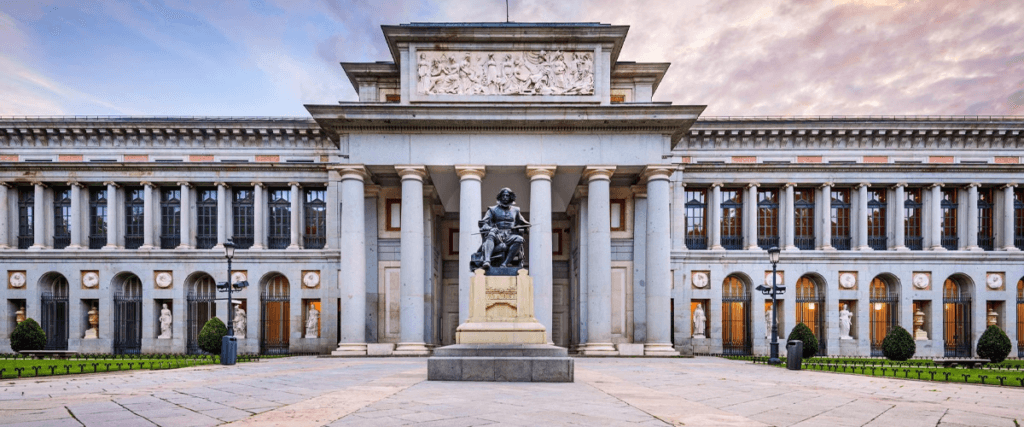
The history of Prado Museum It is as interesting as the works it houses. Before becoming one of the world's most important art galleries, the building served as a science museum, a Napoleonic barracks, and even a source of lead for making bullets.
In this article we review the history of the Prado Museum: how it was born, what anecdotes it has accumulated since 1819 and what are the two works that no one should miss.
From science cabinet to museum: the origin of the building
What we know today as the Prado Museum began as an ambitious project of Charles III, who in 1785 commissioned the architect Juan de Villanueva to build the Royal Cabinet of Natural Sciences. The idea was that it would form part of the so-called "hill of sciences," along with the Royal Astronomical Observatory and the Royal Botanical Garden.
However, fate had other plans. Charles III died in 1788 without seeing his project completed, and years later, in 1808, Napoleonic troops invaded Madrid and used the building as a barracks.
During that occupation, the lead from the roofs was melted down to make bullets, and the timbers from the structure were used to make fires to warm the French soldiers. Consequently, the building was left practically in ruins.
Years later, with the arrival of Ferdinand VII, it was given a new purpose. At the insistence of his wife, Isabel of Braganza, a great lover of art, it was decided to finish the construction and turn it into the Royal Museum of Paintings and Sculptures, which opened its doors in 1819.
But it wasn't a museum accessible to everyone. In its early years, it could only be visited one day a week and with special permission from a member of the court. It wasn't until the revolution of 1868 that it became the property of all Spaniards, under the name of the National Museum of Paintings. It finally adopted its current name due to its location in the former Prado de los Jerónimos.
5 interesting facts about the history of the Prado Museum
- Rainy days, closed doors. During its early years as a public museum, visits were suspended when it rained to prevent damage to the wooden floor.
- Goya saw his own legacy. Francisco de Goya lived long enough to see his works exhibited in the museum.
- A director who never worked as one. Between 1936 and 1939, in the midst of the Civil War, Pablo Picasso was appointed director of the museum, although the conflict prevented him from taking up the position.
- Evacuation in times of war. During the Civil War, the most important works traveled to Valencia, then to Barcelona, and finally to Geneva. All returned intact except for two: Goya's *The Second of May 1808* and *The Third of May 1808*, which were damaged in a transport accident.
- Their rooms are available for rent. The museum allows you to reserve some spaces for private events. The most sought-after is the Sala de las Meninas, which costs around €21,000 to rent for three hours.
The history of the Prado Museum in figures
These figures help to understand the scale of the museum:
- 33,000 works in his collection, although only a few 1.700 They are on permanent display.
- 25 museums The same size would be needed to display everything stored in warehouses.
- 2.9 million visitors in 2018, with a majority of foreign visitors.
- 1819: year of opening, although the building was planned in 1785.
- More than 30,000 m² of display surface.
Therefore, it is advisable to book tickets in advance if you are visiting Madrid during peak season.
The two essential works of the Prado Museum
Las Meninas, by Velázquez (1656)
Considered one of the most enigmatic paintings in the history of art, it has been the subject of multiple interpretations. It was originally called *Portrait of the Empress with her Ladies and a Dwarf*, then *The Family of Philip IV*, until it adopted its current name.
What's most striking is that, instead of showing the scene from the painter's perspective, Velázquez places us in the position of the subject, making us part of the painting. Thus, the Infanta Margarita, illuminated in the center, becomes the true protagonist.
The Garden of Earthly Delights, by Hieronymus Bosch
This triptych, painted between 1490 and 1510, is one of the museum's most mysterious works. Philip II, a great admirer of the painter, acquired it in 1591.
It is read from left to right: paradise, the garden of earthly delights, and hell, although there is no single interpretation of its meaning. Furthermore, the abundance of strawberries in the painting earned it the nickname *the strawberry painting* in 17th-century France.
Another little-known detail of the history of the Prado Museum: when the triptych is closed, an image of the cosmos with God appears and an inscription from Psalm 33:9 which says "For he spoke, and it was done; he commanded, and it stood fast.".
How to visit it today
- Where is: Paseo del Prado, s/n. The nearest metro stations are Banco de España (line 2) and Atocha (line 1).
- How much time to dedicate to it: between 2 and 3 hours for a first visit focused on the main works.
- Free slotThe last two hours of the afternoon from Monday to Saturday, and the last five hours on Sundays and public holidays. However, the queues are long.
- Combine itIt's on the same axis as the Thyssen and the Reina Sofía, just a few minutes away. Literary Quarter and the Retiro Park.
The 4U Madrid team is organizing a private visit to the Prado, just for your group, to discover this and other works up close.
- Private group, 2 to 6 people
- Museum admissions included
- It lasts 2 and a half hours
Frequently asked questions about the history of the Prado Museum
The history of the Prado Museum is, in reality, a reflection of the history of Spain: wars, regime changes, and unexpected decisions that transformed a science lab into a temple of art. And if you'd like us to tell you these stories firsthand, join us on one of our tours.
Origins and history of the Prado Museum
It opened its doors on November 19, 1819, as the Royal Museum of Paintings and Sculptures, commissioned by Ferdinand VII and Isabella of Braganza. The building, however, had been designed in 1785 for a very different purpose.
Because of its location in the former Prado de los Jerónimos, a tree-lined promenade that occupied this area of Madrid, the popular name eventually prevailed over the previous official designations.
To house the Royal Cabinet of Natural Sciences, commissioned by Charles III to the architect Juan de Villanueva in 1785. It was part of a scientific complex along with the Astronomical Observatory and the Botanical Garden.
The collection and the visit
The collection comprises over 33,000 pieces, of which only about 1,700 are on permanent display. The rest are stored in warehouses or loaned to other institutions.
Velázquez's *Las Meninas* and Bosch's *The Garden of Earthly Delights* are the two most visited. Other highlights include Goya's *The Third of May 1808* and the Black Paintings, and El Greco's *The Gentleman with his Hand on his Chest*.
Between two and three hours to see the essentials. To explore it thoroughly would require several visits, as the exhibition area exceeds 30,000 square meters.
